

The old blogosphere had a tradition called fisking, where the blogger took apart somebody else’s article, point-by-point, often line-by-line.1 This format worked well at the time for four reasons:
Blog culture taught that debate was fruitful and that truth could be distilled in the crucible of argument. Today, the tribes have mostly stopped talking to one another.
The blogger business model depended on eyeballs rather than subscriptions. (Revenue came from Google Ads, not from patrons.) Since flaying someone else’s article was likely to get a response (see #1), it was a cheap way to get attention and inbound links.
Blog culture loved dunking on people as much as anyone today, but dunks had to be earned through sustained engagement with the dunkee. Twitter, with its 140-character limit, ruined this, but so did simple human laziness. Once writers and audiences realized the dunk at the end of the argument was more fun than actually winning the argument, the market naturally stopped bothering with the argument.
Early blog culture was essentially an extension of 1990s bulletin board culture, and many participants were constitutionally incapable of tearing themselves away from a flame war. (Do kids still say “flame war”?)
Today, I’m going to fisk Kurt Schlichter’s new column on Townhall.com, “Why the Dem-Friendly Polls May Be Way Wrong.”
I’m not doing this to dunk. I think one thing we learned from the wreckage of blog culture, The Daily Show with Jon Stewart-Industrial Complex, and 2010s Twitter culture (which reached its apotheosis by birthing Woke 1.0) is that dunking doesn’t help. At best, it’s decadent, even masturbatory. At worst, it reinforces polarization and groupthink.
That’s why I chose Schlichter’s piece for this. There’s a ton of copium flooding the Right at the moment, due to, you know, the giant Blue Wave that seems to be headed for the GOP. A lot of it is angry and sarcastic, mocking anyone who could possibly believe “those lying pollsters.” That is the desperation of a cornered predator, like the Biden White House in the months before the most decisive presidential debate in history.2 By contrast, Schlichter, who seems inclined here to shed more light than heat, conveys his arguments in simple, hopeful terms. He makes a bunch of arguments that are very common on the Right at the moment, but he states them well, and admits several times that he could be wrong.
This is wise, because he very likely is.
There is a Lot of Evidence for the Wave Besides Polls
SCHLICHTER: The midterm polls suck, and they might be right – if you believe them, we could be headed for anything from a blue tsunami to a blue wave to a blue trickle. But that’s a big if.
Is it a “big if,” though, really? Imagine a world without election polls. Deprive of our best tools, what evidence would prognosticators look at?
We would start with the standard mid-term backlash. Except for a handful of special cases, postwar midterm elections yield at least a 5-point swing in favor of the out-party:
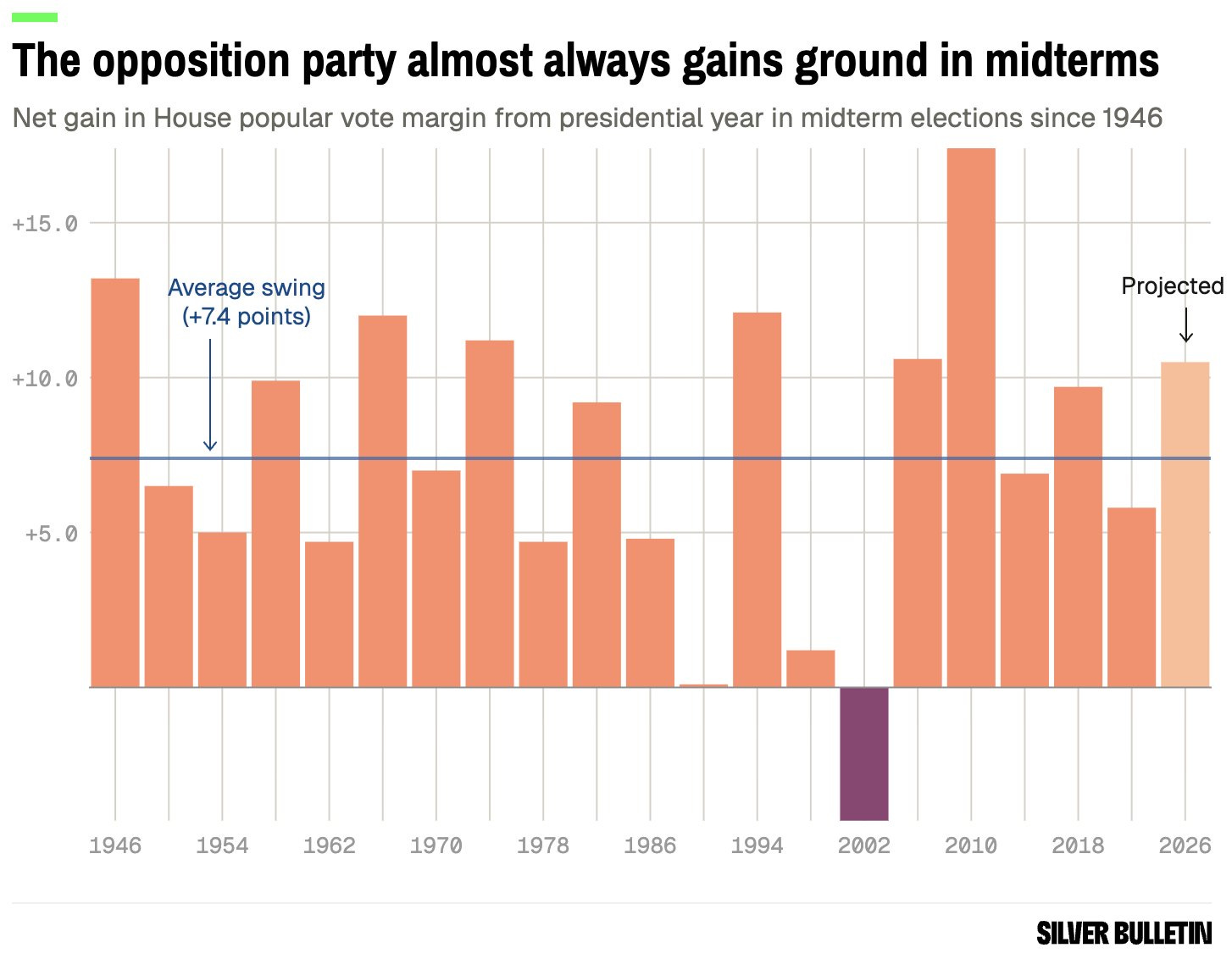
Since Republicans won the 2024 election by 2.6 points, they should start with the expectation of losing the 2026 election by 2.4 points. Admittedly, that wouldn’t be so bad for the GOP. They’d be guaranteed to keep the Senate and, thanks to gerrymandering and other factors, nearly a lock to keep the House as well. However, the 5-point swing is the floor, not the ceiling. Let’s look to other evidence.
Today, gas costs $4.47/gal. That’s not the highest gas price in recent memory,3 but it is much higher than it was in October 2022 ($3.82), October 2020 ($2.16), or October 2018 ($2.86). Everyone knows gas prices are predictive of election results, because gas influences so many other prices. I remember, in 2022, I saw a lot of stickers on fuel pumps of Joe Biden’s head with the words, “I did that!” and anticipated a red wave. Well, now the shoe is on the other foot, and it’s pinching even harder than it was back then. If literally the only thing you knew about the 2026 election was the price at the pump, you would expect a stronger-than-usual performance from the out-party. Indeed, when gas prices were this high in October 2014,4 Republicans won by 6 points and took the Senate.
Although we have, in our hypothetical, eliminated election polls, we haven’t eliminated presidential approval tracking polls. This is a nearly-continuous dataset reaching back to the start of Trump’s first term.5
It is well-known that, when presidential approval ratings are especially low, midterm elections tend to go especially badly.
Now, maybe you think polls are mostly bunk, that the pollsters hate Republicans, and that they’re all working overtime to make Trump look more unpopular than he is. Okay! Let’s go with that! So let’s assume that, for every day on this decade-long chart, Trump was actually 10 points more popular than those lying pollsters claimed. Does that help Republicans’ prospects in the 2026 election?
Not a bit. We can see that Trump’s rating is near its all-time low. We can see that Trump’s approval rating heading into the 2018 midterms were 4-5 points ahead of where they are today. Even if we assume that, because of pollsters depressing Trump’s numbers, Trump’s approval rating in October 2018 was actually 52% (not 42%) and his approval rating today is 47% (not 37%), it’s still lower today than it was back then.
The 2018 midterms were not the minimal 5-point swing against the party in power that midterms always become; they were a 10-point opposition wave. If Trump has fallen another 5 points behind that ugly benchmark, we might, as a baseline, anticipate a 15-point swing toward the Democrats this time—which would be a tsunami.
The polling skeptic might also look to fundraising to tell a story. Here, you can almost construct a tale where Republicans are doing well after all. After all, the RNC is flush with cash and the DNC is broke. However, Democratic candidates have a significant advantage over Republican candidates, which means the total money available to the two sides is much closer to equal than you’d guess just from looking at PAC spending. (Republicans still have the edge, though, which is their best hope of salvaging something from this slow-motion disaster.)
However, in terms of predicting election outcomes, some forms of cash are more valuable than others. If House Candidate A raises $1 million by donating $1 million from his own personal bank account to his campaign, while House Candidate B raises $500,000 by raising $1 from each of 500,000 of his own constituents, Candidate A has a much bigger war chest—but Candidate B is much more likely to actually win the election (since he has the demonstrated support of more than half the voters in her district). Individual contribution total is the measure that tells you the most about who’s actually going to win,6 and Democrats are dominating there, too:
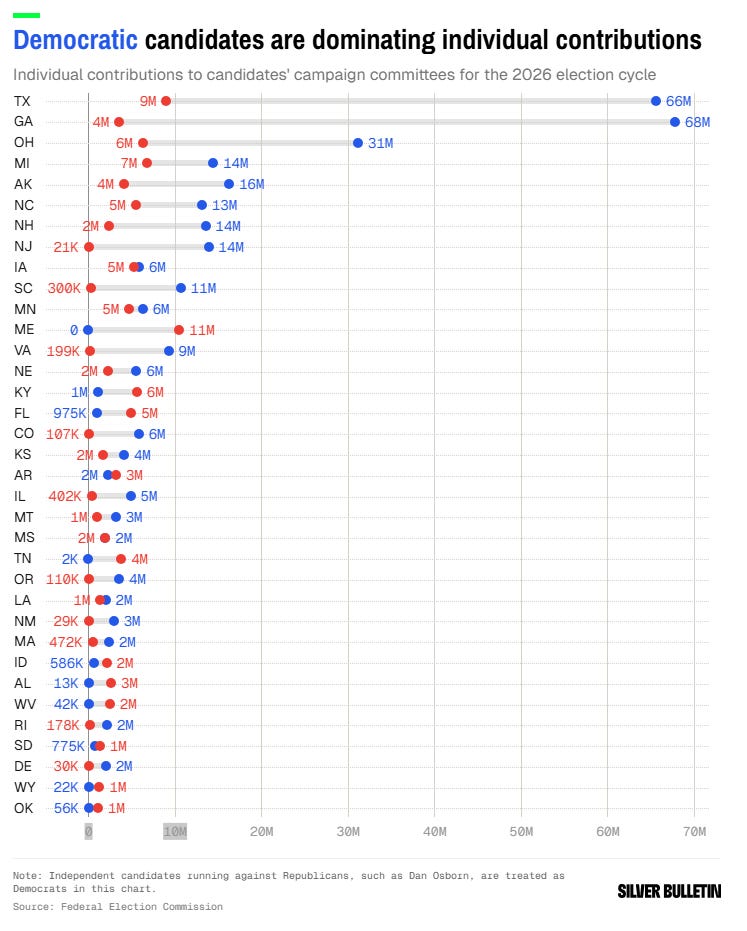
Given this non-polling evidence, are the polls really a “big if”? The polls, which show a terrible result for Republicans on the horizon, are only confirming the story we’re seeing in every other measurement, which also predict a terrible result for Republicans on the horizon.
Remembering My Past Errors
SCHLICHTER: We want to believe that the polls are skewed Dem-ward. We want to believe that there are Republicans out there who aren’t being surveyed by these polls who are going to show up on election day and pull our bacon out of the fire. The power of wanting is potent, and it can blind you. It can make you stupid. It can make you miss the obvious. And that danger exists there.
We’ve all been there.
In 2012, I wrote an article called “The Great Democratic Turnout Miracle,” in which I observed that the polls showing Obama ahead of Romney were based on a finding that Democrats in 2012 would have an even larger partisan advantage over Republicans than they’d had in 2008 or 2006. This made no sense to me. I said so. I made similar benedictions and genuflections to the fact that I could be wrong, and then I went ahead and presented my self-blinded theory. I even did a follow-up, projecting the election result on the hypothesis that I was right and polls were broken.
As it turned out, the polls were skewed in 2012… in favor of Republicans. The Democratic turnout was just as good as polls foresaw, and their vote total among non-Democrats better than expected, so Obama won re-election by even more than the polls had projected. I spent a long week after the election dissecting why Romney had lost (answer: “Not Enough Votes”).
I think this is another reason I picked Schlichter for the fisk. He reminds me of me, fourteen years ago.
It sucked for me, as it will likely suck for Schlichter, but it taught me an important lesson that has served me well ever since: Believe the polls.
…Mostly. There are many exceptions, nuances, and gray areas in psephology. Believing polls more than the polls themselves tell you to can lead to great disappointment and cynicism.
For example, polls in 2016 correctly said that Hillary was probably in the lead, but only barely, and that Trump could win with just a small, normal polling error in his favor. The entire blue tribe rejected this wisdom in favor of Hillary-will-definitely-win cargo culting, and the only people standing against them in blue tribe conversations were, basically, Nate Silver and Harry Enten. Then, when Trump won, the tribe spent the next decade furious at… polling!
I think this happens a lot. People decide to “believe the polls,” but don’t actually understand what polls are saying, end up believing the wrong thing, something polls didn’t say, and then get mad at polls (which didn’t say it) when it turns out not to be true. Thus the eternal “polls are broken” discourse even though polls are actually in pretty good shape and have been all along.
Nevertheless, when you understand what polls say (or know someone who does), you should believe them.
State Primary Polls != National General Polls
Here, in fact, is a good example of that “polls are broken” discourse:
SCHLICHTER: We’re seeing how polls have been missing big lately. Look at Abdul El-Sayed. He was supposed to win that Michigan primary in a walk. We’re talking five, 10, 15 points, according to the primary polls. And yet he barely squeaked past that squeaky woman he was competing with.
There’s two reasons this is a bad comparison.
The first is that Schlichter is comparing apples and oranges. Primary polls are bad. Primaries are much more complicated than general elections. They involve a much smaller population of voters, who are concomitantly harder to fully sample without spending big bucks. Primaries often involve multi-candidate dynamics, which make polling much more difficult, even if voter preferences are stable. Worse, primaries are intra-tribal contests, so they aren’t nearly as polarized as general elections, so voters can swing a lot more than they do in November. As a result, primary polls miss by, on average, a much wider amount than general election polls. “Normal” polling error in a general election is about 1-3 points of margin. “Normal” polling error in a primary is more like 3-7 points.7
In fact, I’ll go farther than that: Michigan primary polls are especially bad. The link I gave you in the previous paragraph is a re-assessment of primary polling after polls badly missed the result of the Michigan primary… in 2012. Arguably the worst polling miss in modern American electoral history was the Michigan Democratic primary… in 2016. I don’t have a ready explanation for this, but I know Michigan primary polls are weirdly disaster-prone. In the general election, however, they do just fine.
Second, in any nationwide electoral contest, involving some fifty states, thirty-some Senate races, and hundreds of other races, you are statistically guaranteed to have an outlier somewhere. All the polls are going to say one thing, and the result is going to be something wildly different, by 10 points or more. That will happen this fall. We don’t know where it will happen. We don’t know whether it will affect the outcome. (People only notice if it affects the outcome, and the worst polling error of the cycle usually doesn’t.8) We only know that somewhere, polls are gonna miss bad.
This is very different, however, from what Mr. Schlichter is asking us to imagine in November 2026: all the polls missing, not in one race, or in one state, or in one region, but across the board, by something like 5 or 6 points.9
Now, that’s not totally impossible. The worst polling error of this century came in the 2020 election, when polling averages were systematically off, nationwide, by 5 to 6 points in Joey Biden’s favor. However, that’s probably attributable to the weirdness of covid, which scrambled a lot of surveys in 2020 (including the Census), and possibly to Biden’s campaign to let states illegally count late ballots (with the blessing of certain judges). Those factors are no worse today than they were in 2022 and 2024, when polls did fine, so we do not have reason to anticipate another large error.
Harris Wasn’t Ahead
SCHLICHTER: We’ve seen lots of other polls that assured us of a Democrat victory. Just ask President Harris about that.
I confess that this line irritates me. There were lots of polls that showed Ms. Harris with a small lead in the 2024 election. There were also just as many polls that showed Mr. Trump with a small lead. The final election forecast, from all the forecasters, was “this race is a dead heat and we have no idea what’s going to happen.” Not only did I use polls to show you the final, correct 2024 election map the night before the election; I even told you that that specific map was the second-most likely outcome!
Meanwhile, over at Silver Bulletin, Nate Silver published the most tied election projection I’ve ever seen him post, for any election, at any level, including every other projection he made of the 2024 election:
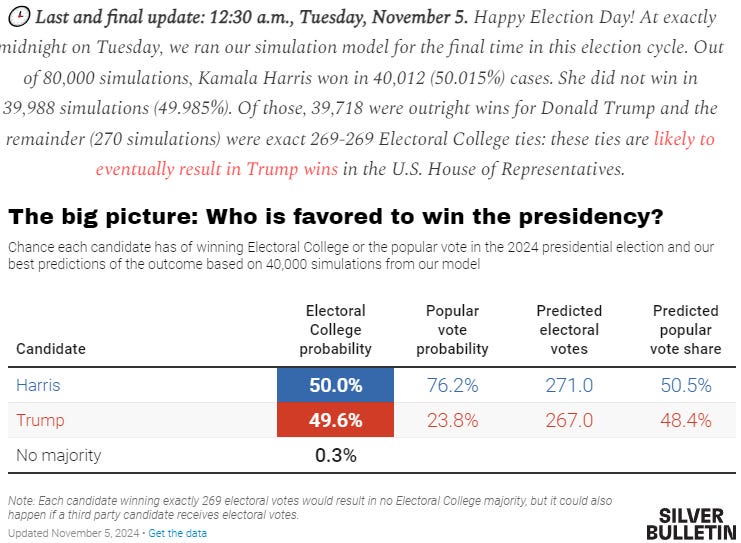
Even RealClearPolitics, whose polling average is pretty bouncy because it’s trying to be simple and understandable, agreed the race was virtually tied, based on polling.
The polls in 2024 were very, very tight. The final result was also tight, well within the margin of expected polling error.
Were there times when Harris led the polling? Sure! Both candidates led at various times during the race. Those leads likely reflected actual voter sentiment at the time. (Harris’s biggest lead came after she won her debate against Trump, for example, and faded as Vance bested Walz in theirs.) The election result changed because voters changed their minds between October 1st and Election Day.
Therein lies the best hope for Republicans: persuasion, that old Scott Adams trick—not polling error. Schlichter’s line here is pure wishful thinking.
Pro-Democratic Bias?
SCHLICHTER: If you’ve been around a while, you know that the polls always favor the Democrats.
This is a common belief on the Right, and it is flatly, categorically false:
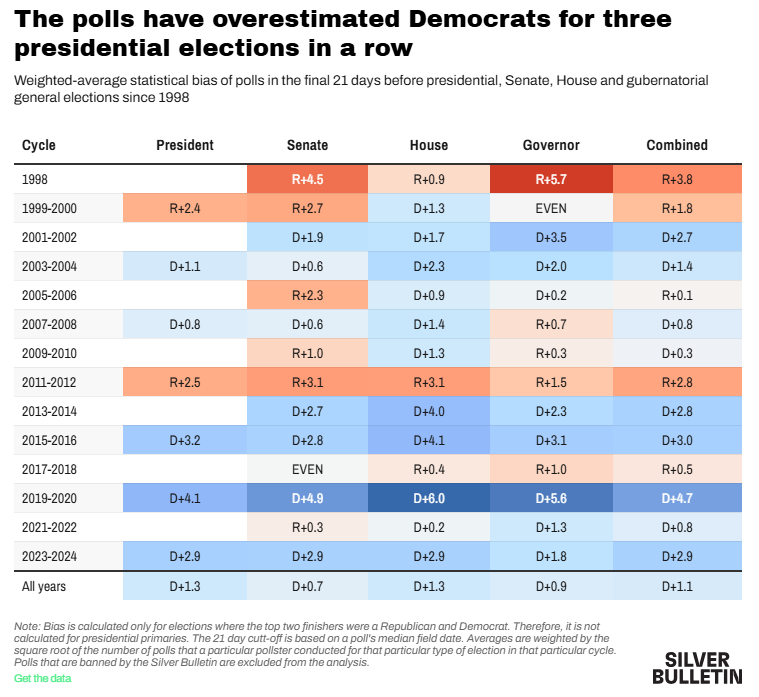
Polls were most recently biased toward Republicans four cycles ago, in 2018. There was, moreover, barely any bias in 2022. Do you remember all the Republicans who confidently predicted a Red Wave on the basis of their certainty that polls would miss again in their favor? Pepperidge Farm remembers.
SCHLICHTER: You almost never see a Democrat surprise us by exceeding his polling against a Republican. You just don’t.
I thought it was pretty significant that Mr. Obama exceeded his polls against Republicans by a wide margin in 2012. That was the most-watched, most-polled race in history up to that point, and the polls just biffed it, giving the GOP hope it shouldn’t have had.
This is, perhaps, burned into my memory more than most, because I myself was so wrong about the 2012 election, but, if you pull out your slide rules and spreadsheets and do it yourself, you’ll find that, as a matter of fact, you see plenty of cases where the polling is biased toward the Republican—sometimes slightly, sometimes significantly. You don’t have to look far for this! In the headline races of 2025, the New Jersey and Virginia gubernatorial races, polls underestimated the Democrat both times—and, in New Jersey, the miss was huge and embarrassing.
I’ll own that, if you look specifically at elections in the Trump Era (2016+), it is more common for Republicans to beat their polls than Democrats—that’s what the chart above shows, after all—but polling errors go both directions.
SCHLICHTER: And of course, there’s an interest in driving down Republican enthusiasm by telling people they can’t win.
People always talk about this idea that polls are deliberately driving down turnout among one side or the other. However, I’ve never seen any convincing evidence that it’s true in either direction:
It doesn’t seem to be true that polls showing one side losing the election has any effect on election results.10
Even if it were true, it doesn’t seem to be the case that non-partisan pollsters are doing this.11
Blue Texas?
SCHLICHTER: In Texas, you must believe the Texans are going to support a blasphemous, anti-meat, anti-gun, anti-white, woke weirdo with a thing for trans kids. Does that sound like Texas to you?
If certified weirdo James Talarico were running against a generic Republican—say, John Cornyn, a bland conservative who won his closest general election by ten points—this would be a pretty telling point. Not the end of the discussion, as we’ll get to, but a good point.
However, the blasphemous, anti-meat, anti-gun, anti-white, woke weirdo isn’t running against John Cornyn. The state’s Republican primary electorate ejected their safe incumbent this year for the cardinal sins in “conservative” circles today: he had criticized Donald Trump, and was seen as part of the villainous “establishment” whose evil cabal had nefariously blocked the SAVE Act12 and also made it rain on your daughter’s birthday.
…I’m sorry, I promised not to be sarcastic. As readers know, I have a lot of problems with the direct election of senators, and with primary elections in general. (They were invented by the Democratic Party to help George McGovern, and, naturally, have wreaked little but evil ever since.)
In Cornyn’s stead, Republicans have stood Mr. Ken Paxton to run. The truth is, I have not followed Paxton very closely. I do not know why voters hate him. He clearly has scandals in his past—I remember he was impeached, saved mainly by Trump—but I don’t know what they are. Nevertheless, voters do hate him, and have all along.
Every Trump-skeptical voter speaks of Paxton as a corrupt, lazy slimeball. I gather he cheated on his wife, which should be disqualifying for any self-respecting conservative.13 However, I gather from the Trump-skepticals that he was involved in other, more explicitly political, wrong-doing as well—or, at least, that the majority of Texans believe he was involved, which (fairly or unfairly) makes him a bad Senate candidate in Texas!
From the more Trump-inclined, I never hear anything about Ken Paxton. It’s like Fight Club: the first rule is don’t talk about Ken Paxton. (If you must, gesture vaguely to his “incredible record.” Do not use more than six words.) The second rule is always divert to talking about how weird James Talarico is. Mr. Schlichter’s column is an example. From my uninformed perch, this Paxtonian silence is even more telling than the criticisms!
The problem is, voters won’t simply ignore Ken Paxton if we don’t talk about him. They have to choose between two options: the blasphemous, anti-meat, anti-gun, anti-white, woke weirdo… or Ken Paxton. It doesn’t seem that surprising that they might be leaning toward the weirdo! (Y’all know my choice.)
There’s another reason the Texas GOP should have been more circumspect: Red Texas is way more vulnerable than most people (including, apparently, most Red Texans) give it credit for. Texan GOP dominance used to be built on an alliance between rural voters and massive suburban sprawl. Between the two of them, the GOP could keep the urban cores and the Blue-leaning Hispanic bloc from forming a majority. However, a growing Hispanic population posed a serious long-term threat to the Texas GOP. People forget that, in 2018, Ted Cruz squeaked past Beto O’Rourke by less than three points!
Donald Trump shook things up in Texas. He alienated plenty of suburban voters, especially women, but he made up for it by making gains among Hispanic voters, especially in Florida and in Texas’s Rio Grande Valley. Those huge Hispanic gains delivered Trump a convincing 14-point win in 2024, despite erosion in suburban support.
However, since 2024, Trump has squandered most of the support he gained with Hispanics over the previous decade. Meanwhile, rather than improving his position with suburbanites to make up for those losses, he’s actually dug a deeper hole! The Texas GOP can win with solid suburbs OR a respectable showing among Hispanics, but it is currently on course for neither, and in a year with a terrible overall environment for Republicans. Paxton’s supporters are still trying to scrape together a win from the table scraps, and they could still pull it off, since Texas is still plenty red… but Texas is not Wyoming. It is no longer a state where you can nominate any jokester with an R next to his name and expect the voters to give your guy the flag lapel (if it ever was).
SCHLICHTER: I’ve talked to a lot of Texan conservatives. Not one thinks this guy is going to win.
Well, yes, because committed Texan conservatives are not where the movement is happening. Talk to Hispanics who live in Hispanic communities in blue districts who voted Trump in ‘24 but backed Biden in 2020. See what they think is happening.
Maybe they’d agree that Paxton’s going to win, and I’d take it seriously if they said so, but these flippers are the ones to watch.
Enthusiasm is Not the Plural of Anecdote
SCHLICHTER: Moreover, we’ve been told a lot of conservatives are going to sit this out. Yes, there are probably some Republicans who are going to sit out this midterm, but I haven’t met any of them personally. Maybe you have. I just don’t think there are a lot of them, especially in light of how appalling the Democrats are.
Again, these aren’t the voters who are at risk of staying home. Engaged people who loudly participate in political conversations on one side or the other are highly reliable voters, and their threats not to vote usually are just petulant whining, as Schlichter has argued elsewhere.
The people who are staying home are the ones who don’t care all that much about elections. They don’t talk about it on Twitter. They voted in 2022, but skipped 2018 and 2014 because they had bar trivia and whatever. They show up for presidential elections, but they don’t even know who represents them in Congress. (You sometimes see some of these voters in polls, telling pollsters that Sherrod Brown is Ohio’s incumbent senator.) These sometimes-engaged voters are the vast majority of this great nation, and they are invisible to our political conversation.
You know how we reach them? Polls! Polls are “tiny, uncertain, vital soundings from miles below” the waterline of our political conversation. Polls are how we find out what the people who don’t talk about politics are planning to do.
It looks like they’re planning to stay home or vote Democrat.
Polls: Science, Art, Ops
SCHLICHTER: No, it’s not scientific, but are the polls scientific?
Yes.
SCHLICHTER: It’s very clear that a significant number of the polls, if not all of them, to some extent have an endgame in mind. Some of them are obviously ops. But others are effectively ops.
To be fair to Schlichter, internal polls released by candidates are “ops.” Their purpose is to push a narrative favorable to that candidate. It’s not that the polls themselves are designed to reach a specific conclusion. Rather, campaigns commission ten polls—all of them honest polls by honest pollsters—then release only the very best poll to the public and fundraise off it. (The campaign itself is smart enough to look at the average of all ten polls, but the public never hears that number.) When you see an internal poll released into the wild, the rule of thumb is to shift it four points away from the candidate. So a Democratic internal poll showing the Republican candidate up +2 should be interpreted as R+6.
However, most polls aren’t internal polls. Most polls aren’t ops!
SCHLICHTER: The science of polling involves statistics, regression, and all sorts of math that makes your head hurt. But there’s an art too. That art manifests as an educated guess.
This is increasingly true, I’m sorry to say. Pollsters have started weighting to things that are dangerous to weight to, like recalled vote, which runs the risk of weighting for the very thing being polled. (The best pollsters still resist this.)
However, for all that, pollsters have had a remarkably good track record when it comes to actual results. I refer again to this chart:
If polling is an art, pollsters remain talented artists!
SCHLICHTER: So, let’s proceed with caution. We’ve got Democrats out there paying tens of millions of dollars to fool us; there’s no need for us to do it to ourselves for free.
These are, genuinely, words of great wisdom.
Return of the Shy Tory
SCHLICHTER: …are pollsters getting a good sample of actual Republicans? In other words, are Republicans either not being called or refusing to participate in polls to such an extent that they are being undercounted? Pollsters will tell you that it’s very hard to poll Republicans. Why? We don’t trust pollsters.
This is the ol’ Shy Trump Voter theory, back again for its sixth cycle in a row.
The polls were dead-on in 2018 and 2022. Do we have reason to believe that conservatives have become even harder to poll since then? Have we become more hostile to media? Granted, we are very hostile to media, and rightly so, but I don’t see much reason to think we’re any harder to poll than we were four years ago, when we were polled perfectly.
There’s probably some truth to Shy Trump Voter theory, at least in presidential years, but it accounts for perhaps 1 to 3 points of polling bias (in presidential years), not 4 or 5.
SCHLICHTER: If my informal poll [on X] is even remotely accurate, the vast majority of the time,
Schlichter is good enough to acknowledge that his informal poll suffers from severe self-selection bias and is in no sense scientific, so I won’t belabor the fact that, no, his poll probably isn’t even remotely accurate.
SCHLICHTER: And of course, one thing that isn’t captured by this poll is what kind of Republicans respond sometimes, usually, or always. This is important because, by showing up, they’re doing a lot of the work of measuring Republican intentions. Are they substantially different from Republicans who never respond? They might well be since the responders might feel more comfortable dealing with the establishment and are therefore probably less hardcore.
It seems to me that this was a reasonable theory in early 2018, but we’ve had four intervening elections, including two in which the polls performed better than average. Again, do we have reason to believe this has gotten worse since those elections? Schlichter’s X poll measured the wrong thing. He should have asked how many of his users would not answer a poll today but would have answered a poll in 2022.14
Summing Up: The Marginal Voter
SCHLICHTER: I don’t think the polls are accurate. I think there is a significant undercount of conservatives because… Republicans are not going to skip voting or vote for the Democrat enemy.
These aren’t the voters you need to worry about.
A common error runs like this:
To win, the other party must win some of the voters from my party.
The median voter in my party would never, ever vote for the other party.
Therefore, the other party cannot possibly win.
All three of these premises are true! In this polarized age, the median Republican is a devotee of the party who would never even think of voting for “the Democrat enemy.” However, the conclusion does not follow, because nobody’s actually trying to convert the median voter.
We’re all courting the marginal voter. This article has been dancing around him (or her), so far, but the marginal voter decides elections. Many many years ago, Megan McArdle, still a mere blogger writing under the pen name Jane Galt, wrote a wonderful article called “A Libertarian View of Gay Marriage” which illustrated the sheer cognitive challenge of thinking on the margin:
[E]conomists hear this sort of argument all the time. “That’s ridiculous! I would never start working fewer hours because my taxes went up!” This ignores the fact that you may not be the marginal case. The marginal case may be some consultant who just can’t justify sacrificing valuable leisure for a new project when he’s only making 60 cents on the dollar. The result will nonetheless be the same: less economic activity.
…Now, in the late fifties, a debate began over whether to extend [welfare] benefits to the unmarried. It was unfair to stigmatise unwed mothers. Why shouldn’t they be able to avail themselves of the benefits available to other citizens? The brutal societal prejudice against illegitimacy was old fashioned, bigoted, irrational.
But if you give unmarried mothers money, said the critics, you will get more unmarried mothers.
Ridiculous, said the proponents of the change. Being an unmarried mother is a brutal, thankless task. What kind of idiot would have a baby out of wedlock just because the state was willing to give her paltry welfare benefits?
People do all sorts of idiotic things, said the critics. If you pay for something, you usually get more of it.
C’mon said the activists. That’s just silly. I just can’t imagine anyone deciding to get pregnant out of wedlock simply because there are welfare benefits available.
Oooops.
Of course, change didn’t happen overnight. But the marginal cases did have children out of wedlock, which made it more acceptable for the next marginal case to do so. Meanwhile, women who wanted to get married essentially found themselves in competition for young men with women who were willing to have sex, and bear children, without forcing the men to take any responsibility. This is a pretty attractive proposition for most young men. So despite the fact that the sixties brought us the biggest advance in birth control ever, illegitimacy exploded. In the early 1960s, a black illegitimacy rate of roughly 25 percent caused Daniel Patrick Moynihan to write a tract warning of a crisis in “the negro family” (a tract for which he was eviscerated by many of those selfsame activists.)
By 1990, that rate was over 70 percent.
(Seriously, if you’ve never read the whole thing, read the whole thing.)
Schlichter is asking: being governed by communists is a brutal, thankless way to live. What kind of idiot would stay home at this midterm, willingly allowing himself to be governed by communists, just because Trump and the GOP didn’t deliver everything he wanted? He’s right: I can’t imagine anyone of that view deciding to vote for commies simply because gas prices are high.
But that’s not the voter who’s going to cave. The voter who caves is the one who was already feeling alienated from Trump or the American Greatness movement, who maybe never felt at home in the camp in the first place. It’s the voter who always thought Trump was a disreputable jerk, but voted for him solely to keep Harris out. It’s the voter who was never really sold on the idea that Sanders and the democratic socialists want to usher in Full Leninism, and who doesn’t read enough political commentary to see arguments by Schlichter or Heaney to the contrary. Marginal voters are not the mainstream of the Republican Party. Marginal voters were not happy when Trump won, and they would not have been happy if Harris had won.
But they were Donald Trump’s margin of victory in 2024. About 10% of the country had unfavorable views toward Mr. Trump, and voted for him anyway.
If all those voters cast their ballots this time for the Democrats, that would be a 20-point swing to the Democrats, and the Republicans would lose Idaho. The marginal voter still wouldn’t be happy, but he doesn’t get to be happy.15 If he had even a chance at happiness, even a slim one, he would no longer be marginal. The median Republican is likely to be very sad in November 2026, but was very happy in November 2024. They are fortunate. The marginal Republican may not have been happy in 5, 10, or 20 years.
Fortunately for the Republicans, they haven’t lost all those voters.
It looks like they’ve lost a little more than half of them.
So What?
At this point, there isn’t all that much to be done about any of this. Those on the Right who have tied themselves to the mast of the Trump movement have already made their choices; they have little alternative but to see their course through to the end and hope for the best.
Those hopes are not without merit. There could be a polling miss. It would have to be the biggest polling miss this century to save the GOP House, but even a small, very normal miss could save the GOP Senate.
Moreover, things can change between now and the election. Gas prices might fall. (They did so in early fall 2022, which was very lucky for the Democrats.) The White House might relent on some of its unpopular tariffs. The Iranian regime might collapse, and the people might greet us as liberators, and give us discount oil in gratitude. Even in a polarized age, events can have an impact on elections! Do I think any of these events are very likely? No, of course not. They are also mostly out of the hands of candidates. However, they could happen. A huge change in the political landscape could shift this election back from “Blue Wave” to “normal midterm.” Alternatively, a small change, combined with a small polling error in the same direction, might accomplish the same thing. Of course, events and polling error could serve the Democrats, too, which could turn the Blue Wave into a particularly large tsunami.
The odds of everything breaking the GOP’s way and saving the Senate are about 30%. That’s not nothing! If you’ve ever rolled a 6-sided die and gotten a 5 or a 6, then you, too, have experienced something that was only 30% likely to happen! The dealer busts in blackjack about 30% of the time! Really good baseball players score base hits! Keeping the Senate isn’t an unreasonable hope for right-leaning voters! (I share it!)
However, when the dust settles, and even if the GOP does cling to the Senate, I hope we on the Right can finally do something that we’ve been memeing and vibeing and skin-of-our-teething our way out of doing for ten years now: I hope we can hear what the country is telling us, and learn a lesson from it.
The voters put the Republicans in charge of the country in order to lower prices, keep woke weirdos out of power, and protect the Constitution. Instead, the government spent two years doing… whatever the hell this has been.
You may love all this. You may shout on Twitter that this is exactly what you voted for. (Some of it was, indeed, good.) But it is not what the marginal voter voted for, and the marginal voter, though never happy, is always revenged.
Not to be confused with MiSTing, which was a fisking based on Mystery Science Theater 3000:
In a MiSTing, the satire is spoken through characters purporting to be the MST3K robots or other suitably bizarre characters, such as the Roman emperors Augustus and Caligula.”
Truly, early Internet was a wondrous place.
You might ask why I never wrote a fisking of the Biden White House’s demented attitude toward polls, or all the copium that the Left got high on in 2024 generally.
It’s because I don’t care if the Left believes dumb nonsense. In many situations, I actively hope the Left does believe dumb nonsense. (This is one of my few political hopes that is granted quite often!) However, I believe that, if there is hope for America, it springs from conservative roots, no matter how choked those roots may have become in recent years. I want the Right to be smart, so I will sometimes hit it pretty hard when it’s being dumb.
That came in June 2022, when it hit $4.93. Fortunately for the Democrats, this spike faded rapidly. By fall, they were back to being just “high” rather than “obscene.” Adjusting for inflation doesn’t really change this.
I also question how much we should adjust gas prices for inflation. High fuel prices are a major cause of higher prices, as well as an effect. This is hard to disentangle in official statistics. God bless the Bureau of Labor Statistics, I guess.
$3.17 nominal / $4.30 in 2025 dollars. (Today’s price at the pump is $4.31 in 2025 dollars.)
I’ve taken the data from three aggregates: the FiveThirtyEight presidential approval tracking from the first term (as preserved and perhaps polished by Nate Silver in his presidential approval model today); the FiveThirtyEight Donald Trump favorability tracker from the Biden years (as modified by G. Elliot Morris during his time at FiveThirtyEight); and finally the Silver Bulletin presidential approval tracker for the second term. Note that there’s a gap between presidential approval and personal favorability. Part of this is methodological, and part of it’s because many Americans can personally dislike someone while still approving of the job they’re doing as president.
I would prefer individual constituent contributions only, excluding out-of-state and out-of-district funding, because those are even more informative… but putting those figures together would be a lot of work for very little gain.
I’m talking there about the error in the weighted polling average; individual polls have much larger errors. In fact, it’s much worse than most people realize.
Take the simple “+/- 3%” you see on most polls. That’s the scientific sampling margin of error. It is the absolute bare minimum margin of error, representing a perfectly conducted poll in a perfectly conducted population, neither of which exist in reality. This error alone means that a “D+2” poll could represent anything from a D+8 to an R+4 result.
People always give me funny looks when I say that— “James, you doubled the error to 6 points!”—so let me explain why it’s true:
Imagine a poll that shows D50%-R50% (Tie), with a +/-4% “scientific” sampling margin of error.
However, margin of error applies to the findings themselves, not to the margin between them.
Thus, a 4% error in one direction gives you R54%-D46% (R+8). A 4% error in the opposite direction gives you D54%-R46% (R+8). A tie poll with a 4% margin of error could be showing anything from a Republican blowout to a Democratic blowout—and that’s before accounting for any other issues with the poll, like non-response bias!
Misunderstanding this is an extremely common error. It has only become more common in the modern era, as we’ve shifted from talking about poll results (“The Democrat has 53% support”) to poll margins (“The Democrat is winning by 6 points”). Any time you’re dealing with margins—which is most of the time now—you must double the official margin of error. (Then round up to the next digit anyway, because polls are never conducted perfectly.)
This may lead someone to ask, well, if polls can’t even confidently hit the broad side of a barn, why do we care about them at all? For any individual poll, you usually shouldn’t! People get way too worked up about individual polls, especially partisans looking for confirmation of their narratives. (Since polls have such wide error bars, there is always some confirmation bias on offer.) Individual polls are good for identifying 80-20 issues, or even 70-30 issues, but, in a world where elections are rarely more lopsided than 55-45, an individual poll can only give you a little bit of information. However, when we take all the polls and lump them into a giant, weighted average—especially an average that takes into account the pollsters’ past performance and biases—that is where polling really starts to turn into an election oracle.
It’s still wrong, of course. Trump did beat Hillary, after all, and nearly beat Biden. Remember that this footnote branched off a comment about the expected error in polling averages in general and primary elections! But the error of the average is much smaller and more tractable.
In 2024, the biggest polling miss was not Ann Selzer’s final Iowa poll, which showed Harris winning the state, sent shockwaves through the country, and led to Trump filing egregiously stupid and destructive lawsuits against her newspaper. The worst polling performance of 2024 was The Dartmouth Poll of New Hampshire, which showed Harris winning by 28 points. She actually won by 3. Nobody cared.
The correct take on the Selzer poll is, of course, my take.
If the final results are about 2 to 3 points more Republican than polls today indicate, it would mean Republicans likely keep the Senate. Make it 6 to 7 points, and Republicans would probably keep the House, too.
There is some evidence that poles showing a close race drive up turnout, and polls showing a doomed race drive down turnout, but the null hypothesis is that this affects both sides equally. The losing sign stays home because it's dejected and doomed, but the winning side stays home because they figure the race is in the bag. I have not seen good reasons to overturn that hypothesis.
There are some partisan pollsters—again, on both sides—who are more or less explicitly trying to drive narratives, and maybe this is what Schlichter is talking about, but this tends to be more in issue polling, where they can control the wording, more than in general election polling. After all, if you deliberately tout a result you know to be wrong in order to depress turnout in one election cycle, everyone’s just going to adjust your poll results in the next election cycle to account for your known error! It doesn’t work!
The idea that the GOP should destroy the filibuster two-thirds of the way into a term to pass the SAVE Act is the stupidest idea I have ever heard in twenty-five years of following politics. It is braindead on every level. It inhabits a plane of unreality I am unable to contact. The Green New Deal was awful but made a lot more sense on its own terms than the “blow up the filibuster to pass the SAVE Act” does. Saddam had more WMDs than this idea has legs. You can write off anyone who seriously argues this as either very ill-informed or—far more often—as a huckster trying to sell you something and/or curry favor for himself.
I say this as someone who supports nationwide voter ID. I also say it as someone who has argued in public that, all things considered, the GOP does have good tactical reasons to blow up the filibuster—at the start of a term, when sitting on a pile of political capital, with a line of shovel-ready bills ready to pass.
If you are an innocent victim of this meme, and you are surprised by this level of invective, I would be happy to write an article explaining why, objectively, this was a terrible idea—and why many people who surely knew better pushed for it anyway, deceiving their voters into backing a terrible measure they knew was doomed.
I’m so old-fashioned I would’ve impeached and convicted Bill Clinton of adultery, even without the perjury! Our failure to do so, of course, gave us a nice push down the moral and civic slide that led us here.
SCHLICHTER: The comments that do matter include the many people who say they’ve never been polled at all. Some of us get outreach all the time – I’m one of the “Never” folks, and I get hit up every couple of days by text or call.
This is off-topic, but a useful tip. If you’re getting called to participate polls every couple days, most of them are probably not “real” polls (meaning, designed to collect actionable information for campaigns from the public). Such polls are mostly random and do not hit the same household repeatedly. However, if you are on a ton of Republican mailing lists—as a TownHall columnist surely is—you’re likely to get a lot of other “polls,” which do ask questions, but are designed either for message testing with the base or fundraising.
FWIW, I get asked to participate in a poll about once per cycle. I’m uncertain how many of these are “real,” though. (I’m on a few mailing lists myself.)
Ask me how I know!
Nitpick: You're right on the timing of the shift to selection of Presidential candidates via primary elections, but their use for selecting candidates in other US elections long predates their use in Presidential elections. Smith v. Allwright was decided in 1944, and primary elections had been in place for quite some time in many places as of that decision. (For instance, Wisconsin introduced primary elections in 1904 after approval in a statewide referendum, supported by, among others, incumbent Republican Governor Robert M. La Follette--yes, I can hear you saying that issue referenda are bad, and I wouldn't disagree with you, though I might cite different examples and reasons--and prior to that the Deep South had been using them as a way of keeping blacks from participating in selecting Democratic Party candidates, which was tantamount to barring them from the election, since that area had been on a slide toward one-party rule since the federal Congress restored passive suffrage to most of those stripped of it by the 14th Amendment.)
Primaries are still bad and have led to, as you know I've argued, the entrenchment of the two major parties in the US (though, interestingly, one of the stronger third-party presences in the US pretty much right up until McCarthyism was in Milwaukee, where Socialist candidates often won by campaigning on public-works project successes like the city's sewer system, leading other members of the Socialist Party to deride the Milwaukee socialists as "sewer socialists"; you may recognize a modern analogue with Zohran Mamdani's program to fill New York City's potholes, and he has himself drawn the comparison, calling it "pothole politics", the theory being that everyone hates potholes and it's politically difficult to make a counterargument to the proposition that spending city funds on filling potholes is good), and I get frustrated every time I see people with whom I agree on many policy questions argue for what I view as a continued undermining of necessary counterdemocratic checks via things like the introduction of binding candidate-selection primaries (in one particular case, even as she vociferously defends others, largely because, from what I can tell, the one produces policy results she dislikes and the other results she likes), but if anything they've been doing damage for much longer than you suggest here!