


Democrats are now up to a 70% chance of flipping the Senate, with probable flips in North Carolina, Maine, Texas (!) and Ohio (!). Iowa, Alaska, and Kansas are too close to call right now. Democrats are more than 90% likely to take the House.
The situation is even more dire than I predicted two years ago, back when people thought it was crazy to talk about a Dem Senate takeover, hadn’t I heard about the vibe shift? I didn’t buy it:
Republicans should anticipate losing the closely-divided House in 2026. Because their Senate win this cycle was so convincing, and the map next cycle remains extremely favorable to them, Republicans are likely to retain the Senate in 2026 ([Democrats’] path of least resistance is probably Maine —> North Carolina —> Ohio —> Texas?), but nothing is guaranteed. (Remember, most voters still dislike Trump! They voted for him despite liking Harris more!) If the Democrats are able to ride popular anger at Trump to a 2018-style victory, they could indeed take back the Senate.
…The midterm result will depend, of course, on world events and on the economy. There’s a lot of luck involved there. It will also depend on voters not getting really sick of Trump really fast. That’s firmly in Trump’s court, and his track record is… not encouraging.
Two years later, Mr. Trump has hit his lowest net approval rating (approval minus disapproval) of all time, including after J6. It is more than 10 points worse than it was in 2018, when Democrats rode a blue wave to control of the House. It is approximately the same as G.W. Bush’s was in 2006, when Democrats rode a blue wave to control of both houses. It is around where Jimmy Carter’s was in 1980, when Reagan defeated him and rode a red wave to control of the Senate. Neither Biden, nor Obama, nor Clinton ever saw net approval ratings this low.
Trump’s supporters, though dwindling, may take this small comfort: the Donald’s net approval is still not as bad as G.W. Bush’s was at the end of his second term, when the start of the Great Recession really made the bottom fall out. He’s also still ahead of where Nixon was when Nixon resigned the presidency. Trump’s bottom is still in. However, no president who’s been where Trump is now has ever recovered (since polling began after World War II).
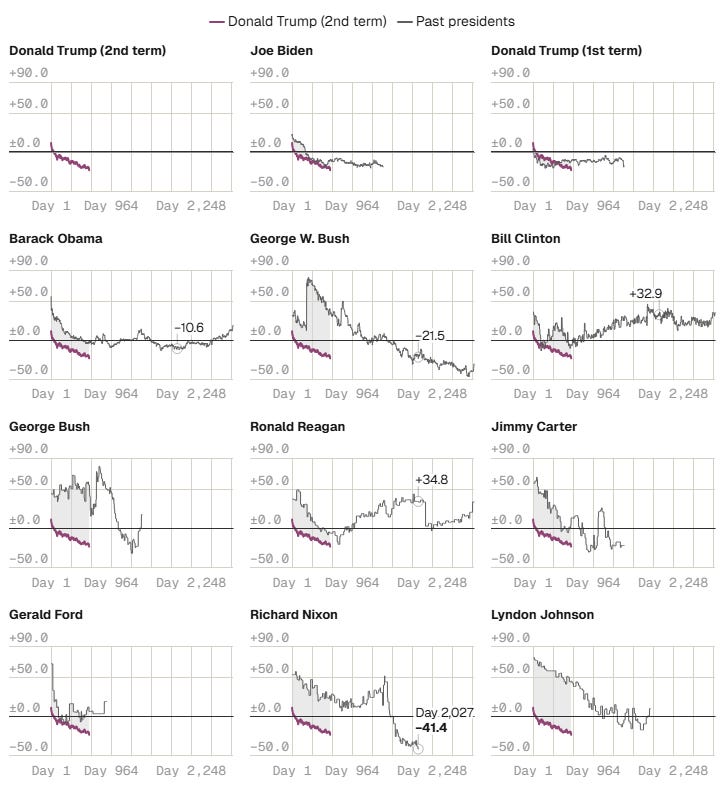
There is a lot more uncertainty in election forecasts than people give credit for, so a blue wave is by no means certain. However, polls after Labor Day are highly predictive, and polling was extremely successful in both of the most recent midterms (2022 and 2018), as well as pretty darned successful in the most recent presidential election (2024). Thus, we have reached the point where any outcome other than a blue wave would be a surprise.
It is, I admit, mentally difficult to cope with this. If you say, “Kansas is in play,” people (on either side) just shake their heads and assume you’re exaggerating. It’s always like this. Obama won Michigan by 16 points in 2008. Michigan had voted for Kerry, Gore, and Clinton both times. It had had a Democratic governor for 8 years. It was a Democratic bastion. Leading up to the 2010 election, Democrats were sure it couldn’t really be as bad as the polls were saying. In fact, it was worse. Republican Rick Snyder won the governorship by 18 points. (That’s a 34-point swing!)
Trump won Kansas by 16 points in 2024.
But what is a blue wave? How will we know? Politicians and their hangers-on love exaggerating even narrow election wins into “historic” “landslides,” or even “mandates.” Despite the tenor of those links, every politician does this. The more they can claim they won by, the more they can convince the public that they’re overwhelmingly popular, the more political capital they have. Also, most of them are too insecure to cope with the sad reality: that they won narrow, bitter elections solely because a decisive fraction of voters considered them the lesser of two evils.
Pundits and news media love pronouncing “wave elections,” too, because wave elections are exciting! People love believing that they just lived through something historic! For the winners, it’s a thrill. For the losers, an excuse.
As a result, America is suffering a wave of “wave inflation.”
I normally save this for my biennial election preview, but I think it would be useful to lay down some markers now, while the election is still thirty-odd days out. This will keep me honest. Better yet, it will save me some typing in November, when my 2026 Election Preview article inevitably spills over 5,000 words again for some reason.
Funny thing is, I already did this once. In the 2022 Election Preview, people were talking about the “coming red wave,” and I did the same exercise! I laid down some markers:
A “wave” is an election in which a party gains 25+ seats in the House.
A “tsunami” is a better-than-average wave, in which a party gains 45+ seats in the House.
This definition was based on a review of past elections that everyone generally agreed counted as “waves.”1 With one weird exception, all wave elections saw at least 25 House seats change hands, and no others did.
However, my 2022 definition failed to account for certain things, most notably the possibility of gerrymandering. Gerrymandering, which is very bad and ought to be banned, had something of a banner decade this time, and the House is now very heavily gerrymandered compared to 2022. It should be stated clearly that both sides participated in this war and contributed to the final sad state of affairs. It even looked for a while like Democrats would ultimately come out on top in this round of redistricting warfare. It should also be stated clearly that the Republicans started this round of the war. They escalated it without provocation, forcing Democrats to respond… and, ultimately, the GOP won this round, too. They were able to gerrymander themselves a House where Democrats need to win the national popular vote by about 3-4% to regain control, versus about 1-2% under “natural” conditions.2 Shame on the Republicans!
Because gerrymandering constructs more safe districts for incumbent parties, the rampant gerrymandering across the country this year means the entire House election is likely to be settled by a relatively tiny number of seats, perhaps 70 in total that are even arguably competitive (each party holding about 35 of them). That makes it a lot harder to pick up 25 seats, even if you’re backed by strong popular sentiment! There just aren’t very many available!
Meanwhile, even without gerrymandering, polarization has made the House a lot less “swingy” than it used to be. Partisans have increasingly moved to be with their own kind. I know Republicans who moved from Minnesota to Ohio to be in a red state, and I know Democrats who moved from Ohio to Minnesota for the opposite reason. Even those who don’t do it for explicitly political reasons often want to be with “their own kind.” The two tribes are now very different kinds of people in all sorts of ways, with parallel cultures and very different norms, and who wants to live in an alien culture? This “great sort” has been going on for years, and it’s been getting stronger.
Moreover, the nationalization of politics has all but eliminated the once-mighty practice of ticket-splitting. When people choose to sort themselves into geographic ghettos and choose to predictably vote the party line, elections become less competitive. (You could only prevent this by, ironically, gerrymandering for competitive elections!)
Between these four effects (gerrymandering, geographic maldistribution, geographic polarization, and the nationalization of politics), there are simply a lot more R+15 and D+20 safe seats than there used to be. When the country is dominated by such seats, there’s a lot less room for even a huge popular swing to translate into seats.
Take the 2026 election! Let us suppose, for a moment, that Democrats enjoy a luscious (for them) 12-point swing in the 2026 House vote compared to their 2024 House vote.
In 1994, a 12-point swing meant the triumphant Republicans picked up 54 seats: a tsunami. In 1974, a 12-point swing gave the Democrats 48 new seats: also a tsunami. In 1966, a 12-point swing sent 47 new Republicans to Congress: tsunami x3.
According to the Silver Bulletin election model, a 12-point swing toward the Democrats here in 2026 would give them only about 24 to 28 seats. Not only is that massive outpouring of public support nowhere close to a 45-seat “tsunami”; it might not even amount to a 25-seat “wave”!
That shouldn’t surprise you. In 2022, a 6-point swing toward the GOP, which might once have yielded 15-25 new seats, rather famously netted them only 9 seats, just barely giving them control of the House after what was infamously (and a little unfairly) dubbed a “red ripple.”
In 2026, it is simply harder to translate popular votes into House seat changes. Therefore, my 2022 definition of “waves” (and “tsunamis”) is no longer adequate. We must dig a little deeper. Here are all postwar House elections:
This is starting to run longer than I intended, so I’m just going to skip to my conclusions:
A “wave” election is an election where one party improves its margin in the House popular vote by at least 9 points.
A “tsunami” election is a better-than-average wave, where one party improves its margin in the House popular vote by at least 12 points.
Make no mistake: going from 9 points to 12 is a lot harder than going from 1 point to 9. When you get that deep into the enemy camp, you’re stuck trying to convert the enemy’s hardcore supporters. Since World War II, House elections have swung by at least 9 points on nearly a dozen occasions, but the swing has never reached 18 points.3
There are two special cases that don’t fit my definition, though, which I must explain and defend:
2008
2008 was the year Obama beat McCain, won a huge House majority, and a Senate supermajority so large it could bypass a filibuster. This gave Obama a “New Deal” moment, which he used in order to pass Obamacare, an impossibility at any other time. Everyone regards it as a wave year.
The trouble is, the Democrats had already had a wave year the previous cycle, 2006, where they had taken both the House and the Senate, reducing President Bush to a lame duck. 2008 was just slightly better: they improved their margin by a little less than 3 points. However, those were the crucial 3 points they needed to build their 2006 wave into a 2008 tsunami. Republicans, who had already lost 30 House seats and 6 Senate seats in 2006, now lost 24 more House seats and another 8 Senate seats in 2008.
This had never happened before in the modern era. There were times in American politics when one party or the other enjoyed a durable majority and consistently beat their opponents by 7 or 8 points, but to win a wave election, then actually grow that wave in the very next cycle, was remarkable.4
I call this a “double-dip wave:”
If, in the cycle immediately following a wave election, the party that won that wave expands its margin by at least 2 more points, that’s a double-dip wave.
Since 2024 was not a wave election for either party, 2026 cannot be a double-dip wave for either party. If Republicans somehow won big in 2026 (that is, if they won the House popular vote by 13 points), it would be a regular ol’ wave election.
1980
In the 1980 election, Reagan beat Carter by a tsunami margin: he won the national presidential popular vote by 10 points, which was a 12-point swing from 1976. In the Senate, Republicans lost the popular vote to Democrats by 7 points (which was a negative swing for them since 1978), yet Republicans still (thanks, I assume, to the somewhat random shape of annual Senate elections) managed to gain 12 Senate seats and control. Republicans also picked up 4 gubernatorial seats.
In the House, Republicans gained 34 seats, thanks to a 6-point popular vote swing toward them, but remained far in the minority (243-192), and lost the popular vote. This was a strong performance for them relative to their recent history (Watergate), but it wasn’t very wave-y.
Many people consider 1980 a wave election. It was certainly epochal. Reagan swept out Carter and inaugurated the Reagan Era, which lasted, more or less, until the towers came down on 9/11, more than twenty years later. The GOP did win the White House by an enormous margin and made stupidly large gains in the Senate (despite not doing so hot in the popular vote). And they gained 34 seats in the House, which is a very wave-y number!
Yet I think calling 1980 a wave is iffy. Not only did they only gain six points, they didn’t even win the House popular vote! The voters still voted to be governed by Democrats in that building! They asked for divided government, not for a Republican wave. It was the beginning of the Reagan Era, but the Reagan Era was not yet consummated, methinks, and 1980 was not a wave.
However, if you wish to count it anyway, I won’t fight you. 1980 is a mixed bag.
Back to 2026
I spoke earlier about the dramatic effects of a 12-point swing, and I defined such a swing as a “tsunami.” These are rare. The last time the Democrats managed a 12-point swing in one election was in 1974, and that’s only if you round up. (They actually only swung 11.5% in ‘74.) The 2008 double-dip wave represented a 13-point swing from 2004, but that was a strange case. The only normal tsnuamis most people alive today remember were Republican tsunamis: the Contract with America in 1994, and the Tea Party Revolution of 2010. No matter how the polls prepare you for a tsunami, it’s hard to believe when it actually hits. States you’d never have believed were in play—states like Kansas—suddenly change allegiance. Sometimes, they never change back.
Fortunately for Republicans, Democrats are not currently on course for a tsunami in 2026.
Technically.
In 2024, Republicans won the national popular vote for House by 2.6 points.5 Democrats currently lead on the generic ballot by 8.1 points. If that polling average turned out to be absolutely perfectly correct, and evenly distributed across the country, Democrats would not attain the 10.7-point swing necessary to qualify as a “tsunami.”
…but they’re only 1 point short. Polls err, and—contrary to popular belief among my fellow conservatives—they do not err exclusively in the GOP’s favor. Moreover, it is pretty normal for individual race conditions to influence popular vote totals, and for the generic ballot reading to change a little bit between Labor Day and Election Day anyway (1.4 points, on average). It would not be the slightest bit surprising, then, for the Democrats to get that 1 extra point to go from “big wave” to “tsunami city.”
That’s the main question of the coming election, in my view: will this be a Democratic wave, or a Democratic tsunami? It’s on track to be a very close call. Of course, the final result may not be a close call at all. There’s even a chance of a “blue ripple,” where no wave materializes at all.
Critics may caution that this is likely. After all, we all remember how hyped up everyone got about the coming GOP wave in 2022, only for their hopes to collapse. However: I did not get hyped up about the “coming GOP wave” in 2022, because it was never supported by the evidence:
A big GOP wave is certainly possible, but conventional wisdom—aka The Vibe—has gotten way ahead of the data on this. …Most real election experts (the Cook Political Report, the UVa Center for Politics, Inside Elections, Sean Trende, etc.) think that the “modal outcome” in tomorrow’s elections is going to be a GOP win in the House and a close race for the Senate (with perhaps a tiny GOP edge). They anticipate the GOP gaining 20-30 House seats.
Data-driven election models are a little more bearish than those experts. De Civitate’s favorite forecast model, FiveThirtyEight, forecasts the GOP landing on exactly 228 House seats (a 15-seat gain), which would be a tidy victory by ordinary midterm standards, delivering control of the House to the GOP… but definitely not a wave. DecisionDeskHQ forecasts 231 GOP seats (a 17-seat gain). The Economist forecasts 225 GOP seats (a 12-seat gain). JHK Forecasts has the GOP on 231 seats (a 17-seat gain). In other words: the modal outcome is a good solid GOP win, but no wave.
The Democratic Wave of 2026 is quite the opposite. Not only is it supported by some evidence this time, but every single piece of evidence we have is pointing out to sea and screaming, “BLUE WAVE INCOMING!”
Of course, that could change between now and Election Day, and there is a good counterargument worth making: the Vibes are all blue right now, too, and the Vibes are not only usually wrong, but they are usually further from the truth than the polls. Even as I feel those vibes very strongly myself, I have enough self-awareness to recognize that it’s very easy to give into memes instead of seeing what the data really says. I think it would be foolish to predict a mere blue ripple in this race (the only responsible prediction is that we likely face a Blue Wave or Blue Tsunami), but a ripple remains a possibility. How much of a possibility? How do we put that possibility in proper perspective, so we aren’t expecting it, but also aren’t shocked if it happens?
I’ll save that, and all further speculation, for the Election Preview the week before November 3, when all the data is in and can be most carefully pored over.
I’ll close on a favorite Bible quote:
“Woe unto the world because of gas prices! For it must needs be that gas prices be hiked, but woe to that man by whom gas price hikes cometh!”
(Protestants don’t know that one because it’s from the Apocrypha. Catholics don’t know it because Catholics don’t know Scripture. But it’s a very real Bible quote and you can definitely trust me on that.)
By this definition, there were waves in 1964, 1980*, 1982, 2006, 2008*, and 2018. There were tsunamis in 1946, 1948, 1958, 1966, 1974, 1994, and 2010.
*2008 was a special case, discussed in the old article, and we’ll likely come back to it today. 1980 is also a special case, so I’ll definitely come back to that.
Because the GOP is more evenly distributed compared to the Democrats (who tend to clump up in intensely blue enclaves), the Republicans have a small but persistent edge. This is not a nefarious act of injustice to Democrats; it’s just how maps work.
Nor is it divinely ordained that the Republicans will always hold this edge. The Democrats will likely regain it someday, as coalitions shuffle. In the 2024 election, the GOP traded substantial White suburban support for substantially more Black, Hispanic, and urban support. If that realignment continues, the geographic edge will gradually shift to neutral, or even toward Democrats, since Black, Hispanic and urban populations tend to be more concentrated in non-competitive districts.
The 2010 GOP tsunami came close, with a 17.4-point swing.
Not quite unique, as it also happened early in the New Deal (for Democrats) and in the 1918/1920 election cycles (for Republicans). Nevertheless, remarkable.
This footnote is a mandatory defense against the charge that they only won the popular vote because of uncontested seats, a charge I’ve responded to occasionally.
"Make no mistake: going from 9 points to 12 is a lot harder than going from 1 point to 9. When you get that deep into the enemy camp, you’re stuck trying to convert the enemy’s hardcore supporters. Since World War II, House elections have swung by at least 9 points on nearly a dozen occasions, but the swing has never reached 18 points."
You see a similar dynamic in presidential elections. Barring a charismatic 3rd-party candidate, each party has an almost guaranteed floor of 40% of the electorate, and a practical floor of 45% of the electorate. Indeed, most of the time each party can count on 47-48% of the electorate.
The dirty little secret of politics is that you're trying to sway that middle 4-6% of the electorate, and that particular slice votes almost entirely based on vibes and which side scares them the least.