

Several years ago, I visited a Dominican friend of mine who was being ordained to the transitional diaconate in Washington, D.C.. When I jokingly mentioned that either one of us could be elected pope, he laughed right in my face and said I would be a terrible pope. (He added that so would he.) My friend was right, of course, but it still got me thinking harder: what makes a good pope? What should a pope actually do?
Now we have a new pope, so, on the off chance Pope Leo XIV is browsing De Civ looking for ideas,1 this ongoing series says what I’d do If They’d Made Me Pope.
I’ve put off this installment for a long time because it seems guaranteed to cause offense to practically everybody. It is therefore also the longest. If I can put some of you to sleep by the midway point, I might still get away with it. (It’s coming out on a Friday, the worst day to publish an essay, for the same reason.)
Peter Kwasniewski is well-known (in certain circles) for his erudite defense of the Latin Mass and (radical) Traditionalism. He is not himself a schismatic, but he has enormous sympathy for the SSPX schismatics, and he has refused to condemn the Écône consecrations, which finally placed that Society firmly outside the bosom and succor of the Catholic Church. This series already dealt (briefly) with the Lefebvrist heresy last year, and I’ve nothing to add since their formal schism in July,2 but I mention Kwasniewski’s views so you can locate his ideological coordinates within the Catholic Church. He is Catholic, and he is smart, but he is as far on the Catholic “right”3 as you can possibly be without tipping over the edge into schism.
Last fall, Kwasniewski wrote an article called “Why They Are Taking Away Your Traditional Latin Mass,” which had the following thesis:
The reason the Church’s leaders persecute the most faithful Catholics is that, broadly speaking, the leadership of the Catholic Church on earth at this time is dominated by a network of active homosexuals and theological modernists. They are not always the same people but they rely on, and receive, one another’s support. We all know individual good bishops or cardinals but such exceptions are a controlled opposition, with very limited mobility. The more they act or speak out, the more ostracized they are, and sometimes they can even be canceled, as priests are canceled lower down.
…You can easily see through the “sodomodernist” arts of deception by asking a question you’re not supposed to ask. If traditional Catholic communities are being shut down because they “reject Vatican II and the reformed liturgy,” why, then, are the vastly larger number of Catholics who reject vastly more things and more serious things…—why are THOSE Catholics not being pursued even more vigorously with canonical penalties, separated off into ghettoes, and finally liquidated?
…The answer is simple: such Catholics and their Masses do not pose any threat at all to the homosexuals and modernists, the chaplains of secularism and the euthanists of Western civilization. In fact, secularized Catholics are their trophy—the desired outcome of decades of deconstructing Catholicism into a this-worldly program.
I believe this thesis is basically correct.
I would not drown it in the gravy of self-pity, nor would I get my jollies from sneering about “sodomites” like a middle-schooler who just discovered dirty words, but I agree:
that Catholic traditionalists and radtrads face constant, low-grade persecution from the Church hierarchy,
that this persecution is (often) disproportionate to that faced by other Catholic wrongdoers (as I wrote last fall),
that this disproportionate aggression toward trads is best explained by a cabal of gay heretics who collectively control a large part of the Church’s elaborate system of patronage, using it to help themselves and harm their enemies.
I don’t think this is some inherent feature of The Gays. Gay people are not, ipso facto, predators. Any sufficiently advanced clique, spread out across a large organization, can corrupt the organization to serve the clique instead of the mission. All that’s required is a loyal, closely connected clique with objectives oblique to the organization’s mission. Minority ethnic groups and religions have both done it.
Gay people have, historically, faced strong social disapproval and even criminal liability, so it is quite natural that gay culture strongly emphasizes intra-clique loyalty. Since gay sex is (rightly) understood as a very serious offense within Catholicism, and even gays who follow Church teaching to the letter face intense suspicion and often-unjust discrimination, gay clerics are uniquely dependent on their clique.
Once a sufficiently tight-knit clique forms, it accumulates power the same way any faction does: by using its connections to install its friends in positions of power while pushing its opponents to the periphery. When one of your guys works hard and is rewarded with a chancery office, he starts bringing up his friends’ names in discussions with the bishop about other offices. When an opponent makes a big mistake, you take a hard line, even though you might be more forgiving to one of your friends. The clique gets one of its guys appointed as rector of the seminary, and then he starts swapping professors in and out accordingly. If your national allies complain enough about the papal nuncio, maybe the pope will swap him with someone more amenable, just to shut you up… and now your clique controls a large number of bishop appointments. If your bishop is a friend of Dorothy himself,4 the diocese is your oyster. The gay clique is naturally allied to modernist theologians, who reject Catholic teaching, and is naturally opposed to traditional (orthodox) theology, which condemns homosexual acts and is suspicious of homosexual orientation.
Story Time
None of this is theoretical. Anyone who spends enough time near a chancery has heard of the “lavender mafia” or “pink mafia.”
I have a priest friend who once told me a story that he’d nearly “been discerned out” (aka “expelled”) from seminary in the 1990s merely for his orthodoxy. His end-of-year board of review consisted of two people who hated him and one who didn’t. Fortunately for my friend, the two who hated him were not just homosexuals, but lovers, and they had a “lover’s quarrel” shortly before his review board met. By my friend’s account, one of the two unexpectedly decided to pass my friend to spite his erstwhile bedmate.
Naturally, when I heard this in the late 2000s, I took it with several very large grains of salt, not because I distrusted my friend, but because the story was simply too outrageous. Surely, my friend had misunderstood! Some years later, however, during the sex abuse lawsuit against the Archdiocese, many hundreds of internal documents became available for one reason or another, and one of them happened to be the official seminary report on this very meeting!5 Reading between the lines of that report, and after doing some research on those involved now that I knew their names, I came away satisfied that my friend had actually told me the dead-on truth. This sort of thing was routine in many dioceses.6
It scaled up, too. It’s been said before, but bears saying again: Cardinal Theodore McCarrick, Archbishop of Washington, was the head of a cabal of gay bishops and their allies (we’ll come back to the allies). McCarrick was placed in power by the energy of the lavender mafia, and, once in power, used his vast influence (which was openly discussed at the time; for example, at Whispers in the Loggia) to extend the reach of the lavender mafia wherever he could. McCarrick probably got now-Cardinal Blaise Cupich of Chicago (who has led the American persecution of traditionalists) his bishop’s mitre.7 Ditto now-Cardinal Joseph Tobin. (+Tobin is best known for his infamous “nighty-night baby” tweet—and no, nobody finds +Tobin’s explanation probable.) Ditto progressive now-cardinal Kevin Farrell, McCarrick’s longtime protégé, and the man who ran the Church as camerlengo during the sede vacante after Francis died.
Moreover, everybody knew that McCarrick8 was not living according to the Church’s sexual teachings. +Tobin knew. Cardinal Wuerl knew! Rod Dreher knew second-hand that the New York Times knew, but the Times never ran the story (and Dreher couldn’t get people on the record, either). However, instead of exposing McCarrick and disciplining him, those in power shielded him. Why?
Because they thought he was just a run-of-the-mill closeted gay bishop, one of the clique, somebody they had a duty to defend. They didn’t realize (I hope!) that he was touching boys under the age of 18—so, in the name of defending the clique, they shut down every investigation of his sexual misconduct, thereby ensuring McCarrick’s criminal misconduct went undiscovered for decades.
We have a duty to notice the lavender mafia, even though it may offend our sensibilities to do so. It is an old pattern, and children will continue to suffer until we address it.
The Straights, Too
The typical traditionalist conclusion drawn at this point is simple: ban gays from the priesthood, period, whether they’re living as active homosexuals or not. Break the lavender mafia and you solve the sex abuse crisis while dealing a crippling blow to the modernist heretics. Although undoubtedly unfair to those orthodox men who (through no fault of their own) find themselves with a homosexual orientation and who attempt to maintain sexual continence, the “gay priest ban” may well be a prudent step under present circumstances.
However, Pope Benedict already took that step, way back in 2005. Yet the modernist/gay cabal continues to wield and even build influence in the hierarchy, twenty years later. I think the traditionalists aren’t thinking big-picture enough. I think that’s in part because they don’t want to see that the problem in the Catholic clergy goes way beyond the gays and progressives.
As I explained in Commonweal in 2018, the abuse crisis turned into a catastrophe thanks to sustained, active collaboration between the “progressive” and “conservative” factions within the clergy. For every Cardinal McCarrick, there was a Cardinal Egan. For every Archbishop Weakland, a Cardinal Law. Why is this?
I think it’s notable that, for all the Church’s problems with diddling boys, the abuse crises that struck me closest to home both involved diddling girls. My former associate pastor served a year in prison for abusing a woman I knew in passing. The priest who said my wedding, a friend, lost his job over (dubious)9 allegations that he’d fondled a girl’s breasts. He was heterosexual and notably conservative, but he still benefitted from the assistance of the lavender mafia in his case.10 Meanwhile, the most prominent cleric-abuser in the world during the Francis papacy, Fr. Marko Rupnik, was an (alleged) abuser of nuns.11 This seems to scale up, too: the late Richard Sipe, sociologist and ex-priest, famously estimated in 1990 that only around half of all priests were living in sexual abstinence at any given time,12 and that considerably fewer than half of priests lived in sexual abstinence consistently over the long haul.
Now, to be fair, Richard Sipe made a lot of outrageous, sensational claims. He also claimed in 1990 that 6% of priests had had sexual contact with minors, to widespread ridicule. Fifteen years later, the John Jay Report revealed that, in reality, only 4% of priests had been accused of having sexual conduct with minors, which is a whole two percentage points less, and, besides, only a tiny fraction of that 4% was actually prosecuted and convicted by a jury of their peers.
Sipe even claimed, in 2008, that a cardinal of the Catholic Church was a homosexual who groomed and seduced seminarians and young priests—not just any cardinal, but the highly respected Cardinal Theodore McCarrick!
Sipe’s “half of all priests” figure was in line with a 1987 South African study13 and a 1996 Spanish study.14 Sipe had both academic credentials and personal experience. Since everyone who dismisses Sipe’s outrageous claims as ludicrous seems to end up wiping egg off his face ten years later, I am inclined to skip the egg-wiping and accept his claim now: as of 1990, half of all priests were sexually active, and it is likely that the majority of those priests were having sex with women, not men. I once believed that violating the vow of sexual continence was almost exclusively a problem among progressives, and that traditionalism would therefore solve the problem. I no longer believe that. Ideology may make some difference, but not nearly enough.
Of course, 1990 was nearly two generations ago. The share of sexually active priests has, hopefully, fallen since then. After all, between all the reforms to seminary life, the revitalization of vocations in the late 1990s, all the attempts to combat loneliness among brother priests, and the simple biological reality of the aging priesthood… is it not reasonable to hope that the proportion of sexually active priests has fallen? We are a people of hope, so maybe, instead of half, the share of sexually active priests is now only a third? Or maybe a quarter? As of 2009, Sipe did not think this at all likely, but there is evidence of a shift starting around that time.
In 2002, the Los Angeles Times polled several thousand priests about their relationship with celibacy. The question is poorly worded, but we’ll work with it:
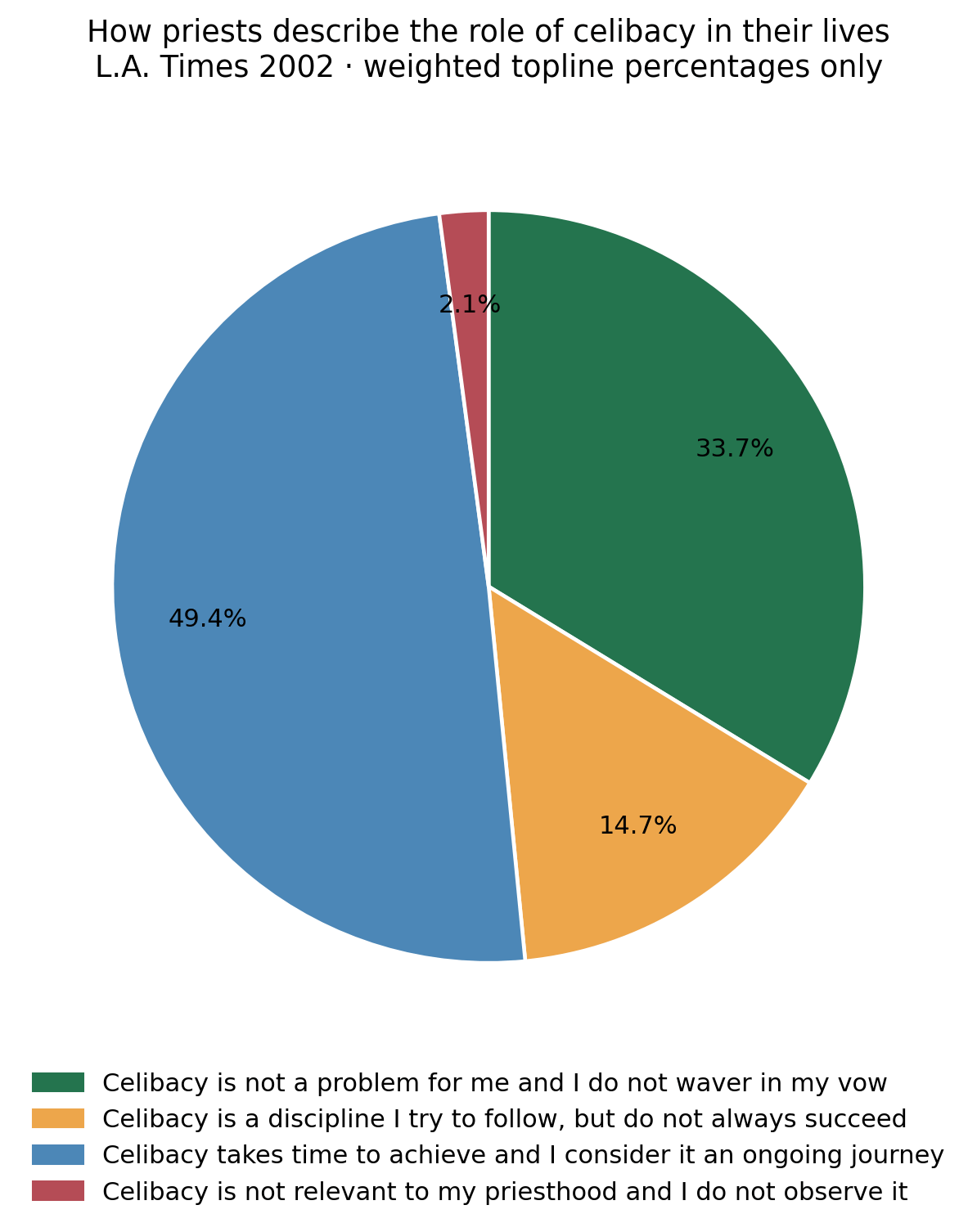
We are already confident (per Sipe and the others) that, at the time this question was asked, around half of priests were sexually active with other people. Fortunately, despite its poor question wording, the LA Times survey seems to line up pretty well with Sipe’s estimate. If we assume that the priests in the blue and red slices of the chart are mostly sexually active; that the yellow slice is partly or sometimes sexually active; and that the green slice is mostly not sexually active, the overall result fits both with Sipe’s estimate and with the logic of those answers.15
The 2020 Survey of American Catholic Priests, conducted by the redoubtable Mark Regnerus (and Stephen Cranney), asked the exact same question, with the exact same (terrible)16 wording. This allows us to draw a direct comparison between 2002 and 2020:
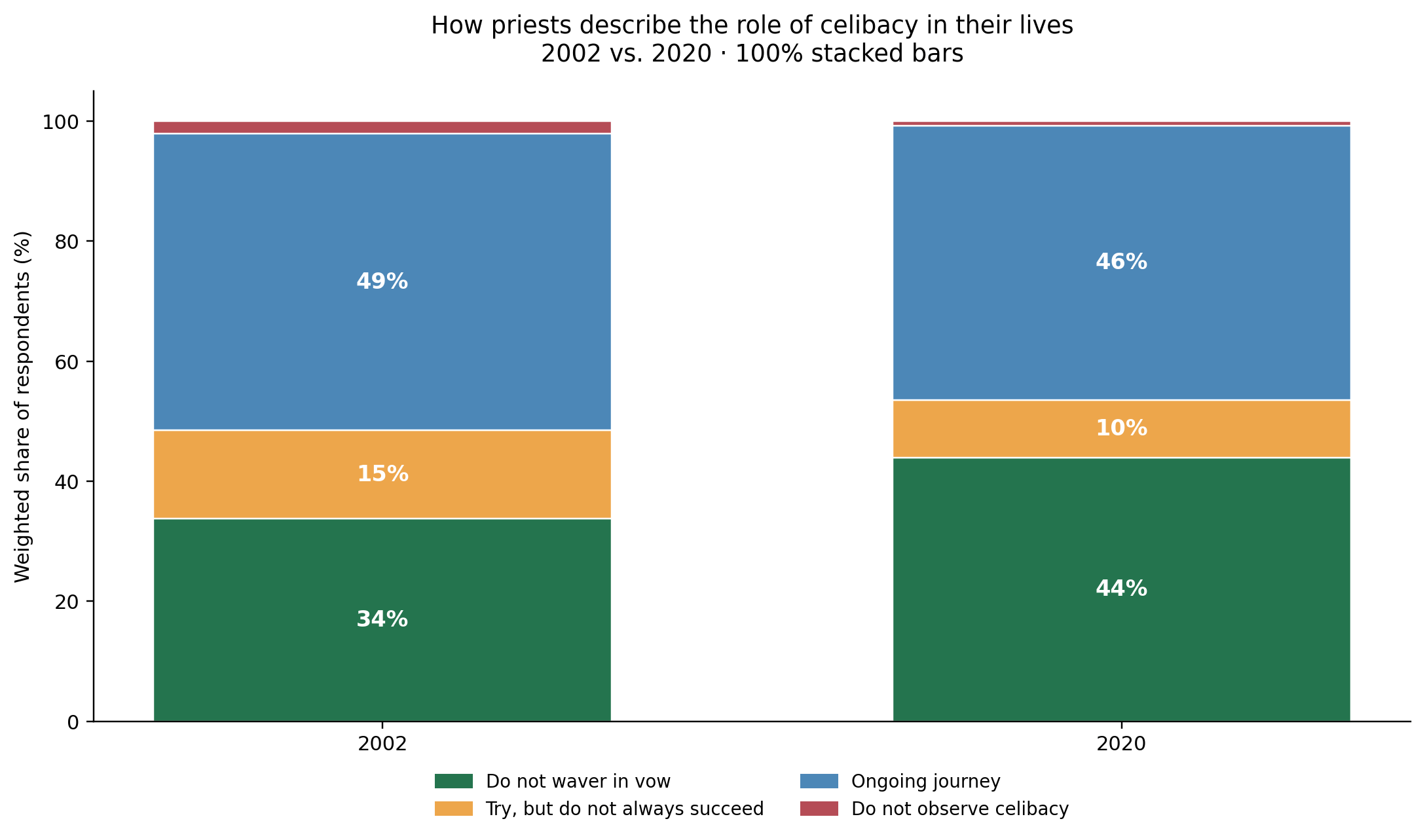
This is an improvement! Solid green rose more than 10%! The presumptively-sexually-active “ongoing journey” group receded a bit!
However, it still ain’t great. Moreover, since these are self-reported behaviors, and some priests would probably not admit behavior they aren’t proud of, even on an anonymous survey, it’s probably a little worse than this, even!
Still, when you break out responses by ordination cohort, the present (and future) looks a little brighter still:
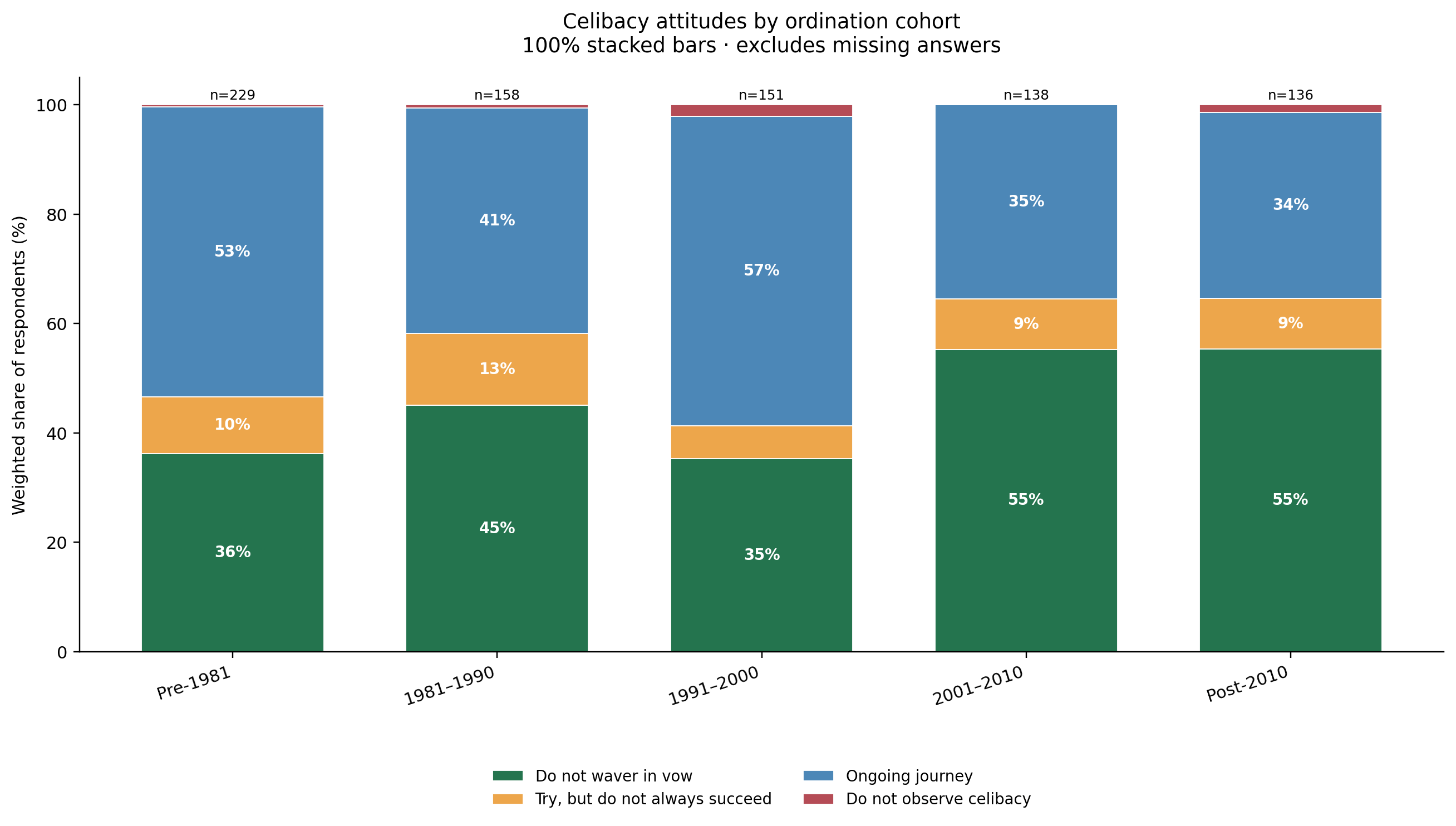
Sipe, in his 1990 study, was looking at the men ordained up until 1990. The solid celibates were a clear minority at that time, just as Sipe said. Things got even worse during the 1990s, which tracks with the story of my friend who almost got kicked out at that time… but then, in the 2000s, we see a turnaround: since then, a narrow but clear majority of priests have done well with celibacy.17
Nevertheless, even among the most recent cohort, fully a third are still calling their celibacy “an ongoing journey,” and still more admit falling short despite respecting the discipline, while a few reject it entirely. Moreover, this is only a snapshot in time. Some considerably larger share of priests have been on a “celibacy journey” with a woman (or another man) in the past, or will be in the future. Twenty years of reforms have brought about only modest improvements.
That’s a whole lotta priests having sex!
Power Dynamics in a Culture of Secrecy
That’s bad in itself, of course (sin! I’m against it!), but it is also dangerous.
The “lavender mafia” rebuilds itself (over and over again) in order to create space for priests to have sex without being exposed or punished. They do this so they can have sex with men. However, the lavender mafia’s most important clientele are the sexually active straight priests, who (when you run the numbers) turn out to substantially outnumber the gay priests. The straights thus become the mafia’s allies, not necessarily out of ideological sympathy, but because they have no choice: the mafia does them a favor, and a certain problem goes away. In exchange, the straights are obliged to do favors in return—and, of course, adhere to the cabal’s culture of control and secrecy.
This culture of control is absolutely pervasive within the Church hierarchy today. Priests are not well-treated in the Catholic Church. They are isolated. Their destiny is at the whim of their bishop. They are subjected to a perverse notion of servile obedience, which came, not from Christ, but from the Jesuit order. I published several seminarian testaments in 2019 (my inbox remains open, ex-sems!), and this was a common thread across all three: the people in power often ruled by arbitrary acts of will, went after those who rejected arbitrariness, and generally made sure that most reasonably normal human beings would be “discerned out” from the seminary. This grooms seminarians to be pliant, nominally to the hierarchy, but also to the clique. Don’t believe me? Look at the Lincoln scandal. Read Father Lavers on McCarrick. We have constructed a seminary system purpose-built to screen out normal people and ordain, well, weirdos.18
Suppose the pope accomplished the impossible: through ruthless screening, perfect universal compliance,19 a lot of erring on the side of caution, and a long wait for the existing crop to die out, the number of gay priests is somehow brought to zero. You’d still have a large network of straight priests having sex. There would therefore still be a lot of demand for a structure that allows them to do so without exposure or punishment. There would still be plenty of pliant subordinates and weirdos providing the raw human material for such a network. The current structure centers on gay priests because they’re a useful Schelling point, I think, but some network like the lavender mafia would inevitably re-emerge as long as a large proportion of priests are secretly sexually active. That network would, inevitably, be used by pedophile priests as a cover to prevent investigation and exposure. They would succeed for exactly the same reasons.
And a large proportion of priests will always be sexually active.20 Sin is ubiquitous, man has fallen, and we are saved only by the blood of the Lamb; news at 11.
The Church, then, has a problem.
A Brief History of Celibacy
Catholic priests having sex is not a new challenge.
In the beginning of the Church, Jesus taught that His disciples would be wise to avoid marriage and sex, and that their renunciation is a great and glorious gift:
[Jesus’s] disciples said to him, “If such is the case of a man with his wife, it is better not to marry.”
But he said to them, “Not everyone can accept this teaching, but only those to whom it is given. For there are eunuchs who have been so from birth, and there are eunuchs who have been made eunuchs by others, and there are eunuchs who have made themselves eunuchs for the sake of the kingdom of heaven. The one who can accept this should accept it.” (Matt 19)
St. Paul underlines the point by connecting virginity to fasting, in that both involve giving up something that is genuinely good in order to focus on something that is even better:
I would like you to be free from anxiety. The unmarried man is anxious about the affairs of the Lord, how to please the Lord; but the married man is anxious about worldly affairs, how to please his wife, and his interests are divided. And the unmarried woman or girl is anxious about the affairs of the Lord, how to be holy in body and spirit; but the married woman is anxious about worldly affairs, how to please her husband. (1 Cor 7)
The nascent Church took this very seriously. Some of the Apostles were married, but norms quickly developed: Christian clerics who became widowers were never to remarry. Someone who was already married could become a cleric, but could not marry afterward. As much as possible, Christian clerics and their wives were to pursue the ideal Christ declared in Matthew: they were to live entirely without sex “for the sake of the kingdom of heaven.” By the late fourth century, this continence21 was understood (in the words of the 390 Synod of Carthage) to have been “what the Apostles taught and what antiquity itself has observed.” That is to say, the early Church understood that St. Peter was married, but also, by and large, believed that, after Pentecost, St. Peter never had sex with his wife again.
So don’t trust anybody who tells you that Christian virginity is bad or that it falls short of the ideal.22 It is the ideal—at least for “the one who can accept it”—and a glorious calling. The Church has recognized this from the very beginning, even though its sexual teaching has been adorned with new insights (like the Theology of the Body) over the centuries, which have deepened our understanding of it.
Support for clerical continence was seen in both the Eastern and Western Churches. The Eastern Emperor Justinian complained that the (apparently numerous) priests who begat children after ordination “despise the holy canons,” and he declared those children illegitimate. Pope Leo the Great wrote around 458 that “the law of continence” was clear and bound all clergy: “[W]hen they were lay people or lectors, they could freely take a wife and beget children. But once they have reached the ranks mentioned above, what had been permitted is no longer so.”
Reading through some of Justinian’s statutes on the subject, one might be struck by how preoccupied he is with, not clerical virginity for the sake of the kingdom, but clerical childbearing from legitimate unions. This is because the legitimate children of clerics could inherit from their fathers, thus passing Church property into private hands. Continence is genuinely a higher calling than the sexual life, but the Church’s interest in it during these centuries was often more practical and economic than spiritual.23
In the early Church, in both East and West, married priests continued to live together with their wives after ordination. They were called to love one another “as brother and sister,” which is the classic Christian euphemism for “without having sex.” (Leo the Great again: “conjugal love [must] be safeguarded and nuptial activity cease.”) However, husbands and wives living together were (understandably) very sorely tempted to break the rule of continence, and many did return to bed with each other. As the first millennium went on and this problem deepened, East and West began to diverge in their treatments of priest sex.
In the West, the Church tightened the law of continence by beginning to separate married husbands and wives at the husband’s ordination. (The wife then had a say in the ordination, of course, since she would be so heavily affected by it.) This tightening continued for several centuries until, finally, in the eleventh century, Pope Gregory declared that the Church would only ordain men who had never been married, and two Councils Lateran agreed. The Western Church, recognizing that those called to virginity were among the best of men, thereby gradually chose to restrict its priestly recruiting pool to those men and no others.24
Meanwhile, in the East, the Church responded to the problem of clerical incontinence between husbands and wives by relaxing the law of continence. By the time of the Quinisext Council in 692, the divergence was sufficient that the Eastern bishops wrote of priestly continence:
[W]hereas they of the most holy Roman Church purpose to keep the rule of exact perfection, but those who are under the throne of this heaven-protected and royal city [Constantinople] keep that of kindness and consideration, so blending both together as our fathers have done, and as the love of God requires, that neither gentleness fall into license, nor severity into harshness. (Canon 3)
Accordingly, the Eastern bishops noted the Western practice of separating husbands from their wives at ordination… and specifically rejected it:
Since we know it to be handed down as a rule of the Roman Church that those who are deemed worthy to be advanced to the diaconate or presbyterate should promise no longer to cohabit with their wives, we, preserving the ancient rule and apostolic perfection and order, will that the lawful marriages of men who are in holy orders be from this time forward firm, by no means dissolving their union with their wives nor depriving them of their mutual intercourse at a convenient time. […] Nor shall it be demanded of [a priest, deacon, or subdeacon] at the time of his ordination that he promise to abstain from lawful intercourse with his wife: lest we should affect injuriously marriage constituted by God and blessed by his presence, as the Gospel says: What God has joined together let no man put asunder; and the Apostle says, Marriage is honourable and the bed undefiled; and again, Are you bound to a wife? Seek not to be loosed. (Canon 13)
Canon 13 instead (re-)imposed an obligation of temporary continence that, as far as I understand Eastern discipline, still binds Eastern Orthodox clergy: priests were to avoid sleeping with their wives during the time they served at the altar (often interpreted as the day leading up to the celebration of Divine Liturgy), but otherwise were free to bed them.25
Both East and West maintained the rule that bishops were to be continent, and, ideally, celibate. This appears to be the consistent practice of the entire Church since the beginning and seems very probably an unwaivable, irreformable, apostolic practice of the Church.26
The Western rule of continent, celibate (or at least widower) priests—typically virgins27—has certainly had benefits. Aside from ensuring that our priestly recruiting pool is restricted to men who are extremely virtuous (or extremely weird), our discipline has also:
Prevented the formation of a hereditary caste of priests, as seemed to be happening at certain times in the first millennium. Fathers raised sons who became priests, who married women who were the daughters of priests. The priesthood became a means for families to hold land and power, and the vocation at the heart of Holy Orders was lost. Priestly celibacy (mostly) ended that.
Protected Church properties and revenues from alienation by inheritance, as mentioned.
Averted a great deal of awkwardness and public judgment around priestly families. The “preacher’s daughter” is a trope that the Catholic Church in the West has entirely avoided. Simcha Fisher has an excellent column called “Time for Married Priests?” about what the day-to-day reality of a married Catholic priesthood would actually look like, and no one should contemplate changes to the discipline without reading her article.
Glorified God and the excellences of the Church of Rome, by elevating our entire sacerdotal order to the ideal set by Christ himself. Although, strictly speaking, unnecessary, this is a symbol of Rome’s especial fidelity, and displays the spirit of “going the extra mile” to which all Christians should aspire.
Spared our priests a great deal of worry about worldly things, from the trivial, like getting their kid to soccer practice, to the difficult, like getting their child with Down Syndrome all the care and accommodation she needs.
Shielded priests from certain outside pressures, allowing them to be more courageous. It's all well and good to be a married priest when the Church is at peace, but then a persecution or a heresy blows in and suddenly you're being told to apostasize or they'll torture your four-year-old daughter to death. Defending one's family is a very natural, noble human instinct, and putting God before family is a choice all Christians must be ready to make... but persecutions usually make a special target of priests, because they are so central to the Church. It is therefore dangerous, both to priests and their families, for them to have wives and children.
Allowed the Church to continue paying priests relatively low wages.28
Made priests available at all hours for all kinds of services—essential to the smooth running of the Church in this era of few vocations.
Destroyed diocesan priests’ rootedness, so that the bishop can swiftly reassign them anywhere in the diocese, or even somewhere else in the world, at a moment’s notice.
Placed priests and their destinies wholly in the power of their bishops, so that they depend for their survival and every good thing in life on servile obeisance to whoever happens to be in power at the chancery at the moment.29
Focused the social lives of priests inward, on their parish, their brother priests, and on the Catholic Church in general, promoting clericalist attitudes and privileging clerical perspectives.
Perhaps you read those last five items and thought, “wait, those are benefits of the current system? They sound like they might also have some drawbacks.” To the priests and laity, I think, yes, there’s both good and bad to priestly flexibility. To the bishops, however, it’s all upside. To a bishop, these are all unambiguous practical benefits… and the bishops set the rules.
It is interesting to consider that the bishops who benefit most from these rules are the ones most desperate for leverage over their brother priests: that is, members of the cabal.
Now that I have laid out my theory of power within the Church, I can reveal that this cabal has been on my mind throughout If They’d Made Me Pope. I’ve proposed a number of reforms, not just for the reasons I gave at the time, but because I thought it prudent to take measures that would structurally weaken the network of gay and sexually active priests who control so much of the Church. I swept aside the Curia, because they are a center of power for the lavender mafia. I restored the election of bishops, because that would move much of the power of episcopal appointments out of the hands of cliques, including the sexual clique, into the hands of subordinates. I revived the rule of law, because duh that’s half the problem. I imposed additional accountability and clearer process, because the clique uses gaps in canon law as its hideouts.
However, I think there is a reason why high-level members and allies of the sexual clique, like ex-Cardinal McCarrick, are often the loudest defenders of the celibacy discipline specifically—even when they dissent, or entertain dissent, on practically everything else.
Power structures are one thing. People, and the culture they create within those structures, are another.
Too Weird
The Catholic Church’s current discipline against married, sexually active priests was designed to ensure that priests are recruited from among the best of men,30 but it doesn’t quite do that. Instead, it ensures that priests are recruited from among the best of men… and from among the weirdest of men.
Young men who are willing to be lifelong virgins are often very holy… or sometimes they have a hormone imbalance. Or they have some peculiar fixation on becoming priests (perhaps trying to please their parents), and figure they can solve the virginity problem after ordination. (My associate pastor who abused the vulnerable young woman in my parish explained to the court, “Living a life of celibacy was much harder than I had anticipated.” Indeed! I’ll bet it was an “ongoing journey!”) Or they’re just young and stupid and full of zeal. Theoretically, one of the main purposes of seminaries is to screen out the weirdos, or at least the “bad” weirdos. Functionally, though, seminaries often seem to work harder to screen out the good ones! I think this has gotten better, but I don’t think it has gotten good.
I don’t know what the priesthood looked like a century or six ago. (Six centuries ago, they hadn’t invented seminaries yet!) I only know what the priesthood looks like today. In Holy Orders today, the ratio of Holiest Of Men to Weirdest Of Dudes seems askew to me. The not-so-holy ones end up embroiled in the culture of secrecy and mutual cover-up. The sex abuse scandal repeats and repeats and repeats. It’s gonna repeat again. Are you pumped for the next round of lawsuits, bankruptcies, and broken lives?
I therefore think that the discipline of clerical continence—a discipline deeply rooted in Scripture and Tradition, and a glorious crown for those who wear it—is, today, doing more harm than good. It is keeping out the normies.
To be absolutely clear: I do not think, as many do, that we should end the current discipline because doing so would solve the vocation crisis by bringing a tidal wave of viri probati into the priesthood. I think that view is facile. It would be lovely, of course, if married priests were able to plug the holes in our sinking parishes, but being a priest is a difficult vocation (glorious, but difficult), and being a married priest may be even more difficult in some ways. I suspect that the number of priests might actually fall after a change in the discipline, and that the divided loyalties of married priests would make them less able to carry the burdens of priesthood.
Rather, I think that we should end the current discipline in order to break certain dangerous and deeply-rooted tendencies in the Catholic presbyterate as a whole, particularly its culture of insularity and secrecy. We began today with Peter Kwasniewski’s (accurate) complaint that the Church is controlled by a cabal of modernist homosexuals. I believe that married priests—a bunch of normal guys who want your kids to come play with their kids at the parish barbeque after Mass—are the best way to break that cabal. You can’t out-doctrine the lavender mafia, you can’t out-maneuver them, and you certainly can’t out-purge them. But you can out-normie them! The cabal draws its power from the favors it does for priests who act out sexually in scandalous ways. Catholic marriages are hardly Edenic, but there’s considerably less of… whatever this is, or this.
Careful There…
One does not simply end a Church discipline that’s older than algebra. Even I, who presumes to give the Pope a policy program in a year-long blog series, am not that arrogant.
I think the celibacy discipline is harming the Church, in the aggregate. I don’t know that. I do know that the current discipline is deeply tied into many, many facets of Catholic life, and that removing it would transform the Church in many ways, lots of which will seem foreseeable only in retrospect. This is a major breaking change.
So, like any major breaking change, it should be tested. If they’d made me pope, I would find five metropolitan bishops around the world, no more than two per continent. (There are thirty-three metropolitans in the U.S. alone.) These would not be eager reformers or Synodal Way types, eager to end celibacy, bring back the felt banners of the ‘70s, and start singing “We Are Church” at clerical weddings. I would find tradition-minded conservatives, ideally ones who are skeptical of the idea and would rather not be the guinea pigs for it. I’d ask them to do a real big favor for the Holy Father: take this on, make it work, and tell me what else you need reformed for it to work.
The rule of clerical celibacy would then be lifted within their archdioceses and suffragan sees. It would be replaced (for the men native to those dioceses only) by the typical rule of the Eastern Catholic Churches: a man in Holy Orders cannot validly marry, but prior marriage poses no impediment to Holy Orders, and sexual continence within marriage, while praiseworthy, is neither expected nor required.
It is possible—even likely—that imposing this rule would induce some current priests to leave the priesthood, since they would be living alongside married priests while themselves barred from marriage. That is okay. Anyone who would leave the priesthood because someone else got to be married probably never had a calling to be a “eunuch for the sake of the kingdom” in the first place. Their ordination was premised on their claim to that calling, and, evidently, that claim was in error. Let them go. No hard feelings.
The initial trial period would last twenty years. That’s long enough for a new crop of priests to enter seminary under the new rule, graduate, and spend perhaps a decade in ministry. If the results were not catastrophic, we would then take everything we’d learned from this initial trial and use it to launch… a Phase II trial, including a number of additional ecclesiastical provinces. (Maybe we’d finally let a progressive try it.) After an additional thirty years, the first generation of priests under the new system would be dying off, several more generations would be well into ministry, and we would finally be in a position to decide whether to change the discipline for the entire Church.
During these five decades of experimentation, we would no doubt discover—and hopefully solve—endless difficulties. For example, we’ll undoubtedly have some priests paying alimony! Does that come out of salary? We certainly aren’t going to eliminate priest crimes, either. That’s impossible. Priests are humans. Humans do crimes. Our aim, rather, is to fatally undermine the specific culture of sexual secrecy that fuels clericalism and cover-up. We’ll find plenty of new sins and scandals to replace it—imagine the hubbub when a middle-schooler finds birth control pills in the pastor’s garbage!—but those sins, hopefully, will be less poisonous to the Church as a whole. Let “no more Bostons” be our motto.
No other entity can do stuff like this, on these timescales. If you asked Congress to support a fifty-year trial run of a new welfare program, they’d laugh you out of the room. However, the Church thinks best when she thinks in centuries. When the current no-married-priests rule was first imposed, back in the eleventh century, it took several hundred years for the bishops to stamp out marriage and concubinage among the priesthood. From that perspective, a twenty-year Phase I trial is actually a bit of a rush!
Even with these safeguards, I tremble at the idea of doing away with such an ancient and glorious Latin Rite tradition. There are many good priests who are thriving under the current system, and I fear messing up a good thing for them. I would expect and pray for them to continue thriving even as married couples began to join them in ministry, but what I’m suggesting is big. Bigger, or so it feels to me, than anything else I have proposed in this series. However, the first duty of the Pope, as supreme legislator, is not to conserve tradition, but to bring about the greater glory of God.
It is true that the greater glory of God is usually best served by conserving traditions. Most traditions are wiser than they first appear (hence Chesterton’s Fence) but Catholic traditions are especially so, since they bear the imprimatur of the divinely-ordained deposit of Faith. For this reason, I count myself a traditionalist.
However, not all traditions serve God best at all times. It seems to me that, in the twenty-first century, mandatory presbyteral celibacy is doing more harm than good. The Church in the West grew for a thousand years without it, and the rest of the Church—including many portions of the Church in full communion with Rome—has never had it. It may have helped before. It may again in the future.
A pope, however, must set Church disciplines that meet the needs of the Church he rules. I’d bring in the normies.
DE CIV NEXT VOYAGE: When If They’d Made Me Pope returns, it will be with some less unpopular opinions. Surprise, I think the German Church tax and Vatican copyright abuse are bad! Stuff like that. However, in the meantime, there’s an election looming, so there will be a little more discussion of that during the next two weeks, plus maybe a post-mortem before we get back to regular programming. I’m also writing a piece for an external source, I owe the paylisters a Worthy Reads, and I think we’re past due for some constitutional amendments. So it’s shaping up to be a busy November/December here at De Civ, as usual!
While this piece was being written, Pope Leo was diagnosed with lung cancer. He is in my prayers, and I am sure he would be grateful for yours.
Except the obvious: repent and submit to the Pope.

Or, at least, repent and submit to the logic of your own position. The doublethink inherent in the SSPX’s doctrine is breathtaking. They claim humble fealty to the pope while directly disobeying his clear command in a matter (episcopal consecration) which sits at the very apex of papal authority, then justify their rebellion by calling the current papal magisterium heretical. Kwasniewski may think me a simpleton for saying so, but Lefebvrism is pure Protestantism, and not even an honest, respectable Protestantism. It is Protestantism taught by people who teach, in the very next breath, that every single Protestant is condemned to eternal hellfire. Better to be cold than hot, but better to be hot than the SSPX, which chooses to be neither!
Lefebvrism is so obviously false, yet so devotedly (and angrily) held by so many (albeit not as many as they claim) that it should make all of us, first, take a moment to admire the depth of the human capacity for self-deceit, and, second, spend some time re-examining our own most elaborate beliefs and the arguments we use to justify them, in case what we mistook for complexity and evidentiary rigor was actually just rationalization gone amok.
So I guess I was wrong: I did have something to add to what I wrote in July. I regret the error.
It is normal for Catholics to flinch at having their theological factions identified as “left-wing” or “right-wing,” since, they argue, those are merely political labels and the Church is beyond politics. However, as I’ve argued before, the Church certainly has factions, and factions can always be mapped onto a spectrum.
Mark well: the number of Catholic bishops who are not only gay and in the clique, but who are actively pursuing sex with men, has not been small during the past several decades. This affects left-wing and right-wing bishops alike.
I am not posting the document because, although the discussion was almost twenty years ago, and some of the principals are now dead, I’m pretty sure my friend made it clear at the time that he didn’t want his name attached to it, and told us the story in that confidence.
Subscribers will recall the “Modern Seminarian’s Dictionary” I shared in last month’s Worthy Reads, but there are more serious books on the subject as well, like Goodbye, Good Men and The Changing Face of the Priesthood.
The Vatican’s official report on the McCarrick scandal specifically denies that +McCarrick got +Cupich appointed to Chicago (p415). However, it avoids addressing the claim I made, that +McCarrick got +Cupich appointed a bishop in 1998.
Of course, I don’t believe the Vatican’s official denial about Chicago, either (c.f. Sandro Magister’s contemporaneous report.) The Vatican’s official report on the McCarrick scandal was a whitewash, and not a very subtle one.
It was brought to you by the same comms shop that used to casually lie about how Pope John Paul II, 84 years old and freshly out of a tracheotomy, was doing great and had just eaten ten cookies and a yogurt. He was dead two months later. The Vatican reported the Pope was doin’ great, right up until, uh, he wasn’t.
This was just two years after Baghdad Bob, so, of course, my mom and I started making jokes on the couch. (We both had the flu that week.) “The Pope has arisen from his hospital bed and has just driven off the infidel invaders in his pontifical tank! They flee from our walls!” Lest you say, “That was twenty years ago, James, let it go,” Francis’s Vatican was still lying in 2021.
So, anyway, this is why I would abolish the Vatican comms shop.
Leo’s apparently trying to just teach them to tell the truth. Good luck, and I sincerely hope he succeeds.
I don’t have to put the +cross next to his name anymore, since, thank God, he faced some accountability and was removed from his cardinalship.
When people say “dubious allegations,” they usually mean “obviously false allegations.” Calling them dubious is just an arch way of denying them without having to back up that denial with evidence.
That is not what I mean here. The allegations here were genuinely doubtful, as in the movie Doubt. The evidence was much weaker and more circumstantial here than is typical in clerical abuse cases, but not wholly without force. I think it is more likely than not that the allegations were false, but there are days when I see it differently. I was, in any event, too close to the accused priest to make a fair judgment, hard as I tried to do so. Indeed, I still consider this priest a friend. (There’s probably a whole essay to be written on the duties imposed by friendship in the face of a possible-but-dubious accusation.) The accuser was also in my social orbit, but I did not know her personally.
I am not naming priest or accuser here, because I do not want to do further damage to either person’s reputation when I am so uncertain what happened, particularly given how closely my social circle intersects with both of them. However, it was local front-page news at the time, so it would not be difficult for the determined reader to figure out everyone’s names from what I’ve already written.
I gave a clear example of how the lavender mafia helped him out below the paywall in “Worthy Reads: All Fun and Games” last year.
Fr. Rupnik’s case rose to prominence because of Pope Francis’s apparent protection of his fellow Jesuit.
Sipe also claimed that only a third of priests were gay, and that gay priests were sexually active at about the same rate as straight priests: about half are sexually active at any given time, about half living out their vows at the moment.
Some sexually active priests, of course, do it with a lot of guilt and shame, knowing they are falling short of their vows and trying to do better. Meanwhile, some sexually inactive priests have no problem with breaking their vows, but are inactive simply because they’re between partners, or have reached a certain age. Statistics are powerful because they generalize, but we must remember that they are generalizations. There are as many distinct individual stories contained in a statistic as there are members of the sample.
Kotze, V. S. 1987. Stress among Roman Catholic clergy in South Africa. Thesis, University of Witwatersrand.
I have not been able to track down a copy of this thesis to read myself, so am trusting Sipe’s characterization of it:
A 1991 study of a random sample of Catholic clergy in South Africa revealed that approximately 45% of priests reported being sexually active with an unspecified partner within the previous two years. This study was conducted by a Catholic priest, Victor Kotze.
Note that Sipe’s characterization disagrees with my sources about the year of its publication, so it’s possible my citation is mistaken, and that the claim actually was made in a separate 1991 study.
Rodriguez, Pepe. La vida sexual del clero. Rodriguez finds that 60% of priests are sexually active. Of those, Rodriguez claims, about two-thirds have sex with women, the other third with men.
By “sexually active,” I mean sexually active with other people. A much larger proportion of priests masturbate (Rodriguez claims 95%).
I’m not casting stones here; masturbation approaches ubiquity among men. Even among elderly married men (age 57+), i.e. the men facing the least internal pressure to masturbate, more than half masturbate anyway. Among unpartnered youth, the figure is doubtless higher.
You are free to point out that calling celibacy an “ongoing journey” is not a direct admission of sexual activity. I can only respond that, while I wish we had a better survey asking a better question, no survey instrument is perfect, and that my interpretation fits very nicely with other data, whereas several alternative interpretations do not.
Or, to put it more bluntly: If Barbara Walters asked a married celebrity, “What role does your vow of marital fidelity to your spouse play in your life?” and he replied, “Well, I see fidelity as an ongoing journey, which takes time to achieve,” everyone would conclude that he’s cheating, and they would almost certainly be correct.
The authors admit and agree (page 7) that this is a badly worded question, but they were trying to follow up on the Los Angeles Times poll, and so they felt they had no choice but to re-use it. Fair enough.
As we’ll see in a future footnote, the survey question doesn’t even use the word “celibacy” correctly. They use it to mean “sexual abstinence,” which is not what the word actually means. However, everyone seems to have understood what they meant and answered accordingly.
The survey also provides support for the common belief that conservative, straight priests are significantly better (but not overwhelmingly better) at following the Church’s celibacy rules than progressive and gay priests.
For example, this chart shows how likely you are to be celibate based on how carefully you follow the Church’s doctrine on its most divisive moral issue (artificial contraception):
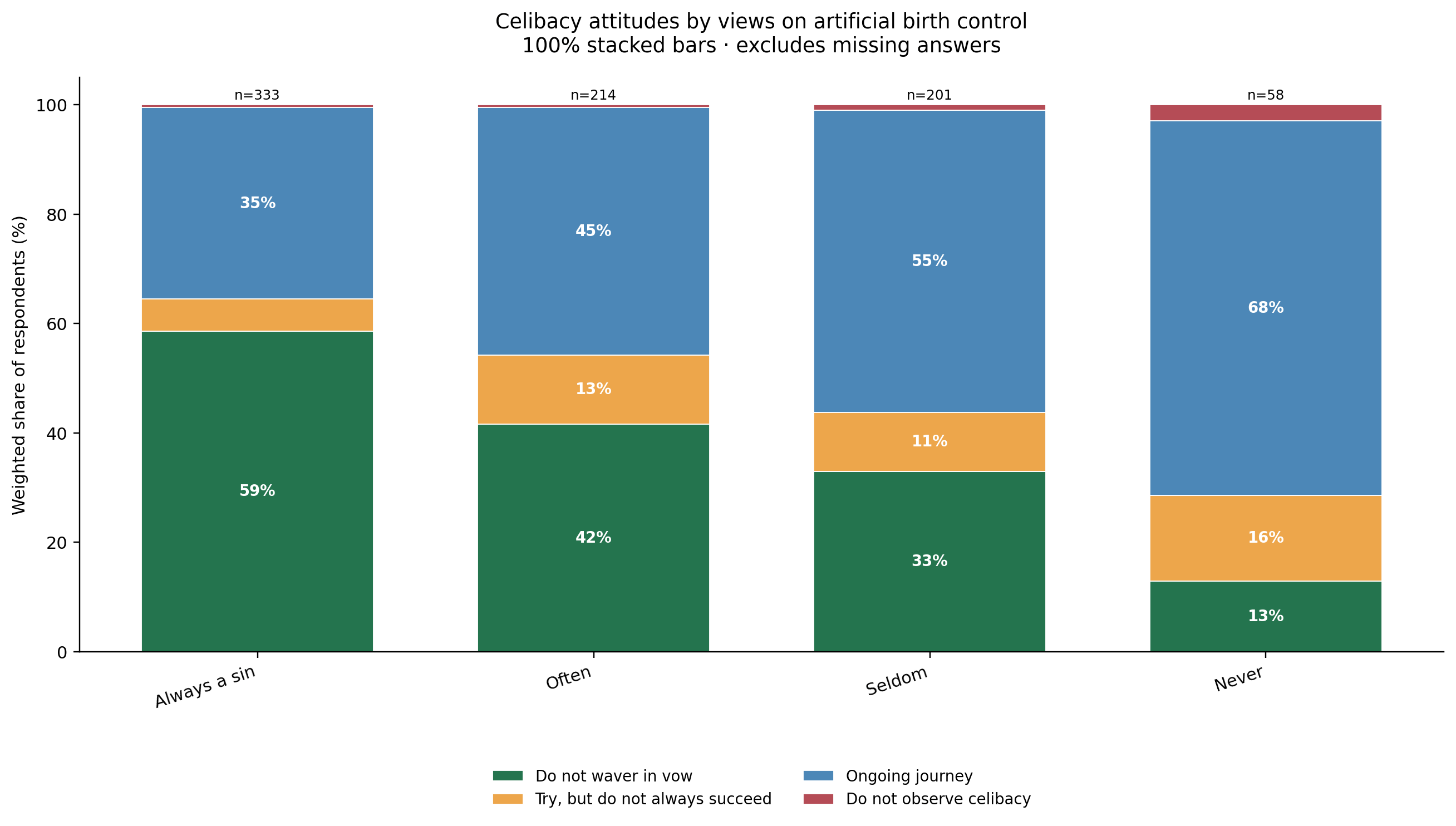
So, the more doctrinally sound you are, the more likely you are to be solidly celibate.
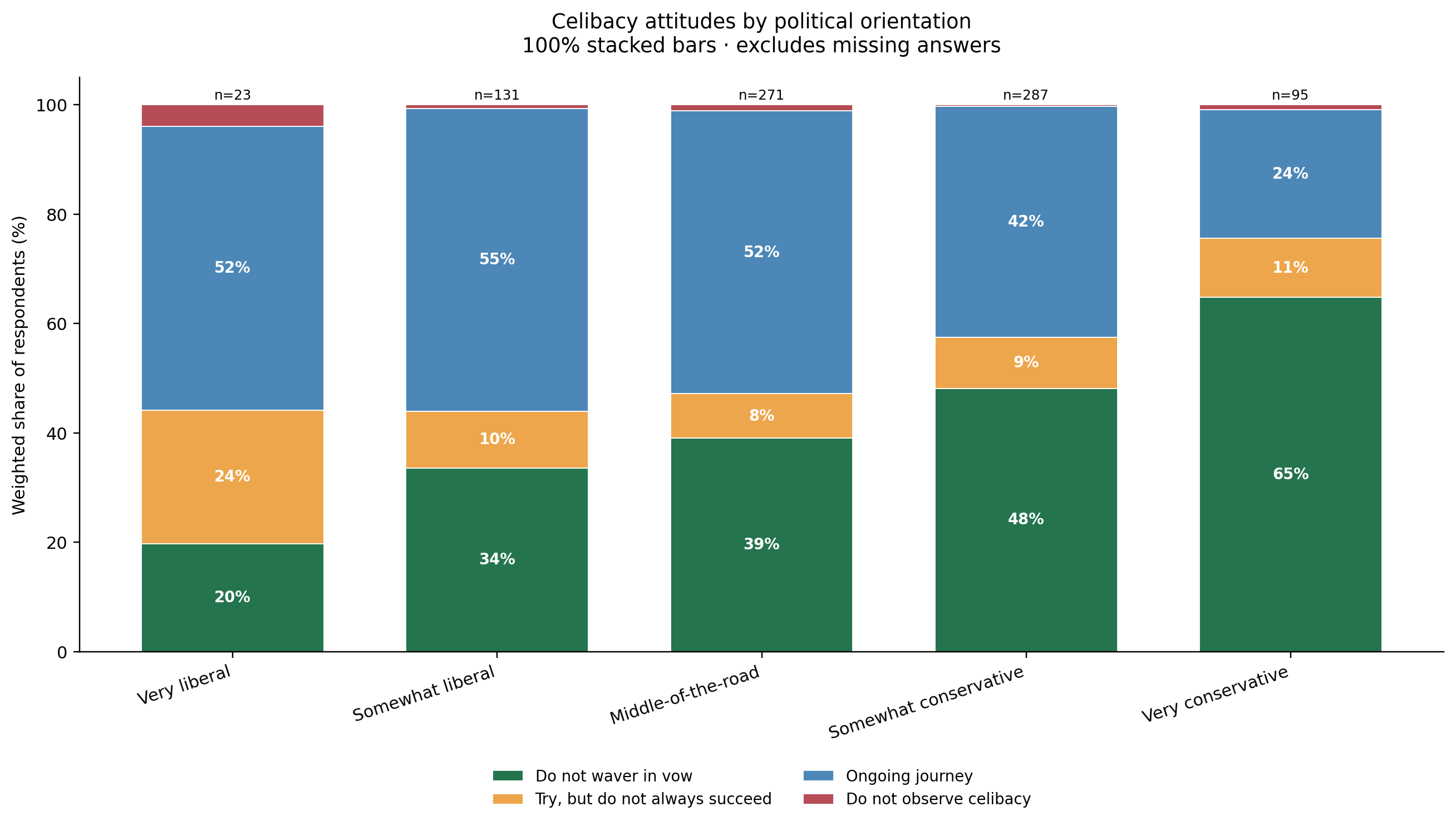
Likewise, the more politically conservative a priest is (a condition highly comorbid with liturgical and doctrinal conservatism), the less likely you are to be having sex:
And, on that note, straight priests really do behave differently from gay ones:
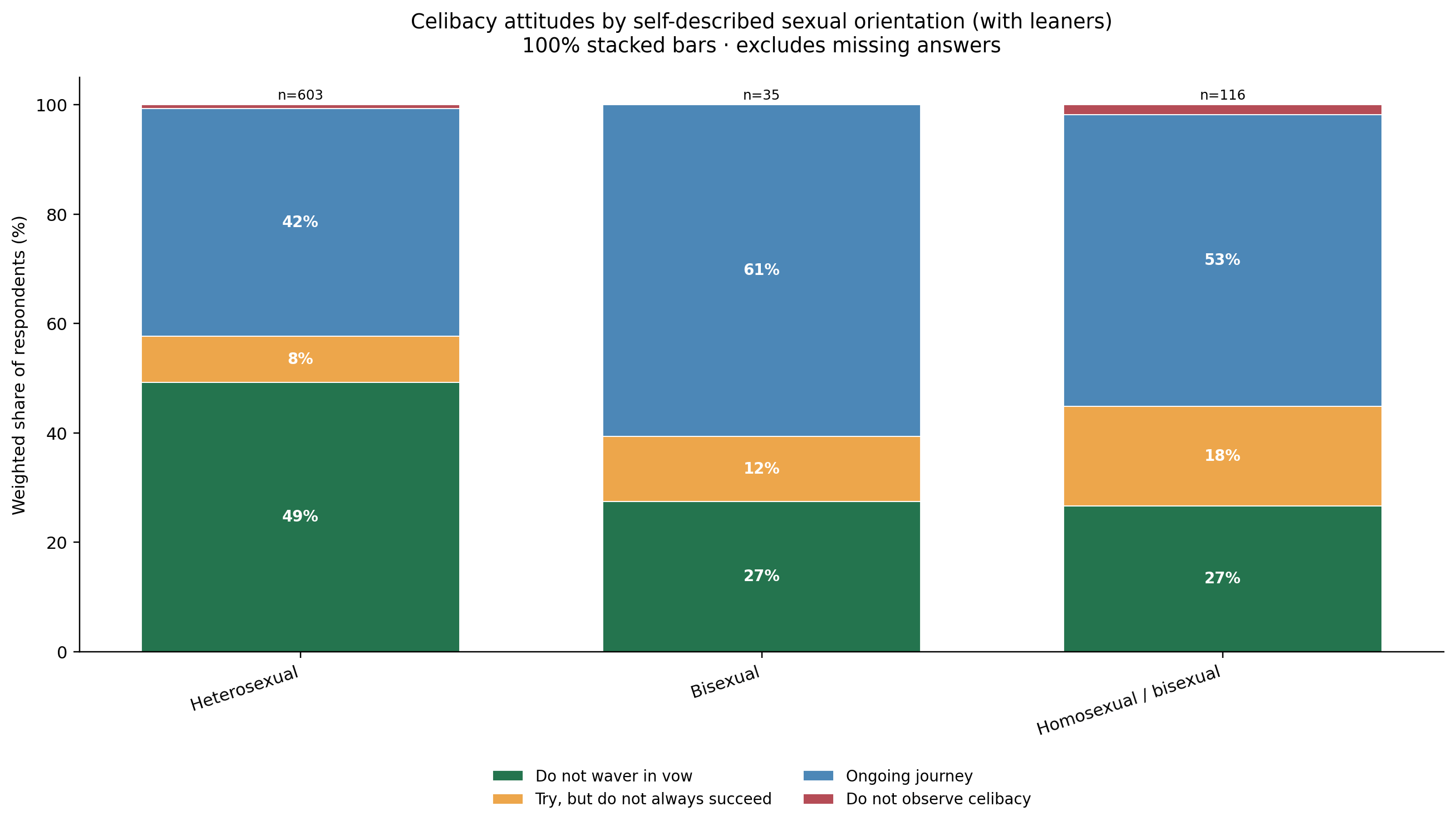
However, even among conservative, orthodox, straight priests, there’s still a ton of hanky-panky implied here! Think about your five favorite orthodox priests. Statistically, one or two of them is in a sexual relationship. Do you ever wonder which one?
Don’t judge ‘em. That’s not my purpose, and I’m in no position to cast stones. There’s plenty of sexual sins on my soul, too. I am merely describing a structure. This isn’t something out in the world. It’s hidden, it’s everywhere, and it’s close to home. It’s best to realize this before your former associate pastor is arrested. Fortunately, most clerical sexual activity is consensual, heterosexual, and non-criminal. It’s just non-marital.
Once again, and as usual, the data’s on my GitHub if you want to play around with it.
Weirdos can be good. Lots of saints were weirdos. Some of the weirdest priests I know are, as far as I can tell, some of the best and holiest of men. However, weirdos can also be bad. An organization that is built around weirdos will usually find itself relatively deficient in common sense and thumos, which both seem to have been factors in the crisis.
If you are one of my priest friends: yes, when I said “good weirdos,” there’s a good chance I was thinking of you. I’m sorry you had to find out this way, Fr. Jefahl. :P
There has never been perfect universal compliance with any papal directive in the past two thousand years.
Traditionalists sometimes like to think that the clerical sex crisis is the result of modernist heresy and the Second Vatican Council, but that doesn’t seem to be the case. The infamous Boston abuse scandal was mostly about priests ordained before the Council, sometimes long before the Council. Abusive priests and surrounding coverups were hardly a rarity in the years leading up to the Council, and references to various scandals and patterns of sexual bad behavior by priests can be found in Church documents scattered throughout the past millennium. It seems most probable, then, that the modern world didn’t create the abuse crisis. Rather, it seems to have only exposed it. It’s been going on for centuries. We’re just the first ones to know about it.
People often confuse celibacy, continence, and chastity, but they are three distinct conditions:
A continent person is refraining from sex. This may be for any reason and for any length of time. Voluntary permanent continence is the “eunuch for the sake of the kingdom” ideal. There are other forms of continence, many of which can be connected to traditions of fasting and penance. However, historically, “continence,” without a modifier, typically refers to sexual continence (not urinary continence).
A celibate person has never married. Once you have married, you can be continent at different seasons of your life, but you will never be celibate again.
This is true even if you never have sex during your marriage. Mary the mother of Christ died a virgin, but she was not celibate, because she had married St. Joseph.
It is also, of course, very possible to be celibate but incontinent. The frat boy who’s sleeping with every cheerleader on the squad is celibate, because he hasn’t married any of them. He may very well be going to Hell, because that’s a lot of sins, but celibacy isn’t about sins. It’s literally about marital status.
(Widows and widowers are sometimes referred to as celibate, even though they were married, because they aren’t currently married. This is a legitimate usage, but should be clarified in context.)
Finally, a chaste person is living out his sexuality according to right reason according to his station in life. An unmarried person lives chastely by living in continence. A married person lives chastely by having sex with his spouse when she asks for it.
Modern parlance has hopelessly confused these three terms. I guess that’s fine, since words are allowed to evolve, but I don’t think these words have evolved in a useful direction. Continence now refers exclusively to refraining from urination, which is just too narrow a use (in my opinion) for a very flexible word, and celibacy and chastity are now both used as synonyms for… sexual continence! We don’t need two different words doing that work, especially not when “continence” was doing such a fine job of it already.
P.S. By this traditional rubric, incels (“involuntary celibates”) are, for the most part, incorrectly naming themselves. They don’t want to get married; they want to have sex. They are involuntarily refraining from having sex. So they should really be called incons.
One of the surer signs that Martin Luther’s theology was wrong was his unbalanced thinking about sex. He condemned continence, arguing in 1522: “If it doesn’t go into a woman, it goes into your shirt.”
This tells us an awful lot about Martin Luther—not a man blessed with the gift of sexual continence, he!—but it is far from the experience of many profoundly happy virginal (or at least continent) men and women, including a great many excellent priests. Nor is it possible to reconcile this view with Scripture or apostolic and patristic practice. Any Christian tradition that does not see celibacy as a special, sanctified gift from God is a tradition that has lost its moorings in the Christ, and Luther lost his moorings fast.
This is not an accusation, just an observation. Shrewd as serpents, right?
This sort of implies that young men are supposed to discern a calling to virginity before they start thinking about whether they might be called to the priesthood, but, with men entering college seminary at 18, that’s obviously not how it works in modern practice. Young men start by believing they might be called to the priesthood, then start discerning virginity as a facet of their priestly discernment. It seems to me that this gets the laudable parts of the Gregorian reforms entirely backwards, but also that it is absolutely inevitable given the structure and age range of the insular seminary.
Seminaries themselves are a much newer innovation than clerical celibacy, arising mainly after the Council of Trent, and I think it is past time for a serious evaluation of whether they are fit for purpose. I probably won’t cover that in this series, because I don’t have a lot of good ideas for what to do about it, but my papal administration would certainly have a blue-ribbon commission on whether seminaries should continue to exist, and, if not, what could replace them.
This rule does not necessarily bind clerics in one of the Eastern Catholic Churches, the 23 smaller churches that arise from the Eastern tradition but are in full communion with Rome. The Code of Canons of the Eastern Churches, promulgated by Rome and binding all such churches, prescribes at Canon 374 that married clerics are to “excel in the virtue of chastity,” and leaves it to the “particular law” of each church to “establish suitable means for pursuing that end.”
I obviously did not check all 23 churches’ canon laws, but I checked out the relatively large Ukrainian Greek Catholic Church. Their Canon 55 requires only that married clerics “follow the teachings of the holy fathers… apply the advice of their spiritual directors,” and take courses. Fasting is required from food and drink only (Canon 89), and only for an hour before serving Mass. (This fast is very slightly longer than the pathetic fast that binds lay Catholics in the Western Church.) Perhaps their spiritual directors impose some degree of pre-liturgy sexual abstinence.
However, whatever their rule is, it certainly can’t be the full rule of temporary continence observed in the ancient East. In the West, priests typically say Mass every day. If you have to be continent for a day before saying Mass, and say Mass every day, it follows that you must embrace perpetual continence! This is one of those weird things that always comes up when the Western Church talks about ending priestly celibacy and sexual continence.
This, incidentally, is why my entire If They’d Made Me Pope series is a lie. If they’d actually made me pope, I would be made a bishop, and therefore no longer be allowed to sleep with my wife. Since my vow of perpetual continence would deprive my wife of something she has a right to by marriage—namely, my body—the Church has, for well over a thousand years, recognized her right to veto my ordination.
Obviously, you never know until you’re in the situation, and what a weird situation it would be, but I suspect that my wife would exercise that veto. (Not because of insatiable carnal desire, mind you—at least, not mainly!—but because me being the pope would be terrifying and unmanageable.) I also suspect that her veto would be good for my soul in the long run. Of all the many virtues I struggle to live out, chaste continence is, for me, perhaps the struggliest.
(I’m also a sucker for power, and the pope’s near-absolute power would—well, you know the saying.)
…wellllll… I mean…
Yes, Western priests are typically virgins in the colloquial sense: they have never had sexual relations or intercourse with another person.
However, according to Aquinas, anyone who has ever deliberately sought out the “venereal pleasure” that “results from the resolution of semen,” has “destroyed” his virginity, “whether copulation takes place or not.” (II-II.152.1 ad 4). (Nocturnal emission or being the victim of rape, on the other hand, do not destroy virginity, since these are involuntary.)
Western priests are Western men. Among Western men, masturbation is endemic, especially in adolescence. Without having done a survey of my own, it seems safe to say that the number of Catholic priests who are virgins in the strict sense is very small. Those who have pulled it off are all the more praiseworthy for having done so in such a difficult climate.
To be sure, my diocese pays priests a base salary of $43,000, plus full benefits (which I understand are very solid). Plus, many priests live in parish housing and don’t have to pay for utilities, etc., so that $43,000 is largely discretionary income. For a single man, this is actually quite a magnificent sum. (I understand my diocese pays fairly well, but I could be mistaken.)
However, if we started having married priests with children, priest housing would quickly be overwhelmed, and $43,000/year isn’t going to cover basic expenses once Catholic school tuition gets started! Ministers in other denominations typically get paid at least $60k and often closer to (or beyond) $100k, because they have families to support, and a married Catholic priesthood would inevitably need to see wages rise.
In fairness, this one can cut both ways. There’s a whole subplot in Barchester Towers (the 19th-century novel by Anthony Trollope) about Father Quiverfull, an Anglican priest with fourteen children. He’s desperate for income, because he needs to put bread in the mouths of his many, many kids. That makes him willing to bend whichever way he needs to if it gets him into a wealthier benefice. The new bishop’s cronies recognize his pliancy and decide to use it to their advantage.
Christopher Altieri noted in 2019 that it is weird and confusing that our priests are as docile and servile as they are, since their rebellion wouldn’t take bread out of the mouths of their children (since our priests have no children). Why aren’t they more courageous? Hopefully I have shed some light on the reasons for this in other parts of this article.
Moreover, in these latter days, the Father Quiverfull maneuver wouldn’t work. Married priests have wives! Many/most of those wives will have careers of their own. (On a priest’s salary, they’ll need it!) This would give married priests some financial footing outside the will of the bishop, giving them a degree of independence impossible for the celibate priest.
…and also to keep children from inheriting Church properties, but I trust we all agree that this very practical concern is not sufficient justification for such a difficult spiritual restriction.
I know this is unrelated to the article in question, but I'd like to hear your final midterm predictions. Mine are that Dems win 237 House seats and 52 Senate.