

The number of people who called me a “bootlicker” this week for stating obvious facts like, “Police can, do, and should stop people from violating police cordons, by force if necessary” means that we are, unfortunately, due for another of De Civitate’s regrettable series of “Not-That-Bads.” We will start with general principles, because there is great confusion about even the most basic facts of immigration law. We will then consider a couple specific Twin Cities cases.
Q: Is ICE abducting people?
No. Immigration and Customs Enforcement is a federal law enforcement agency. It was established in 2003, but its predecessors date back to the Immigration Act of 1891. Every Congress has voted to fund ICE, every year, since its creation.
As a law enforcement agency, ICE has the authority to detain and arrest people for legitimate law enforcement purposes, if consistent with the Fourth Amendment.
Q: Whom can ICE try to remove from the United States?
If ICE has probable cause showing that a person is not legally present in the United States, it may initiate removal proceedings against that individual.1
Q: That’s it?
That’s it. It does not matter if someone illegally present in the United States never committed a single crime (even speeding) or if he murdered a hooker. It does not matter if he has been overstaying his visa and paying taxes peacefully for 27 years or snuck over the border last week. It does not matter if he is a family man or an identity thief (or both). It does not matter if he was brought here at age 4 and has faithfully attended every check-in, or if he was applying for a green card and on the verge of getting one.
ICE generally makes the worst people its highest priority, but that doesn’t mean it ignores everyone else. Indeed, generally speaking, when ICE chases down a convicted rapist illegally in the United States, it finds a number of other people in the process—often people whose only crime is entering the country illegally.
Q: Wait, is entering the country illegally a crime? I thought it was just a civil offense, like a traffic ticket.
Illegal entry into the United States is a federal offense under 8 USC 1325, carrying a maximum prison sentence of up to six months on the first offense (higher on subsequent offenses). That makes it a Class B misdemeanor (18 USC 3559), which means it is alternatively punishable by a fine of up to $5,000 plus an additional civil penalty of up to $250. That’s quite a bit more than my worst traffic ticket.
ICE frequently declines to prosecute suspects under this statute, because it is a criminal charge that requires a jury trial, proof beyond a reasonable doubt, and all the bells and whistles. It’s much easier (and cheaper) to just send them home. Basically, ICE is willing to pretend a foreigner ended up in America by some elaborate and hilarious mistake (“Whoopsie! Musta takin’ a wrong turn at Albuquerque!”), because ICE thinks it’s better to just send people home instead of punishing them plus sending them home.
That last part seems to be where people get the idea that it’s all just a civil offense. ICE frequently shuts its eyes to the criminal offense because it’s too much of a bother. Illegal entry is a civil offense only as an act of mercy.
Even then, the U.S. prosecutes this crime tens of thousands of times every year.
(That said, worth noting: overstaying a visa is not a crime. However, ICE can still remove anyone who overstays a visa from the country.)
Q: How can ICE be so heartless?
ICE didn’t get a vote. We did.
What I just described are the immigration laws of the United States. Our Congressmen wrote and passed them. We, the People voted for those Congressmen. ICE merely carries out our will under the Constitution. That’s what it means to have a rule of law in a democratic republic.
Many Congressmen have made many attempts to change these laws in order to create exceptions in sympathetic cases. President George W. Bush tried this.2 Sen. Marco Rubio tried it. President Barack Obama tried it repeatedly, and became so frustrated with Congress's refusal that he created an illegal program to override federal immigration law, a desecration of democracy that led directly to President Trump's alarming ability to also urinate over whatever Congress tells him to do.
Every time a party tries to liberalize American immigration law, it is punished severely at the ballot box. Bush’s legacy was Obama. Obama’s legacy was Trump. Even within the Democratic Party, Joe Biden defeated many immigration reformists in the 2020 primary, in part, by trying to be basically normal on immigration… then lost the 2024 election pretty specifically by not being normal on immigration. The American people have consistently and repeatedly expressed their strong view that people have to come into our country “the right way” in order to be allowed to stay in it.3
If you don't like that, I understand! I am the great-great-grandson of an immigrant, the superb Kate Durkin. She was considered very undesirable (because Irish), but she was admitted anyway because, in the 19th century, the United States had open borders. Anyone who wanted to come here could come here! I am here because of that generous policy!4
However, if you don't like these laws, your beef is not with ICE, but with clear and durable bipartisan majorities of the American people. I am not writing this article because I think U.S. immigration law strikes the correct balance between protection and generosity. I may write about that separately, but I am writing this, today, because I’m seeing so many nuclear-overheated takes treating ICE as some kind of lawless rogue secret police re-invented by the second Trump Administration to commit mass racisms, including from people who ought to know better.
Perhaps, now that immigration law is finally being enforced, it will become less popular, and this will all change at the next election. Until then, however, ICE is carrying out the Constitutional mandate. The White House must “take care that all the laws be faithfully executed.”
The scandal is not that this White House is following that oath at last; the scandal is that so many previous White Houses aggressively undermined it; the scandal is also that this White House so frequently undermines the rule of law in other contexts. We should damn the White House for that hypocrisy, but not for finally deigning to enforce the law. You cannot object to the Trump Administration on rule-of-law grounds5 and broadly oppose ICE enforcing the rule of law.
What ICE is doing right now is what every American president swears to do, in a solemn oath made before the entire country and before God.
There are many people who do not acknowledge this. (Many of them are on Reddit and mad at me.) This faction insists on characterizing ICE arrests as “kidnappings” and hype every justified use of force as a crime against humanity. These people reliably have no interest in the due process violations they allege. They think the immigration law the American people have created is fundamentally unjust and want it cancelled immediately, but they know that position is very unpopular, so they grasp whatever thin reed they can find and start hammering ICE with it. When you show all the holes in their evidence, they don’t acknowledge it, they don’t update their opinions, they just move on to a new argument. When they run out of arguments, they call you names and say, “Imagine thinking [very normal thing] is normal.”6
I mention these people because they are very, very loud right now, a lot of people are listening to them, and you should not listen to them, because they are actively trying to deceive you.
Q: Wow. Oof. Alright. What happens once someone is in removal proceedings?
In a removal proceeding, the individual is brought, “without unnecessary delay,” before a federal official called an “immigration judge” (not a real judge) whose job is to hear ICE’s evidence, the suspect’s defense, and issue a ruling. ICE can arrest and initiate removal proceedings with relatively little evidence (probable cause), but, by this hearing stage, ICE must show proof (clear and convincing evidence) that the individual is not legally present in the United States.
If this federal official agrees with ICE, he issues an order of removal. The suspect may appeal this decision until it gets to a real judge, and can potentially go all the way to the Supreme Court. Once appeals are exhausted, the order becomes final and ICE may return the individual to his nation of citizenship, or to another nation that agrees to take him.
Q: Are people in removal proceedings allowed to live normal lives while they await a verdict?
ICE has the option to detain someone in removal proceedings, or to release them on bond or parole to lead normal lives. In most cases, this is purely at the White House’s discretion (8 USC 1226), and Congress explicitly gave ICE the power to revoke bond or parole, at any time, for any reason.7
For much of ICE’s history, it has been pretty generous about granting bond. In the absence of aggravating circumstances, ICE has ordinarily granted bond to anyone who isn’t a flight risk or a danger to the community. However, several things changed in recent decades, which rendered that system non-functional:
FIRST: the number of people unlawfully present in the United States exploded, overwhelming the system. According to Brianna Nofil’s very anti-enforcement book, The Migrant’s Jail, immigration detention rose by a factor of ten between the Immigration & Naturalization Act’s passage in 1952 and the early 2020s. (It doubled again in 2025 alone.) Over the same seven decades, the U.S. population only doubled once. Removal proceedings that once might have taken weeks can now take years to move from initial arrest to actual deportation.8
It’s one thing for someone unlawfully present to “build a life here” for a few months. It’s quite another for him to spend a decade, marrying, having children, and the like. When his final order of removal inevitably arrives, it’s going to do a great deal more damage to a whole lot more people.
SECOND: our limited capacity for processing immigration cases depends on many people caught unlawfully in the United States not fighting it. Instead, they can voluntarily get on a plane and go home. After all, that’s the honorable thing to do. You get caught breaking the law, you ought to admit you broke the law, stop breaking the law, and be grateful you aren’t being prosecuted as a criminal.
However, the possibility of being able to stay in the United States indefinitely seems to have created a different calculus, at least for many people. A large share of people illegally present, who know they are illegally present, now decide to fight their cases in court. This is expensive, but it keeps them in the U.S.A. for years at a time. This makes the already-long backlog even longer, creating even stronger incentives to fight cases and delay removal—a vicious cycle.
THIRD: The U.S. has generous asylum laws (which is good!) that promise individualized review to each person applying for asylum here. This is a slow, expensive process. It was designed to help relatively small numbers of people escape political and religious persecution, like the Jews fleeing Hitler (whom we turned away at the border under our old laws). Today, however, advocates for those accused of unlawful presence have learned that making an asylum claim, even a very weak one, can extend the process for years. Meanwhile, the claimant would get released into the U.S. mainland to start a life here in the Land of the Free until his distant court date. Asylum requests were under 100,000/year during the early 2000s. They surged to about 350,000/year in 2016, then skyrocketed when President Biden was elected and instituted more generous asylum rules. In 2023, there were well over a million new applicants for asylum (across some 800,000 separate claims). The system was not capable of handling this flood of claims, so everything slowed down more… and anyone who could get into the country now could stay even longer, even if they knew they had no right to be here, even if they got caught.
FOURTH: Someone caught by ICE who then voluntarily agrees to leave the country (without forcing ICE to go through the full legal process) is usually barred from re-entering the country for ten years. This creates a strong perverse incentive: if someone is caught and fights their case, they can continue to live in the U.S. and pursue alternative means of legal immigration in the meantime. If they agree to leave, they not only lose whatever life they’ve built here; they are also cut off from any hope of restoring it for at least a decade! Our legal immigration system is extremely slow, so sending these people to the back of the line may keep them out of the U.S. until they are elderly. You might say, fair enough, they broke the law—but, obviously, that risk pressures a lot of people into fighting their cases who might otherwise have given in and gone home voluntarily.
Much of what is crushing the immigration system, then, stems from the strong incentives we created for people not legally present to stay here and continue living their lives while fighting their (often hopeless) cases in immigration court for years and years. One of the striking things about the Kilmar Abrego Garcia case was its protracted timeline: he entered the country illegally in 2012, he received a final order of deportation in 2019,9 and then… nothing happened until 2025! He just kept living his life! This seems to happen a lot in our immigration system.
When you know you’re legally in the wrong, fighting it is an abuse of the system, but you can understand why people do it anyway.
In this context, ICE has made the obvious move: it has changed its policies to make abusing the system less attractive.
This began under the late Biden Administration, when President Biden curtailed asylum claims and made it harder for asylum seekers to enter the U.S. while their cases were pending. It continued under Mr. Trump. ICE is now largely putting people in immigration detention to await their hearing dates instead of allowing them out on bail. It is routinely revoking existing bail and parole. This preserves the due process rights of every single person accused of illegal presence in the U.S., while making it much less tempting to abuse that system. Abuse no longer gets you years of freedom in the U.S. mainland; it only gets you a cell in a detention facility while you await your court date.
I think pretty much everyone will agree this is unfortunate. There are a lot of sympathetic immigrants, even those with no legitimate legal claim, and it is kind to be generous with them. If this new approach works, and people without a legal right to be here stop flooding the system with doomed cases, we can hope that ICE will, in the future, find itself in a position where it can return to its prior approach.
…Or the American people will sour on detention altogether, elect new leaders with new policies, and end most immigration detention. However, the consequences of that choice are obvious. Indeed, we already saw the consequences during the Biden Administration! The American people probably have to decide whether they prefer immigration detention or very large waves of illegal immigration. While alternatives are available,10 few are politically plausible.
Q: But I know people who are stuck in immigration detention even though they had legal status?
In every single case I have encountered where someone made this claim, the detained person did not actually have “legal status” (i.e. the right to be in the country).11 They were instead enrolled in a bail or parole program, such as Alternatives to Detention (AtD) or Deferred Action for Childhood Arrivals (DACA), which was either revoked or which provided no shield against immigration detention and removal in the first place. In some cases, they even had a final order of removal already, but the Biden Administration had placed them in AtD anyway, because President Biden simply didn’t want to remove them, even though the law demanded it.
Maybe the person you know is an exception! Maybe your neighbor really had some legal shield against ICE’s discretionary detention power and ICE ignored it! I don’t know. I don’t know you or your neighbor or the facts of his case. All I can say is that I haven’t seen that yet.
Q: Can ICE arrest anyone else?
Congress has granted ICE broad authority to arrest people, including citizens, if ICE has probable cause to believe they have committed other crimes, especially crimes committed in the presence of ICE officers. (8 USC 1357(5))
This is not an unusual power. Many law enforcement agencies can arrest someone, even without a warrant, especially when that person commits a crime in their presence. Of course, they still have to make a probable-cause showing to a judge within a couple of days, at most. This creates a ton of drama in police procedurals: “I know you think he’ll kill again, Higgins, but if you can’t convince a judge he’s the murderer in the next sixteen hours, the chief says we have to cut him loose!”
When ICE arrests a person for a non-immigration crime, those rules apply. They must have probable cause at the arrest. They must show that cause to a judge to continue holding that person for more than a very short while. They must find another law enforcement agency willing to deal with it and turn the person over to them, because ICE is only equipped to prosecute immigration violations. The accused must be convicted by a jury of her peers with proof beyond a reasonable doubt in order to be punished.
Federal law declares, “Whoever forcibly assaults, resists, opposes, impedes, intimidates, or interferes with” any federal agent in the performance of his duties has committed a crime, with a prison sentence of up to a year. This means ICE agents can arrest someone they believe, on probable cause, is impeding or intimidating their officers on the job.
On the other hand, if ICE can’t find another agency willing to take on the case, or if the evidence isn’t clear-cut and proved beyond a reasonable doubt, or if they just have too much else going on that day… ICE will often find itself in the position of releasing people they just arrested, even when it is fairly clear that those people committed federal crimes. ProPublica collects 130 such cases, but, in typically dishonest ProPublica fashion, breathlessly reports the fact as a scandal proving some sort of malfeasance by ICE, rather than a lot of mostly-guilty people getting off the hook because evidence was inadequate.
Q: Aren’t people in ICE custody routinely “disappeared”?
No. Like most (not all) law enforcement agencies in the modern era, ICE has a detainee registry and an online portal where you can search for them. They have a website listing their locations and describing visiting hours, lawyer hours, and ways to send gifts to detainees.
Also, of course, unlike most prisoners, people detained for immigration violations usually have the option to leave, in fairly short order, by accepting voluntary departure to their home country.
Like any real-world detainee tracking system, ICE’s detention records have hiccups and oversights. For example, Florida’s “Alligator Alcatraz” was a state system, not integrated with the federal system, and so detainee tracking there was, by all accounts, horrendous. However, as in any real-world detainee tracking system, these problems appear to be the exception, not the rule.12
Moreover, I suspect conditions in immigration detention are little better than conditions in U.S. prisons. It has been related to me by people I trust that the condition of U.S. prisons is miserable and unfair. This is a legitimate concern, to say the least.
However, to be “disappeared” is to be pulled into a gulag archipelago and/or summarily executed with no opportunity to make your case to a judge or jury, no access to legal representation, and no real contact with the outside world, with friends and families deliberately kept in the dark about your whereabouts for an extended period of time. (You certainly can’t just leave!) ICE arrests do not remotely resemble that.
(However, see below for a discussion of the White House’s invocation of the Alien Enemies Act, which did resemble that.)
Q: But sometimes ICE takes people in unmarked vans wearing unmarked uniforms!
For what it’s worth, I don’t think this is a good policy. Eventually, someone getting arrested for an immigration violation is going to legitimately believe she is being abducted by a cartel, she is going to be armed, she is going to pull out a gun, and people are going to end up dead. If this happens (and, if the unmarked-everything policy continues, I’m confident it will), those deaths will be entirely ICE’s fault, not the person they were trying to arrest.
However, this is not a “disappearance.” People arrested in this way show up on the detention tracker in 48 hours like always. There’s rarely any genuine ambiguity about who is doing the arresting or why. Plainclothes detectives have been doing this for years.
On top of that, it seems to be pretty rare. Every ICE interaction I’ve seen in the Twin Cities involved officers with ICE/ERO/Police clearly labeled on their obvious police vests, back and front. Perhaps ICE reached the same conclusion I did, and stopped doing the stupid “unmarked” thing?
Q: Is ICE grabbing people off the street just because they look Black or Hispanic?
It certainly doesn’t look like it.
In July 2025,13 during street arrests and similar activities, ICE arrested some 4,494 persons who had no criminal record and no final order of deportation. If ICE were just arresting people who looked different, this is the statistic that would show it. The vast majority of Black people (96%) and Hispanic people (79%) in this country are citizens, so, if a government dragnet arrests a bunch of Hispanic people just for their skin color, we would expect about four out of five of them to turn out to be U.S. citizens. The ratio would be even higher in this dataset, because we’re already excluding people with final orders of deportation.
Of the 4,494 immigration suspects arrested in July, 209 have been released (<5%). 30 won their cases and received some form of formal relief. The others were released without much detail, but it seems safe to assume that ICE realized that they were likely to win relief in some form and pre-emptively granted it themselves. Zero—I repeat, zero—of those arrested were U.S. citizens.
I don’t doubt that there are racists in ICE ranks. There are racists everywhere, and it doesn’t take a genius to see why racists might disproportionately flock to join the ranks of Immigration and Customs Enforcement. Nevertheless, ICE policy appears to be constraining them, at least as far as arrests go.14
ICE’s policy, which it recently defended in the Supreme Court (more on that below), is that no one can be lawfully taken into custody, or even questioned, on the basis of skin color. Skin color (or ethnicity) is never a sufficient basis for probable cause, or even reasonable suspicion.
Q: But I read a Cato Institute study that said 1 in 5 ICE arrests are random completely innocent Latinos on the street!
That is certainly how that study’s findings have been communicated, and I am quite confident that the Cato Institute intended their findings to be miscommunicated in precisely that way. They knew what they were doing.
However, you now know enough about federal immigration law to see the sleight of hand in their headline. What they actually wrote was, “One in Five ICE Arrests Are Latinos on the Streets with No Criminal Past or Removal Order.” See it?
That’s right: many people with no criminal convictions or a final order of removal still lack a legal right to be in this country, and the law therefore instructs ICE to apprehend them and remove them from this country. They are not citizens. They are not even innocent. Aside from those brought here as children, they chose to enter this country unlawfully. As we saw above, ICE is finding them pretty reliably, with few false positives.15
Q: Whom can ICE question?
As federal law enforcement officials, ICE agents have the power to detain individuals briefly for questioning if they have reasonable suspicion that that person has violated U.S. immigration law, or is involved with a violation of U.S. immigration law by another person. These brief detainments typically last just a few minutes, but may last a little longer. During questioning, ICE may not conduct a search without consent (unless the answers give them probable cause). This is similar to a police officer’s authority to pull you over and ask you questions and frisk you if you are driving a vehicle in an area where an armed criminal recently fled in a car of similar color. This is not a violation of your constitutional rights, even if the officer is completely mistaken about the color.
These short detentions are sometimes referred to as “Terry stops,” named for a 1964 Supreme Court case that established their legality. In that case, an Ohio police officer saw three men walking back and forth in strange patterns in front of a store. He thought they were casing the joint, so he stopped them, frisked them, found several illegal weapons, and arrested them.
To dispel all doubt about ICE’s authority in these matters, Congress has explicitly granted ICE the authority to “interrogate any alien or person believed to be an alien as to his right to be or to remain in the United States.” This belief must be grounded in some reasonable, articulable facts (more than a hunch), but almost necessarily falls far short of proof, or even hard evidence.
However, “the dude looked Hispanic” is not enough to justify questioning someone. Race alone is never sufficient to meet even the low bar of reasonable suspicion.
Q: Hang on, didn’t the Supreme Court just say ICE could question people based on skin color?
Again: that’s how the case Noem v. Vasquez Perdomo was reported, because our media’s strategy for reporting Supreme Court cases is (and always has been) to read only the lead opinion by a progressive justice and then report everything in that opinion it as absolute fact. However, that’s not what the case held. Some legal history:
In the 1975 case United States v. Brignoni-Ponce, a Border Patrol agent in Southern California pulled over a car for suspected illegal immigration and searched the vehicle. Both passengers had indeed entered the country illegally (and were arrested), and the driver was arrested for knowingly transporting such persons. However, there was a problem: the agents had pulled the car over in the first place solely because the people in it looked Mexican. The Border Patrol admitted this. It was pure racial profiling.
The Supreme Court ruled 9-0 that this was an unreasonable search which violated the Fourth Amendment, because pulling someone over requires at least a “reasonable suspicion” grounded in “articulable facts.” The unanimous court explained that race can only legitimately be one factor in establishing reasonable suspicion. For example, if a car filled with people who appear to be from Mexico, of a make and model typically used to transport people over the border, is spotted late at night, near the border, that is enough to establish reasonable suspicion. However, race cannot ever, by itself, establish reasonable suspicion. In the words of the majority (which was 8-1, Douglas dissenting, on this point):
The likelihood that any given person of Mexican ancestry is an alien is high enough to make Mexican appearance a relevant factor, but standing alone it does not justify stopping all Mexican-Americans to ask if they are aliens.
This year, in the Noem case, ICE was questioning people (not arresting them) based on a combination of the following four factors:
the types of job they worked (people unlawfully present disproportionately work in certain kinds of jobs)
presence at particular locations (people unlawfully present are disproportionately found at certain places, like car washes and construction sites)
language and accent (people unlawfully present disproportionately speak languages other than English, or speak English with a heavy accent)
apparent race or ethnicity.
ICE policy was and is that some of these things in combination can form the basis for reasonable suspicion to make a Terry stop and ask a few questions. (In particular, race by itself could never justify questioning.) This policy appears to fit squarely within the four corners of Brignoni-Ponce, a fifty-year old precedent. An L.A. district judge, however, ruled16 that it did not. She ruled that ICE could not use any of the four factors, by themselves or in combination, to establish reasonable suspicion.17 Frimpong’s order didn’t just defy Brignoni by telling ICE they couldn’t consider race at all; it went further than that, and forbade ICE from even considering other, more important factors, like employment and location. Her order would have effectively shut down ICE raids.
Is ending ICE raids good policy? Perhaps. Would it be good politics for the GOP? Looks that way.18 Is it what the Fourth Amendment requires? Not according to Brignoni-Ponce, a fifty-year-old precedent. This Court rarely overturns precedents, and regularly goes out of its way to avoid doing so, so it was certainly not going to blow up this one on the emergency docket. Unsurprisingly, then, the Supreme Court majority ruled that ICE could continue using the four factors, while clearly affirming, “To be clear, apparent ethnicity alone cannot furnish reasonable suspicion”.19
Somehow, this nuanced approach to approaching suspicious-seeming individuals for brief questioning (the Supreme Court repeatedly emphasized that it must be “brief”) got transmuted in much of the press and social media into, “The Supreme Court just agreed with Trump grabbing Hispanics off the street and throwing them into a gulag just because of their skin color!” This isn’t true, and the fear it creates certainly doesn’t help Hispanic-Americans.
Q: Why doesn’t ICE show its warrants to concerned citizens or answer their questions about an arrest?
Generally speaking, because it violates the suspect’s right to privacy. The Privacy Act of 1974 prevents ICE from disclosing personally identifiable information to third parties, including the information that appears on an administrative warrant. There are exceptions and discretionary loopholes, but the last thing ICE wants is to lose an arrest because one of its agents inadvertently violated the suspect’s privacy rights in response to a question from a random bystander with no involvement in the matter, so it doesn’t.
Moreover, these questions and demands are usually being raised by protestors whose interest in the answer is insincere (it’s not like they’ll stop protesting even once you prove the arrest is 100% legal), so answering them is unhelpful. Almost the only thing it can do is delay and/or compromise ICE’s ability to perform its mission.
Q: What if ICE breaks these rules?
As the Supreme Court confirmed once again in Noem, anyone whose Fourth Amendment rights are violated by ICE (through wrongful arrest, excessive force, etc.) may sue the government for compensation. The Federal Torts Claims Act is available for this purpose.20
I’m not fool enough to think that every ICE agent has done everything right, and I sincerely hope anyone victimized is able to win the compensation they are owed. No law enforcement agency is ever perfect, which is precisely why we have these liability laws in the first place, both to make victims whole and to discipline any agencies tempted to go rogue.
Q: Doesn’t ICE, unlike all other law enforcement, wear masks, like secret police?
Hm.



![r/policeporn - Lee County, FL Sheriff Carmine Marceno gives a press conference surrounded by his deputies in full SWAT drip [1000x563]](https://substackcdn.com/image/fetch/$s_!o5Tz!,f_auto,q_auto:good,fl_progressive:steep/https%3A%2F%2Fsubstack-post-media.s3.amazonaws.com%2Fpublic%2Fimages%2F32506838-6dd2-4142-b4eb-0dc36a5e6f8e_1000x563.png "r/policeporn - Lee County, FL Sheriff Carmine Marceno gives a press conference surrounded by his deputies in full SWAT drip [1000x563]")
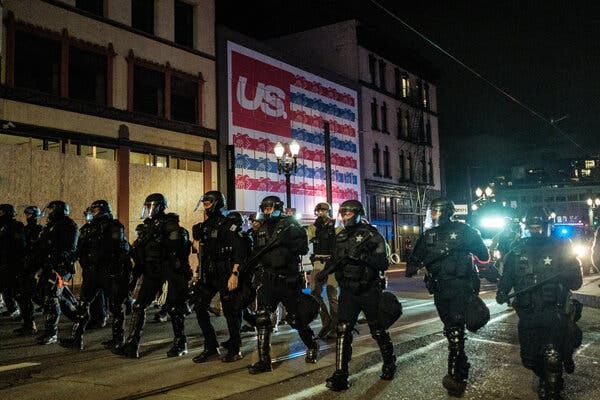
Police forces at all levels routinely wear masks to obscure their identities (or to provide armor). They seem to do this particularly when entering situations where it might be dangerous to themselves or their families to be identified. For example, when agents go up against powerful drug cartels who can plausibly threaten their children, they seem more likely to be masked.
I think it might be a good idea to pass a statute that requires all agents to be unmasked, or at least to wear identification numbers prominently. I agree with the concern that masked law enforcement is less accountable law enforcement.
On the other hand, ICE agents in 2025 are facing organized resistance that reminds one of the “massive resistance” campaign in the South against the Civil Rights movement. There are popular phone apps dedicated to tracking ICE’s movements. There are constant attempts to “doxx” ICE agents, specifically so the Internet mob can target them and their families.
Who would agree to be an ICE agent if you knew it meant protesters would follow your kids home from school chanting that they should be deported (or worse)? Charlie Kirk was murdered just a few months ago! I’m not happy ICE agents are masked, but I certainly understand why, in this climate, ICE considers it necessary to ensure the laws passed by We, the People are not subject to a heckler’s veto (or an assassin’s veto).
Q: You say people get all these protections, but what about when the White House invoked the Alien Enemies Act?
This was genuinely really bad.
For those who missed it, earlier this year, the White House attempted to activate the Alien Enemies Act, alleging that it permitted removal from the country without any due process due to an ongoing “invasion” by alleged gang members who entered illegally. This is not what the Constitution or the AEA means by “invasion.” (Remember that the early United States had open borders, so the Framers had no concept resembling modern “illegal immigration.”)
Many of those removed under the AEA were shipped to El Salvador, where the local dictator, President Bukele, put them in CECOT, a notorious so-called “torture prison,” at our government’s request, again without any due process. The government then claimed that, since they were no longer in the country or under our jurisdiction, there was nothing any judge could do about it, nyah-nyah. One of those thus sent to CECOT was the now-famous Kilmar Abrego Garcia (although he was not removed under the Alien Enemies Act).
I wrote scathingly about both the Abrego Garcia case and the AEA case in April. Information that has subsequently emerged about conditions at CECOT… well, let’s just say it’s not beating the “torture prison” allegations. This was a shameful chapter in American immigration history and a permanent stain on an already soiled Trump Administration.
However, the Administration has climbed down from the AEA in intervening months. The court system swiftly (for courts) put the kibosh on Alien Enemies Act removals. The Administration has accepted this and returned to normal legal removal processes. Abrego Garcia’s case did continue and he is currently free in the U.S., although the Trump Administration continues to pursue what seem like obviously retaliatory criminal charges against him for the crime of showing them up. (Again, this is utterly contemptible, especially since it comes from the Oval Office rather than from on-the-ground ICE agents.) Under political pressure over this lawless episode, the White House arranged a “prisoner exchange” between El Salvador and Venezuela that got hundreds of detainees out of CECOT. Of people removed from the United States, there appear to be only a handful remaining in the El Salvador prison system (just one in CECOT)—all of them native Salvadorans who remain imprisoned, apparently, on Bukele’s orders, not the United States’. (This obviously sucks for them, but they are citizens of El Salvador, subject to El Salvadoran law.)
It is right and just to bitterly criticize the Administration about this affair. It was clear that, as the saying goes, “the cruelty was the point”—not the law. I hope a bunch of the victims find a way to sue the United States and win cash money. It is also understandable and rational that, after such an egregious breach of the law, many people will default to never trusting the Administration or its faithfulness to the law ever again. Fair enough.
However, this whole affair involved a couple hundred cases resolved (in the main) almost six months ago. When ICE arrests your parish sacristan or your soccer coach, he’s not being sent to a foreign torture prison without due process. Donald Trump would love to be a dictator (one of many reasons I’ve never voted for him), but he isn’t.
Q: What about Sue Tincher, the 55-year-old U.S. citizen held for hours just for asking questions?
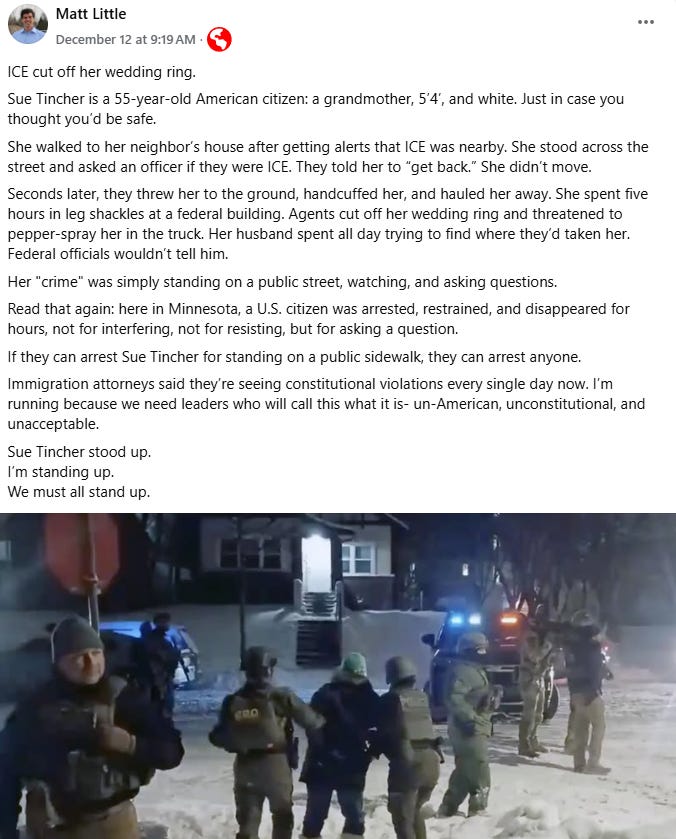
Sue Tincher was not arrested for “asking questions.”
Tincher is a devoted opponent of ICE. She received an early-morning phone alert that ICE was coming for some of her neighbors (who, apparently, are not legally present in the United States). She got outside and confronted the officers as they attempted to conduct this lawful detention. Tincher asked officers whether they were ICE officers. (Their vests were clearly labeled.) Because she was too close to the action, ICE ordered her to back away. Tincher refused, apparently firmly and repeatedly. (I have no idea where Matt Little got the “seconds later” line. It’s in none of the media reports. Given that it’s Matt Little, I suspect he just made it up.)
Tincher, refusing lawful and necessary orders from law enforcement in a deliberate attempt to oppose and impede their operations, was duly arrested—an inherently forceful affair, and never a pleasant experience. She spent the whole walk to the car crying “help! help!,” apparently asking her neighbors to attack the ICE agents and free her by force. Fortunately, it was perfectly obvious that she was being arrested (not abducted), and both ICE and Tincher’s neighbors knew better than to take seriously the cries of a privileged White woman performatively getting herself arrested.
It took much of the day for Tincher’s husband to figure out where, precisely, she was being held. ICE, like many law enforcement systems, has some delay between arresting someone, booking them, and getting their location into the electronic system. A few hours later, she was released without charges.
The Department of Homeland Security claimed, in a statement, “Susan Tincher was arrested after she assaulted a federal agent, tried to break through a security perimeter set up for public safety, ignored lawful commands, and became violent.” I have no particular reason to believe that she became violent, but her violation of a cordon and refusal of lawful commands was sufficient to justify her arrest. As we have seen, ICE is empowered to arrest citizens (on probable cause) for impeding ICE operations. Tincher is fortunate she isn’t being prosecuted.
Q: What about “Mubashir,” the anonymous Somali-American citizen tackled by ICE for no reason and detained while insisting he was a citizen?
Mr. Mubashir was not detained “for no reason at all,” as Minneapolis Mayor Jacob Frey claims in this video. It was not “in clear violation of law and the Constitution of the United States,” as he goes on to claim. It does not show that “American citizens may be in the crosshairs,” as he further claims. These claims are vandalism, and Mayor Frey—not the ICE agents in the tapes—should be ashamed of himself.
Mr. Mubashir saw ICE agents when he left a local restaurant. They were questioning someone nearby whom they suspected was in the country illegally. Upon seeing the ICE agents (who were, once again, in clearly marked gear), Mr. Mubashir turned and ran. (Hence the agent shouting, “Why were you running?” in the first video.)
Under every “reasonable suspicion” standard in the history of the world, “man sees cops and books it” establishes reasonable suspicion. The ICE agents duly decided to question Mr. Mubashir, so they gave chase. They caught him. It appears to be under dispute whether and to what extent Mr. Mubashir resisted arrest between his capture and ICE’s car. At this point, Mr. Mubashir began loudly insisting that he was an American citizen. By this point, however, a hostile, threatening crowd had surrounded the two ICE agents on the scene, and they decided (reasonably, in my view) remove themselves and their suspect to a safe location to check his ID. When they arrived at ICE’s local facility, they duly checked his ID, verified his citizenship, and immediately released him. Mr. Mubashir requested a ride back to where he had been (six miles away).
ICE declined. That’s the part of this story where I think it would have been good for ICE to do other than it did. Beyond the fact that it would have been courteous of them to give him a ride, I can see Mr. Mubashir arguing, plausibly it seems to me, that, although his detention for questioning was obviously legal under the reasonable suspicion standard, ICE taking him six miles from his location and refusing to return him constituted an arrest, which requires probable cause, which ICE does not appear to have had.
You may be wondering why Mr. Mubashir ran, since he was a citizen, had done nothing wrong, and had nothing to fear from ICE. That means you have not spent enough time in anti-ICE groups online, where anti-ICE activists routinely circulate messages advising citizens to “disrupt” ICE by pretending to be illegally present, drawing ICE’s attention, and pulling them away from whatever it was they were doing… then playing the victim card as hard as possible when ICE pursues. Mr. Mubashir followed the playbook perfectly. No word on whether the person ICE was originally questioning got away, but it seems like a good bet that he did. I suspect, but obviously cannot prove (and, of course, I could be wrong!), that Mr. Mubashir has just gotten away with deliberate interference with federal agents—and even gotten a platform out of it, thanks to a willfully gullible media eager to join the fantasy that ICE is the Gestapo as long as it hurts Trump.
Q: And the pregnant woman they dragged through the snow?
See, you’re still falling for the frame these people want you to use. Who told you she’s pregnant?
Should you trust those people? Could ICE have reasonably believed or confirmed the claim, in that moment, while actively being attacked by the same angry mob that was claiming a pregnancy? You should put a real big asterisk next to “pregnant” until she has been named and her pregnancy reputably confirmed. You will know your critical reading glasses are on when you don’t need me to tell you that.
Anyway, ICE was attempting to make an arrest. They used the minimal necessary force to bring it about, despite the threatening, violent atmosphere the mob had created. That is what the law allows and requires. If that woman is pregnant, she apparently cared more about making a spectacle than protecting her baby. All she needed to do was go quietly, as anyone (guilty or innocent) should do when arrested by law enforcement.
Of course, the baby himself is completely innocent, and that does pose a dilemma for the agents here. They are responsible for arresting the woman. They also cannot set a precedent where every woman becomes instantly un-arrestable as soon as someone in an onlooking mob shouts “she’s pregnant!” Yet they are also responsible for the safety of the baby! There’s no winning here. Personally, if I thought the claims of her pregnancy were at all credible in the moment, I would have erred on the side of the baby. However, without seeing her more clearly, I don’t know how to assess that. It was an awful situation created by, first, the woman herself and, second, by the mob, but that doesn’t absolve ICE if there is a baby and the baby is harmed.
Q: Can’t you see that this isn’t about the rule of law for this Administration? Aren’t you Catholic? Can’t you read the statement of your own bishops and stop law-washing a campaign of scapegoating that revels in its own cruelty?
This is a really good question, because—unlike most of the pointed questions we’ve looked at today—this one is coming from a true premise: it isn’t about the rule of law for this Administration. The White House is scapegoating people not lawfully present here, and it relishes the opportunity to be needlessly cruel.
The Alien Enemies Act fiasco, discussed above, was hardly the most egregious example. There were trump’s comments on Somalians: “[Minnesota is] a hellhole right now. The Somalians should be out of here. They’ve destroyed our country. And all they do is complain, complain, complain.”21 There was the terrorization of Rümeysa Öztürk, who was sold to us as a Hamas supporter to legally justify her removal, but who turned out to just be a standard anti-Zionist dope.
The one that really, really stuck in my mind, though, was the “deportation ASMR” video. It made the least practical difference, but that somehow made it worse; the White House was just openly celebrating the suffering of people on what’s probably worst day of their lives, for no other reason than hate. Some were hardened criminals, some were just family men with no legal right to be here, but none deserved that cruel relish. The people in this White House are bad.22
My view, then, is not that the White House is doing good stuff with the ICE deployment to the Twin Cities and that we should be delighted about it. My view is simply that it’s Not-That-Bad™:
The rules of this game are simple: President Trump implements a bad policy, makes a bad decision, or says a bad thing, which is worthy of condemnation. The Cathedral reacts by describing that policy, decision, or quote in apocalyptic terms, becomes hysterical, and then questions not the wisdom of the policy but its very legitimacy–its legality, its authority, and its membership in the set of things that may be reasonably discussed by reasonable people. In most cases, this overreaction is (in my opinion as a hardcore Rule-of-Law guy) more dangerous to the American system of government than the actual bad things Trump is doing. So then I need to stand up and say, “Hey, guys, it’s Not That Bad,” explain why it’s Not That Bad, and then remember to still mention somewhere that it’s still bad.
I wrote that in early 2017. It’s nearly 2026. Please, please can we stop playing this game.
We might follow the U.S. bishops’ example. I think the bishops’ statement is very good:
We are disturbed when we see among our people a climate of fear and anxiety around questions of profiling and immigration enforcement. We are saddened by the state of contemporary debate and the vilification of immigrants. We are concerned about the conditions in detention centers and the lack of access to pastoral care. We lament that some immigrants in the United States have arbitrarily lost their legal status. We are troubled by threats against the sanctity of houses of worship and the special nature of hospitals and schools. We are grieved when we meet parents who fear being detained when taking their children to school and when we try to console family members who have already been separated from their loved ones.
The bishops are right to remind us of the inherent dignity of every immigrant, even those who enter illegally, and the necessity of treating them with kindness and discretion, indeed to honor their suffering, even when we are removing them. The other matters of concern they raise are all very reasonable concerns, some urgent. I think they are right, too, that American law does not currently strike the correct balance on immigration, and they are therefore right to continue lobbying Congress for reform.
However, try to imagine a different presidential administration. Imagine someone with the public persona of, say, Mitt Romney or Barack Obama,23 who is genuinely devoted to his Oath of Office and the rule of law. What would this kinder, gentler, law-abiding administration do?
Well, it would enforce our immigration laws, since Congress passed them and the President swears to “take care that the laws be faithfully executed.” It would deploy ICE agents to cities around the country to pursue the most dangerous people illegally present in the country… and, in the process, it would sweep up many, many more, and put them all in removal proceedings. It would send agents to locations where people illegally present are known to congregate, and ask them questions. Those agents would pursue people who ran from them, and arrest people who interfered with them. They would use no more than necessary force, but that would still be plenty of force, especially if chanting mobs pursued them everywhere they went. There would be headlocks, people would be forced to the ground, pepper would be sprayed. This hypothetical administration would not honor or extend unlawful arrangements made by previous administrations, like Deferred Action for Childhood Arrivals (DACA) or President Biden’s abuse of the detention parole power. In the wake of recent spikes in unlawful entries, they would hire a lot more ICE agents and a lot more immigration judges, while building or renting more detention facilities.
In other words, take the most decent President, give him the job of enforcing our immigration laws) to the best of his capabilities, and what you’d end up with… looks darn similar to what’s going on in the Twin Cities today.
This ICE deployment has stirred up full-on non-cooperation from both city governments, false cries of illegality and constitutional breach, mob tactics against legitimate federal law enforcement agents, and constant online comparisons to Nazis. Violence against ICE in some other cities appears to me to be straightforward insurrection. All this comes in response to ICE simply enforcing the law We, the People gave them, by the rulebook We, the People wrote for them.
I think this mostly comes from a place of good intentions, from sympathy with people in a very precarious position. The fact that those people ended up in that position because they broke the law should not erase our sympathy for them, and should actually give us occasion to consider whether we cannot be more generous with our mercy. The good intentions behind this movement make a stark contrast to “deportation ASMR.”
Nevertheless, their lawlessness (often wrapped, falsely, in the name of the law) poses a threat to our Constitution and the American system of government. It poses as a counter to Trump’s lawlessness, but it is a mirror.
Q: Don’t you get it? You can’t stand over here nitpicking the good guys when the whole country is on fire. You have to pick a side.
A:

Q: Bootlicker.
Scheduling Notes: It would be surprising if I wrote much between now and New Year’s. Other responsibilities require my attention at this time of year, and the fact that my short pieces keep turning into long ones has only made me fall further behind. Therefore, Merry Christmas!
BONUS Q: Why are you talking so weird? This sentence is clinical, at best, stilted if we’re honest.
I am trying to avoid charged language. The statutes generally refer to “illegal aliens” and similar terms. The Left often argue that this term “otherizes” the immigrants too much, and that we should instead emphasize their common humanity. “No human is illegal,” is a common sentiment on the Left. (It is also, strictly speaking, true, which perhaps explains its power.) Thus, I am trying to refer to them as “persons not legally present” and so forth.
I refuse to go all the way to euphemism, which is why I do not use the term “undocumented immigrant.” They aren’t undocumented. An undocumented immigrant is somebody whose green card got lost at the laundromat. These immigrants have immigrated illegally. Nevertheless, they are people, and I’m willing to play the language game to avoid giving unnecessary offense.
On the other banana, the usual statutory word for “kicking out somebody illegally present” is “deportation.” In this article, however, I am using “removal.”
This is due to recent debate over these terms within a (much smaller) faction of the Right, largely the Catholic Right. It comes in response to religious teaching against deportations. For example, in Veritatis Splendor, Pope John Paul II, citing the Second Vatican Council, wrote:
[W]hatever is opposed to life itself, such as any type of murder, genocide, abortion, euthanasia or wilful self-destruction, whatever violates the integrity of the human person, such as mutilation, torments inflicted on body or mind, attempts to coerce the will itself; whatever insults human dignity, such as subhuman living conditions, arbitrary imprisonment, deportation, slavery, prostitution, the selling of women and children; as well as disgraceful working conditions, where men are treated as mere tools for profit, rather than as free and responsible persons; all these things and others of their like are infamies indeed. They poison human society, but they do more harm to those who practice them than those who suffer from the injury. Moreover, they are supreme dishonor to the Creator.
Seeing “deportation” listed alongside slavery and abortion tends to take the wind out of the sails of immigration hardliners.
The Catholic Right responds that “deportationes” (the Latin word used in the document and elsewhere) refers to the removal of a people from their native land, along the lines of what the Soviets did to the Chechens, the Nazis to the Jews, and the Americans to several Indian tribes. They contend that what the United States is doing to persons not legally present is merely removing people from a land where they are not native, and so (they contend) the proper word is “removal.” That word happens to be used in plenty of U.S. law, too, so, to avoid the controversy, I am using “removal” instead of “deportation” in this article. I do not pretend nor imagine that this resolves the moral debate surrounding removal, no matter how you label it.
Full disclosure: I strongly supported President Bush’s immigration reform. However, I was 15 years old, and I am not sure how I would view the proposal today.
An important nuance here is that Americans appear, in polling, to be willing to make certain exceptions and grant certain amnesties (for example, to “DREAMers” who were brought to the U.S. illegally as children), but only if they can be assured that the amnesty will be accompanied by sufficiently stringent enforcement to ensure that we will never find ourselves in that position again.
Put another way, polling and voting behavior suggests that Americans want the current DREAMers to stay, but not if letting them stay will encourage a second generation of DREAMers. This is rational, but terrible for those whose futures end up as bargaining chips, through no fault of their own.
Although neither Kate Durkin nor her children ever saw Ireland again, part of my family did eventually visit the branch of the family that remained in the homeland. Suffice to say that they lead a very different life from our side of the family, and I am very grateful to have been born American. I owe my life here to an open-borders policy nearly 150 years ago.
To be clear, you should very much oppose the Trump Administration on rule-of-law grounds.
I have no problem with the people who openly argue that our immigration law is unjust and advocate, in good faith, for changing it, without raising a bunch of red herrings about ICE and due process. I’m even sympathetic! However, those people are not the loud ones right now.
Because someone not lawfully present in the United States has no right to walk free in the United States in the first place, detaining them while they seek that right is not considered punitive. This, when combined with Congress’s strong constitutional authority over the border and U.S. sovereignty, means immigration detention does not require a judicial warrant… at least, not as long as ICE finds probable cause for detention, the detention is temporary (even if prolonged) and not arbitrary, and the due process provided by immigration law is followed.
(This description greatly oversimplifies a complex set of legal rules and surrounding debate.)
To be fair, some of that is also because courts imposed needed due-process restrictions on the immigration court system. People unlawfully present today have way more rights than they did in 1952. This seems necessary, but it does slow the system down.
While I’ve been working on this, a judge ruled that there was some kind of paperwork error in Abrego Garcia’s 2019 hearing, and no final order of removal was ever actually issued against him (even though all concerned certainly seemed to think it had). If so, that’s terrific news for Abrego Garcia! This is a technicality, but an important one, and I don’t begrudge him the win. If the order is upheld on appeal, he will now be able to legally stay in the United States while ICE is forced to start from scratch on his removal proceedings. However, all this tends to underline my point.
One such option is mandatory E-VERIFY. First, ensure that every employer verifies that every employer verifies that every employee has a right to work in the country with a central database. Second, punish the employers (not the people who immigrated illegally) for hiring people they know full well don’t have the right to work here. Eliminate the illicit job market for exploitable labor and watch our immigration caseloads fall.
I’ve been banging this drum since 2005. No luck. Democrats don’t want to stop illegal immigration, and there remains a substantial portion of Business Republicans who don’t want to end a legal system that gives them access to cheap, exploitable, terrified labor, plus civil libertarians who get their backs up at anything that looks sort of like a national ID system. So, instead, we continue to swing drunkenly between open borders under Democrats and mass removals under Republicans.
“Legal status” is a weird term. Everyone has a legal status. The legal status of Ted Bundy is “criminal.”
Like most similar system, it excludes minors for privacy reasons, and, like most similar systems, it has a lag time between arrest and posting in the system.
Actually June 29 to July 28, and I’ll explain that weird window later on. (The reason is boring.)
Perhaps ICE’s racists are getting their jollies by aggressively questioning Hispanic citizens, detaining them right up to the edge of what’s permitted in a Terry stop (see next question), and then releasing them without making an arrest. This would allow ICE agents to bully Hispanics without it showing up in arrest records. However, I lack evidence to test this hypothesis, and, you must admit that it would be odd for this to be widespread when so few citizens end up actually under arrest.
There are other factual problems with the Cato headline. For one thing, the “one-in-five” figure is actually for all races, not just Latinos. (ICE is deporting its fair share of white people, too!) Once you factor out the non-Latinos, it’s more like one-in-six. (It’s still a large number because about 80% of people not legally present in the U.S. are Latino, although—to repeat—the overwhelming majority of Latinos in the U.S. are citizens.) For another thing, it covers only one month—29 June to 28 July 2025. This adds to my suspicion that Cato is misleading the public on purpose.
Citation info if you want to look up the opinion on a better service than Justia: 790 F.Supp.3d 850, United States District Court, C.D. California; 2:25-cv-05605-MEMF-SP.
In fairness to Judge Frimpong, she is in the Ninth Circuit, which has a number of circuit precedents which, Frimpong argues, reinterpret and substantially narrow Brignoni-Ponce, or at least its most natural reading. I don’t know Ninth Circuit precedents, so she may well be correct. I do not wish to impugn her unfairly as an “activist judge” when it doesn’t appear to me that she acted as one here.
However, insofar as those rulings actually do curtail Brignoni-Ponce, they were doomed to collide with the Supreme Court, because the Supreme Court is bound only by its own decisions, not by circuit precedents.
TBH, probably too late to undo the damage. Voter loyalty is hard-lost, but, once lost, very difficult to restore, and it looks like Latinos are turning decisively against the GOP at the moment.
Because the case was on the emergency docket, the decision actually had no majority opinion. Emergency docket decisions are customarily decided per curiam. However, Justice Kavanaugh filed a concurring opinion. In these cases, the concurrence is generally understood to be broadly reflective of the majority’s views, without overcommitting most of majority to any specific positions, in case they change their minds when the actual case surfaces. I am being cautious about overinterpreting this, but I think I stand on very solid ground when I report that the Supreme Court’s majority agrees with Kavanaugh that race can never, by itself, amount to reasonable suspicion.
I also want to note for the record that I find the Sotomayor/Kagan/Jackson dissent pretty plausible. They interpret Brignoni-Ponce differently from Justice Kavanaugh, and their interpretation is not at all ridiculous, particularly when read in light of cases like Reid v. Georgia (1979). ICE may yet lose when this case arrives on the permanent docket! However, the majority’s decision more obviously preserves the status quo ante for Fourth Amendment law and longstanding ICE practice.
Technically, so is a Bivens action, but Bivens is a Supreme Court case that the Supreme Court has spent several decades narrowing down as far as it can. It seems to be available basically for excessive force claims and nothing else. Of course, suing under the FTCA is not necessarily an easy matter, either.
Seeing me complain about these quotes on my Facebook wall, a friend of mine who is supportive of Trump said that those words weren’t directed toward all Somalians, just Somalians who remain “loyal to Somalia” rather than to America.
I like my friend, but I think this is absurd. I know, I know, “take Trump seriously, not literally” (except when his supporters say you should take him literally) but look at his argument over several days!
I don’t want them [Somalis] in our country. Their country is no good for a reason. Their country stinks, and we don’t want them in our country. …[Minnesota is] a hellhole right now. The Somalians should be out of here. They’ve destroyed our country. And all they do is complain, complain, complain. …We always take people from Somalia, places that are a disaster, right? Filthy, dirty, disgusting, ridden with crime. The only thing they’re good at is going after ships. …Why can’t we have some people from Norway, Sweden, just a few? Let us have a few from Denmark.
This argument isn’t about loyalty!
It’s almost certain that Trump was triggered into this rant by the national news media picking up stories about the massive frauds in Minnesota, largely committed by Somalis. (Follow Bill Glahn on this on Twitter—@billglahn—he’s been toiling for years and years on this and he’s not been paid nearly enough heed.) The blame for all this belongs, of course, to Gov. Tim Walz and the Minnesota DFL, who were responsible for the funds in the first place and, when it became clear they had allowed the state to get scammed, spent years trying to keep it from coming to light. They shut down the state legislature for several weeks this past January, in large part to prevent the GOP from setting up a fraud investigation committee with a subpoena power!
Back in 2018, I said that we should elect a state auditor who had actual experience doing audits. Instead the DFL ran Julie Blaha, who had never done an audit in her life. She won anyway, because the experienced auditor candidate (Pam Myhra) had the vile “(R)” next to her name. How’d that work out for us Minnesotans?
The Minnesota Republican Party, in one of its rare attacks of good sense, has spent the past several years building the case that the Democrats lost $2 billion of our money (in a state that spends just $35 billion per year).
So then Trump trundles in and says, “Nope! It’s actually because of the black people from the garbage country I hate.” Thanks, Donald. I thought for a minute the MNGOP might conceivably win its first election in twenty years—and might even deserve it. Oh well! Maybe 2030!
You may be wondering why the whole fraud story went national now, rather than, y’know, back when it actually happened, or—at the very least—when Tim Walz was nominated for Vice President. The whole story was already well-known in Minnesota and well-documented in the press by August 2024. How much did you hear about it during the election? What does that tell you about our media?
As far as I’m concerned, the reason it’s coming out now is simple: Tim Walz is running for re-election in the Minnesota Democratic primary, but the Minnesota Democratic Party is sick of Tim Walz. The national Democratic Party is mad at Tim Walz about losing in 2024. Knives out for Tim Walz. The fact that Donald Trump shot the MNGOP in the foot in the process was an unlooked-for bonus. The instant Tim Walz is defenestrated and/or wins his primary, this story will vanish like a dream. The press will never allow this story air if there is any risk at all that it might cause a Republican to win any office anywhere. Still, seeing a Democrat held accountable for something is fun while it lasts. Gov. Walz certainly deserves it.
Anyway, a few days after the fraud story went national and Mr. Trump laced into Somali-Americans, ICE was here in the Twin Cities, even though 94% of Somali-Minnesotans are citizens. Many of the remainder have a visa or similar that grants them a legal right to be here, so ICE just isn’t likely to find very many people to apprehend here.
We do have ~705 Somali refugees here on Temporary Protected Status, but that’s less than 1% of the state’s Somali population. TPS was granted in 1991 and was intended to give Somalis a safe place to stay and work for two years during their country’s civil war. Unfortunately, in the intervening 35 years, that civil war has never been entirely settled (although the country has somewhat stabilized), so TPS has been renewed over and over again. Around the same time as all this, Mr. Trump announced that he is terminating Somalia’s TPS, at least in Minnesota (I don’t think he can do TPS state-by-state), but he hasn’t done it yet, and has the attention span of a gnat, so who knows? March 2026 is when it will expire, if it expires. In the meantime, I don’t think ICE can do anything to those 705 refugees, so why send them?
When the White House sends it’s people, they’re not sending their best. They’re not sending you. They’re sending people that have a lot of problems, and they’re bringing those problems with us. They’re bringing drugs. They’re bringing crime. They’re rapists. And some, I assume, are good people.
(The fact that their rivals are also bad doesn’t change that.)
Not the actual Mitt Romney and Barack Obama, of course. Mitt is the kind of low-character scum who cheats at political conventions for absolutely negligible gains, and Obama knew perfectly well that “if you like your doctor, you can keep your doctor” was a big ol’ lie. But both characters project public personas that perform decency really well.
Good points throughout. And, in my opinion, I would consider many nails being hit by the same hammer. We are living in unprecedented times of exaggerated claims, as well as exaggerated emotions with a hyperfixation of POV footage that only depicts ONE side of the story. Laws are laws, and I will not stand here and let the law be abused.
I mentioned this in my own little reflection on OLG, as someone who has traveled the immigration system, it is a system RIPE FOR ABUSE. It's easy to lie, easy to cheat and very easy to extend things for major gain.
Heck, even the citizenship process was simpler than what many people go through to adopt a child that was born in the U.S.
With all of that being said.
One thing that does stand out, but not for lack of information, but rather because it escapes the concept of "objective" is that it seems like one of the goals of the administration is to use a certain level of fear tactics to affect the people who reside in this country illegally. Which is not a tactic that I disagree with 100%. The REAL ISSUE is that when you use certain tactics, you also affect the people who have been going through the already harsh and invasive immigration process (though easy to break) and add even more fear into their hearts.
I have felt a need to carry my naturalization certificate (a rather inconveniently large piece of paper) in my person for the JUST IN CASE moment. A moment that has not yet come to pass.
Will ICE ever come to my door looking for me? No, 0% chance of that happening.
Will ICE ever come to my children's school looking for my children? No, 0% chance of that happening.
Will ICE ever detain me if I am in at the wrong place at the wrong time?... I want to say 0%, but I honestly have the fear in my heart, so I have to say. The odds are not 0%.
So, congrats Trump admin. You did strike fear into the heart of ONE immigrant turned U.S. Citizen.
Your post is informative and it helps me with my own fear, but I cannot look at the situation and say "Yup, thats never gonna happen to me" Because the system by which I came here seems flawed by designed. Flawed enough (in my opinion) to say "Maybe I made a mistake and I am not sure, but now I am looking over my shoulder".
Sometimes a law is just on its face and unjust in its application. For instance, I have been arrested on a charge of parading without a permit. Now, there is nothing wrong in having an ordinance which requires a permit for a parade. But such an ordinance becomes unjust when it is used to maintain segregation and to deny citizens the First-Amendment privilege of peaceful assembly and protest.
I hope you are able to see the distinction I am trying to point out. In no sense do I advocate evading or defying the law, as would the rabid segregationist. That would lead to anarchy. One who breaks an unjust law must do so openly, lovingly, and with a willingness to accept the penalty. I submit that an individual who breaks a law that conscience tells him is unjust, and who willingly accepts the penalty of imprisonment in order to arouse the conscience of the community over its injustice, is in reality expressing the highest respect for law.
Of course, there is nothing new about this kind of civil disobedience. It was evidenced sublimely in the refusal of Shadrach, Meshach and Abednego to obey the laws of Nebuchadnezzar, on the ground that a higher moral law was at stake. It was practiced superbly by the early Christians, who were willing to face hungry lions and the excruciating pain of chopping blocks rather than submit to certain unjust laws of the Roman Empire. To a degree, academic freedom is a reality today because Socrates practiced civil disobedience. In our own nation, the Boston Tea Party represented a massive act of civil disobedience.
We should never forget that everything Adolf Hitler did in Germany was "legal" and everything the Hungarian freedom fighters did in Hungary was "illegal." It was "illegal" to aid and comfort a Jew in Hitler's Germany. Even so, I am sure that, had I lived in Germany at the time, I would have aided and comforted my Jewish brothers. If today I lived in a Communist country where certain principles dear to the Christian faith are suppressed, I would openly advocate disobeying that country's antireligious laws.
(Dr. Martin Luther King, Jr., "Letter from a Birmingham Jail")
"Someone who says 'I'm against abortion' but says 'I am in favor of the death penalty' is not really pro-life. Someone who says that 'I'm against abortion, but I'm in agreement with the inhuman treatment of immigrants in the United States,' I don't know if that's pro-life."
(the current Pope, admittedly speaking off-the-cuff)