

Next week, Minnesotans will vote on a state constitutional amendment modifying the Minnesota Permanent School Fund. Not knowing anything about the Minnesota Permanent School Fund, I wanted a better understanding before casting a vote. Unfortunately, nobody seemed very interested in offering me one. From the school districts to the state legislature to the newspapers, everyone seemed determined to repeat the same talking points: the amendment would give more money to schools without raising your taxes, don’t worry about it, vote yes.
This only piqued my curiosity. There ain’t, after all, no such thing as a free lunch. So what’s going on?
“Inviolate and Undiminished”: A Brief History of the Perpetual School Fund
Way, way back in the 1800s, Congress divided the territory that would become Minnesota into townships, six miles by six miles. Out of the thirty-six square miles of each township, Congress dedicated two sections to the support of public schools. That is, the proceeds from the sale, lease, or use of these lands would fund education. Many of these lands were indeed sold, and the money was (I gather) used to fund plenty of public schools.
In 1858, Minnesota became a state and inherited the remaining public-school lands from the federal government. As part of her original state constitution, Minnesota established a fund for public schools, based on the proceeds from these lands, which “shall forever be preserved inviolate and undiminished”:
ARTICLE VIII: School Funds, Education, and Science
Section 1. The stability of a republican form of government depending mainly upon the intelligence of the people, it shall be the duty of the legislature to establish a general and uniform system of public schools.
Sec. 2. The proceeds of such lands as are or hereafter may be granted by the United States for the use of schools within each township in this state, shall remain a perpetual school fund to the state and not more than one-third (1/3) of said lands may be sold in two (2) years, one-third (1/3) in five (5) years, and one-third (1/3) in ten (10) years; but the lands of the greatest valuation shall be sold first; provided that no portion of said lands shall be sold otherwise than at public sale. The principal of all funds arising from sales, or other disposition of lands, or other property, granted or entrusted to this state in each township for educational purposes, shall forever be preserved inviolate and undiminished; and the income arising from the lease or sale of said school lands shall be distributed to the different townships throughout the state in proportion to the number of scholars in each township between the ages of five and twenty-one years, and shall be faithfully applied to the specific objects of the original grants or appropriations.
The crucial phrase here is, “The principal of all funds… shall forever be preserved inviolate and undiminished.” The state is free to harvest the yields from the fund, but never the principal. This is a simple, very old-fashioned way to make sure a fund is truly perpetual: if you never diminish the principal, the fund can never die. This was a necessary and prudent safeguard. A 1922 Federal Bureau of Education report (written by a Minnesotan!) found that, of the 30 or so states that had received federal land grants for public schools, more than a third had effectively ceased to exist, in many cases because the state government had spent the principal.
In 1875, Minnesota amended this provision of its Constitution to allow these funds to be invested, although investments were restricted to rock-solid government bonds only. (Passed with 34% yea, 13% nay, 53% abstaining.1) The fund could now theoretically take losses, but only in case of Minnesota or the federal government fully defaulting on its loans, which had never happened (and, 150 years later, still hasn’t).
In 1877, Minnesota amended this provision to ban Catholic (“sectarian”) schools from receiving any of these funds. (Passed: 37% yea, 17% nay.)
In 1886, Minnesota amended it to allow the fund to make loans, at 5% interest, to individual school districts or counties, for the exclusive purpose of building schools. (Passed: 60% yea, 8% nay.) This increased the risk that the fund might someday lose money, but not very much.
In 1896, Minnesota amended it to allow the fund to be invested, not just in rock-solid federal and state bonds, but in Minnesota municipal and university bonds as well, under certain restrictions.2 (Passed: 38% yea, 11% nay.)
In 1900 and 1902, Minnesota voters rejected amendments to loosen the restrictions on investing the fund in heavily-indebted cities, towns, and villages. (Failed: 34% yea, 10% nay in 1900; 42% yea, 8% nay in 1902.3) However, in 1904, the legislature proposed the change a third time, and, this time, it passed (59% yea, 16% nay). This, again, increased the risk that the fund might someday lose money, but not very much.
In 1912, the legislature proposed expanding the municipal investment base to include farm mortgages, but the measure narrowly failed to secure the necessary majority. (Yea: 48%, Nay: 11%) They tried again in 1914, but, this time, they only got 44% of the vote. Also in 1914, an amendment to rededicate $250,000 of the Permanent School Fund to pay for “roads, ditches, and fire breaks” in the land-trust districts failed (Yea: 46%). Both amendments were proposed again in 1916 and finally passed. (Farm mortgages: 51%, road funding: 58%.) The farm-mortgage “investment” plan, in particular, increased the risk that the fund might someday lose money.
In 1942, Minnesota narrowly amended again to allow the fund to not just invest in cities and farm mortgages, but to extend them loans as well (at not less than 2% annual interest). (Passed: 51% yea, 23% nay.) This, once again, increased risk to the fund. Make a few bad loans, and the “inviolate” principal could take losses!
In 1952, voters rejected an effort by the legislature to tighten the investment rules back up. (41% yea, 34% nay.) I don’t know what induced this proposal, but I speculate that the fund had taken some losses!
In 1962, Minnesota merged the very similar Permanent Swamp Fund4 into the Permanent School Fund (65% yea). In the process, it completely rewrote this section of the Constitution and introduced several crucial innovations:
For the first time, the fund could be invested in the stocks and bonds of private corporations, with a few restrictions. This would help the fund grow faster.
However, this also basically guaranteed that the fund would sometimes face losses, including losses to the principal. That’s the iron law of investment markets: the greater the financial reward, the greater the risk. However, the state wanted to stand by the principle that the principal would be “perpetual and inviolate forever,” and the revision even kept that specific phrase.
So the fund finally had to establish a constitutional rule for dealing with losses: whenever the fund took a loss to its principal, the loss had to be promptly repaid to the fund from its future gains. The fund was already taking far more risks than its creators envisioned, but these safeguards were reasonable and ensured the fund’s perpetuity.
In 1984, Minnesotans agreed to remove the bulky language explaining exactly where the fund could be invested (54% yea, 30% nay). Instead, the voters entrusted the fund managers “to secure the maximum return consistent with the maintenance of the perpetuity of the fund.” The board that manages the fund now invests it basically the same way any mutual fund manager would: a diversified portfolio of stocks and bonds, calculated to maximize return while minimizing risk.5
The strict rules about offsetting losses remained in place.
Finally, in 1998, Minnesota abolished the office of state treasurer, which required a minor change to the Permanent School Fund to delete references to the treasurer.
The current text of this provision resides at Article 11, Section 8 of the Minnesota Constitution.6
The Permanent School Fund Today
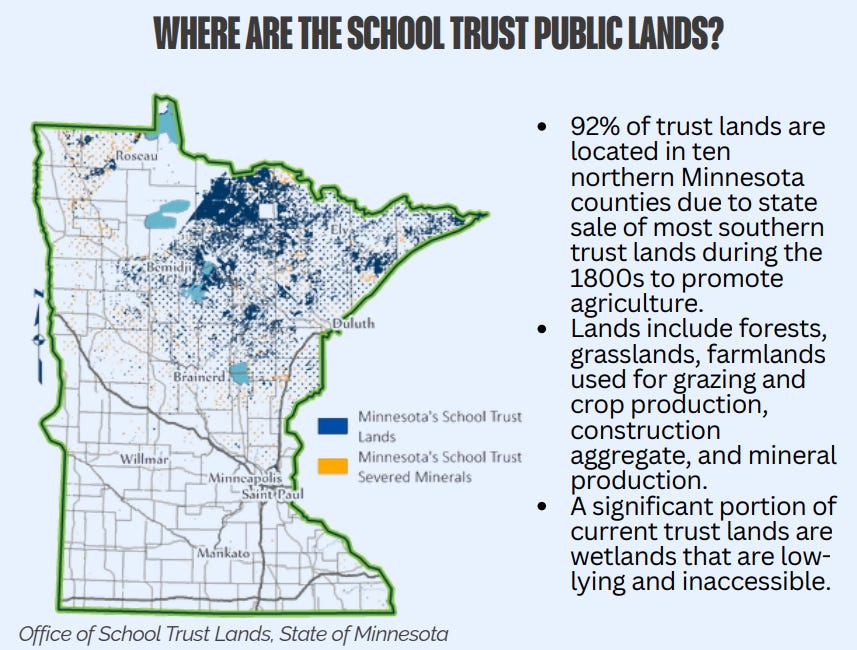
Although the Permanent School Fund was originally established to collect the proceeds from the sale of public land, at a certain point, Minnesota mostly stopped selling and switched to landlord mode. The Permanent School Fund controls very little land in the south of the state, but, between the original township tracts and the merger with the Permanent Swamp Fund in 1962, a lot of this land is still under the Fund’s control here in 2026:
This means that the Permanent School Fund is still fundamentally a land trust, and, I don’t know if you heard, but land had a crazy decade in the 2010s. That’s why you can’t buy a house if you’re under 35! Meanwhile, the stock markets enjoyed one of the longest and strongest bull runs in history, generating enormous capital gains. In 2010, the total value of the trust fund was $675 million. By last year, it sat at over $2300 million. Not a bad run!
However, this is a little bit frustrating for the fund managers and school districts, because a lot of those gains came from increases in land value and capital gains. Both are currently considered part of the fund’s principal, not its yields, and principal is, per the Constitution, held “perpetual and inviolate forever.” So the state has a giant pile of value in its coffers that accumulated over the past decade… and it can’t touch a dime of that value, only the “dividends and interest” that it periodically throws off.
These restrictions have limited the legislature to withdrawing only 2.5% of the total value of the fund, on average, over the past ten years. The 2.5% varies from year to year, sometimes sharply. If there was a recent loss that the fund has to make up, the distribution to schools is curtailed accordingly. Districts are never sure how much money they’re going to get from the school fund, and everyone knows it’s a lot less than what they could get from the school fund if it weren’t for that pesky never-touch-the-principal rule.
In 2025, a fairly good year for the fund, the Permanent School Fund distributed $58 million, or $68 dollars per student. This is, to be sure, a drop in the bucket. In 2025, the Minnesota legislature spent $12,000 million,7 or $13,000 per student, so the Permanent School Fund is contributing substantially less than 1% of that.8 However, it’s still money that’s earmarked for schools, and the schools are big fans of that.
The 2026 Proposal: What You’ve Been Told
This year, the Minnesota Legislature proposed another amendment to the Permanent School Fund. With a tied House and a one-seat DFL majority in the Senate, Minnesota has the most closely divided legislature in the Union, but this amendment passed with overwhelming bipartisan support: it was just shy of a two-thirds majority in the Senate, and it passed the House unanimously.
Everyone says that, by ending the archaic distinction between “principal” and “interest,” the proposed amendment would simply increase the annual withdrawal rate from ~2.5% to 4.5%:
Currently, the constitution provides that Minnesota school districts receive 2.5% of the permanent school fund’s net asset value each year. The amendment would increase the distribution amount to 4.5% of the three-year average value of the fund, increasing funding to school districts and charter schools on a per-pupil basis.
Voting yes on the amendment would allow for schools to receive 4.5% of the fund’s returns instead of the current 2.5%. MPR reports that this would result in about $33 extra per pupil.
State voters will be asked to allow the annual distribution from the permanent school fund endowment be increased up to 4.5% of the fund’s three-year average.
The change actually fortifies guardrails on the fund to ensure it remains strong and continues to grow. Currently, the fund pays out a fixed amount annually. Under the new formula, it will pay out an average of the previous three years of market value. If the stock market slows down, the payouts will shrink; if it rises, the payouts rise, but no higher than 4.5%.
This is a sensible idea. The strict distinction between principal and yield is indeed archaic. The best investment manager manages the whole of the value entrusted to him. As for withdrawal rates, there’s a well-known rule of thumb that says that, if your fund is safely invested in a healthy mixture of stocks and bonds, you can safely withdraw 4% or 5% annually without harming the long-term health of the fund. It’s a good rule. In fact, my entire personal retirement plan is built around the 4% rule.
Amending the Constitution in this way would strike a healthy balance between serving the interests of students today and ensuring the perpetuity of this trust fund for students tomorrow. It would increase average annual funding per student from about $70 to about $105. Still a drop in the bucket, but a nice little treat for the districts with no real downsides. I was therefore prepared to support this amendment.
Unfortunately, that’s not what the proposed 2026 amendment actually does. Everyone says it constitutionally increases the withdrawal rate from 2.5% to 4.5%, but that is false.
The 2026 Proposal: What It Really Says
Here is the actual text of the proposed constitutional amendment that you will be voting on next Tuesday:
Sec. 8. The permanent school fund of the state consists of (a) the proceeds of lands granted by the United States for the use of schools within each township, (b) the proceeds derived from swamp lands granted to the state, (c) all cash and investments credited to the permanent school fund and to the swamp land fund, and (d) all cash and investments credited to the internal improvement land fund and the lands therein. No portion of these lands shall be sold otherwise than at public sale, and in the manner provided by law. All funds arising from the sale or other disposition of the lands, or income accruing in any way before the sale or disposition thereof, shall be credited to the permanent school fund. Within limitations prescribed by law, the fund shall be invested
to secure the maximum return consistent with the maintenance of the perpetuity of the fundand managed as a perpetual financial resource for the sole purpose of apportioning money to the different school districts of the state. Management of the fund shall be designed to provide annual distributions while preserving the purchasing power of the fund over time and balancing the needs of current and future beneficiaries.The principal of the permanent school fund shall be perpetual and inviolate forever. This does not prevent the sale of investments at less than the cost to the fund; however, all losses not offset by gains shall be repaid to the fund from the interest and dividends earned thereafter.Reasonable and necessary administrative costs associated with managing the fund or school trust lands may be paid from the fund in the manner prescribed by law. The distribution policy shall be prescribed by law and consistent with the aforementioned principles.The net interest and dividends arising from the fund shall be distributedDistributions from the fund shall be apportioned to the different school districts of the state in a manner prescribed by law.
You will notice that there is no mention in this text of a specific withdrawal rate. Neither the current text nor the new text talks turkey like that. The only thing this amendment does is abolish the protections the Constitution places on the principal.9 It does not replace those protections. The Star Tribune claimed that the amendment “fortifies the guardrails,” but read the text for yourself. It does no such thing.
The effect of this amendment, then, is to give the Minnesota Legislature full and perpetual control over the Permanent School Fund. Once they have access to the principal, the amendment allows them to do whatever they want with it. They could indeed set an annual withdrawal rate of 4.5%, as has been suggested. They could also, just as easily, set an annual withdrawal rate of 9%, or 15%, or more. Yes, the legislature could, under this amendment, drain the entire trust fund dry. Who’s going to stop them? The amendment text still has some vaguely worded pabulum about perpetuity, principle, and policy, but no specifics. Even if someone had standing to sue over some future legislature’s abuse of the trust fund, the courts couldn’t meaningfully police such vague language, especially not when wielded by a co-equal branch of government.10
Now, as it happens, the legislature has settled on a 4.5% withdrawal rate, for the time being, in accordance with the recommendation of its own Permanent School Fund Task Force Report. However, this 4.5% withdrawal rate is established by statute, not by constitutional text. If the legislature decides to recklessly increase the withdrawal rate, they will not have to ask the voters.
So what this amendment is really asking the voters is: after 150 years of a constitutionally-protected Permanent School Trust Fund, do we want to remove those protections and entrust the fund to the Minnesota Legislature? Do we trust the legislature to be responsible about it, to follow the principle of perpetuity, not just today but decades and centuries into the future? Are we comfortable with the likelihood that, if this amendment passes, the Permanent School Fund will never come before the voters ever again?
Perhaps we do! It is undeniable that the legislature already has a great deal of power over the fund; for example, it already has the power to set the repayment schedule when the principal takes losses. Our legislature has used that power responsibly. On the other hand, I think back on that federal report from 1922, with its stern warnings about how legislative misappropriation had brought so many other school funds to ruin.
If you’re a Republican, do you trust the DFL tax-and-spend trifecta (coming to St. Paul in 2027, if the polls are accurate) not to raid this fund, spend it all in four years establishing new “education programs,” and then raising taxes in subsequent years to pay for those by-then-entrenched programs?
If you’re a Democrat, do you trust a future cut-cut-cut GOP trifecta (the GOP is likely to win a trifecta in the next 12 years) not to empty this trust fund to keep schools temporarily on their feet, while they send an equivalent amount of money back to Minnesotans in the form of vote-buying “tax rebates”?
Does it affect your opinion at all to know that the sponsor of this amendment, Rep. Spencer Igo (R-Wabana Township) was quoted as saying:
My dream for the school trust fund is one day we’ll see that be giving $300–$400 per pupil across this state
…even though distributing even $300/pupil would require an annual withdrawal rate of over 10%, which would collapse the fund within a generation or two?
That’s what it all comes down to: trust.
The proposal, as it has been presented, is actually a good idea. I support it. However, the presentation has gone to great lengths to obscure the reality that this amendment is designed to transfer authority over the Permanent School Fund from voters into the perpetual hands of the Minnesota Legislature. I trust legislators more than most people do, but giving the legislature new authority to spend money gives even me pause. When I further consider how deceptive this whole campaign has been, my skepticism curdles into suspicion.
Speaking for myself, then, I do not trust this Minnesota legislature. Even if I did trust it, I would not trust every future Minnesota legislature. Therefore, I will vote “no” on this amendment, although I remain open to voting “yes” on a future version of the amendment that includes constitutional safeguards.
You must evaluate for yourself, in all prudence, whether you trust the Minnesota Legislature more than I do, or whether the short-term gain to schools outweighs (for you) any risk to the long-term health of the fund.
Will This Matter?
Oh, god, no.
This amendment has bipartisan, near-universal support from both houses of the legislature. There is no organized opposition at all, which is why I had to do all this research to finally reach this conclusion. Minnesota always votes for anything it thinks gives more money to schools. That’s doubly true in Blue Wave years, and this year’s shaping up to be a Blue Tsunami unlike anything since the Red Tsunami of nearly twenty years ago. The amendment’s going to win by at least 35 points.
Moreover, the Permanent School Fund is small potatoes. As we’ve seen, it currently provides only about one-half of one percent of the money Minnesota spends on students. 99.5% comes from other sources. If this amendment passes and everything goes absolutely perfectly and nobody tries to raid the fund, the Fund’s contribution to MN K-12 education might eventually amount to perhaps one whole percent, with 99% coming from other sources.
I’m not even convinced it would be bad policy to raid this fund and use it to pay for something else! My primary reason for preserving the Permanent School Fund is because it honors the wishes of our ancestors, who gave it to us in trust. Filial piety demands that we respect those wishes, if not unreasonable. (In other words: it might be good policy to dissipate the Fund for other purposes, but it would also be a sin.) I intend to cast my useless “no” vote against this measure and then never think about it again, except maybe to take a “told you so” lap in the late 2030s, when the legislature strips the fund dry in order to plug budgetary holes in the midst of the global fiscal crisis I’m expecting around that time.
However, although it is ultimately not very important, I was irritated that I had such a difficult time finding accurate information about this proposed amendment. My hope is that other voters who are doing their research here in the final week of the 2026 campaign will come across this article and gather enough information to make an informed judgment of their own.
If your judgment does not match mine, that is fine by me. This issue is not especially important, but it is an example of what I have called “ordinary politics”: an issue where everyone involved fundamentally agrees on what we want (flourishing students), but where we may disagree on the most prudent way to accomplish that. The United States, in this deranged time, has mostly given way to what I have called “ordinary antipolitics” and even “extraordinary antipolitics.” Moments of ordinary politics, when citizens of good will can come together and discuss affairs of the day and disagree in good conscience without having to enter a moral judgment against the other side, are the mortar of democracy… and they are increasingly rare. They are to be treasured.11
Rather than dismissed as boring nothingburgers, I think we ought to take them seriously. We bloggers, in particular, who earn our paychecks by getting readers excited (often about culture-war issues), should occasionally give the “nothingburgers” the same attention we give the divisive-but-thrilling issues of our day.
DE CIVITATE NEXT VOYAGE: In the 2026 election preview, we’ll examine which of the two very great evils will be running Congress for the next two years! That should be coming out Monday (Election Eve) or Tuesday morning, Election Day.
Minnesota law now (wisely) provides that the state Constitution cannot be amended unless a majority of voters who cast ballots positively affirm the amendment. Thus, in modern times, abstaining from an amendment is equivalent to casting a “No” vote. This rule had not yet been imposed in 1875.
This “actual majority approval” rule is not sufficient insulation for a constitution. States really ought to have 60% thresholds for amending their constitutions, lest the whole state’s system of government or the human rights it recognizes pivot on the say-so of a bare 50%+1 majority egged on by campaign propaganda and partisan media. However, it is a lot better than the system that prevailed in 1875, under which a mere quarter of voters could impose an amendment on the entire state!
The Minnesota Legislative Reference Library indicates, contrary to my description, that the 1896 amendment extended the loan authority established in 1886. It seems to me that the Minnesota Legislative Reference Library is simply mistaken on this point; this is an extension of the investment authority established in 1875, not the loan authority of 1886, and it was subject to none of the same rules as the loan authority. However, allowing the fund to invest in town bonds is a loan, of a special sort, so the description on the MLRL is not exactly wrong, simply misleading.
Minnesota passed its amendment requiring positive approval from a majority of all voters casting a ballot in 1898, so these amendments both failed, despite defeating the “no” side 3-to-1, because they didn’t have majority support.
The Permanent Swamp Fund was established by constitutional amendment in 1882. It worked very, very similarly to the Permanent School Fund, and half of its proceeds went to the Permanent School Fund anyway. (The other half went to “the educational and charitable institutions of the state.)
The 1984 amendment also removed the constitutional rule requiring apportionment by number of pupils in each school district… although, in practice, I believe the legislature has continued distributing the money based on pupils per district, so nothing has changed.
The anti-Catholic school provision remains in the Constitution today at Article 13, Sec. 2.
Consistent with past practice, I am expressing all figures in millions because switching between “millions” and “billions” is confusing. For those unused to multiplying or dividing by a thousand without even thinking about it, constant switching makes readers unable to follow complicated budget discussions. I am convinced that this is part of why Americans in general are so illiterate about the federal budget deficit.
That’s just the legislature! Districts spend more on top of that, and the federal government more still.
Okay, it also introduces the “reasonable and necessary administrative costs” clause.
At a certain point, it is possible that a legislative act would so blatantly defy the Constitution’s requirement of perpetual management that it would trigger a court’s intervention. For example, if the legislature tried to withdraw 100% from the fund in a single year, that would make a pretty strong case that the legislature was not following its constitutional obligation to ensure the fund’s perpetuity. Taxpayer standing may even exist in that case.
However, courts can generally only intervene when the legislature defies the state Constitution, not when the legislature is merely reckless about the Constitution’s stated policy goals… and they are generally required to apply a deferential standard.
For the same reason, I’m looking forward to voting in my local sheriff’s election: both candidates seem good, so, for once, I’ll be casting my vote for the greater of two goods, rather than the lesser of two evils.
I’m leaning toward Joe Leko, largely on the strength of his huge list of endorsements—including an endorsement from Kathy Keena, our very sound county attorney. However, I’m open to persuasion about Lambert, who also spoke well in his West St. Paul Reader profile.
if you, like many other prudent investors, are predicting a crash soon, would it not be better to liquidate everything before then?