

She was, by all accounts, a lovely woman.
She was my age, or just about. I keep thinking about that.
What a woman my age was doing there in the middle of a Wednesday morning, in the January colds, I still don’t understand. I guess, when you feel that the nation is doing something Really Bad, you take PTO, put on a warm coat, and make your voice heard. I guess that’s America. I guess good for her.
I’ve seen the ugly events that followed from so many camera angles now I get dizzy. By now, we all have.
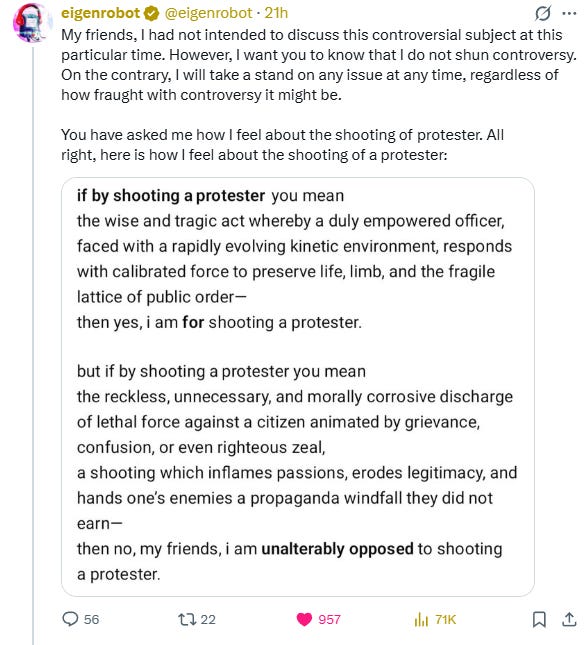
The moral interpretation of what happened is an exercise in Shiri’s Scissor:
However, these facts, at least, seem to be generally agreed upon:
Agents of the federal government were attempting to execute the law of the land as they understood it.
This young woman had come to believe, quite strongly, that the government’s actions were not only unjust, but illegitimate. She was immersed in a fever-pitch world of friends, social media, and news sources that reinforced her views.
So she came out to protest the government’s actions. Given her beliefs, we must agree, this was a reasonable response!
At some point, however, she made a further decision. Instead of merely protesting, she began to actively interfere with the government, hoping to prevent the actions she opposed. This is, of course, illegal. However, as a country, we only rarely actually prosecute interference with law enforcement. At worst, it’ll get you arrested for a few hours or a night. (Then you can come out the next day with huge social standing in your friend group.) Besides, she was a white woman. In the absence of some aggravating act of violence, this poor young woman probably expected lenience. I’m not sure that expectation was unreasonable. Many others had recently gotten away with worse, and she knew that.
She didn’t count on the larger environment. She didn’t realize that the law enforcement officials she was confronting were overtaxed and undertrained. She didn’t understand how ill-prepared they were to deal with the resistance from her and her allies. She had a lot of allies. They had already harassed the agents. They were on edge, twitchy, aggravated, and probably more than a little scared. The rhetoric of the past few days had been hideously ugly, often violent. The LEOs knew there were people present who wanted them dead, and knew they might not have much time to react if a lethal threat presented itself.
In the end, she started committing her little crime, but federal law enforcement officers told her to stop, to freeze right where she was. Alas, she did not! Was she panicked? Was she angry? Did she even understand the commands, in the adrenaline and terror of the moment of confrontation? We can never ask her. One of those officers, in particular, probably shouldn’t have been on the scene at all that day. It wasn’t that he was evil or criminal; he just had some things in his past that meant he might not make very good split-second decisions in this sort of context.
He pulled his weapon.
He fired.
She died.
Was she armed? It depends on whom you ask, and how you define “armed.” Law enforcement had some reasonable basis for thinking she posed a deadly threat to them, but it’s arguable whether that basis was sufficient to justify firing on her. In a sense, that doesn’t matter: it is ambiguous enough that her supporters have taken to saying that the feds “murdered” an “unarmed woman.” They warned (and are still warning) the country that “you could be next” if you just happen to find yourself “in the wrong place at the wrong time.”
Of course, this omits that “the wrong place at the wrong time” here means committing a (non-violent) crime in the middle of a tense protest against armed agents carrying out the law, which is not actually a place or time in which I regularly find myself. The killing and the subsequent rhetoric has, nevertheless, radicalized many people on her side. When skeptics point out that she was in the middle of a crime, refusing lawful orders from federal agents, the response comes quickly: “Illegal protest doesn’t warrant the death penalty.”
Donald Trump, naturally, almost immediately logged on to post some nonsense that was seemingly calculated to pour gasoline on an already raging fire. Abraham Lincoln did everything he possibly could to avert the Civil War, short of surrender. Donald Trump, on the other hand, seems to do everything he can to hasten it. I don’t think that’s his plan; I think that’s just his id. I don’t think that makes it better.
Anyway, none of these post-mortem reactions change the fact that she is dead. She was a nice woman, caught up in a revolutionary movement. In my view, the revolutionaries’ ideas were mostly (though not entirely) false, but that’s beside the point. She didn’t want to hurt anyone; she just wanted to be heard, and to protect her country from the oppression of the federal government. However we ultimately assign the blame, I think we can all agree that her death was needless, and sad, and a terrible loss for her friends, her family, and the country. Through the mercy of God, may Ashli Babbitt rest in peace, amen.
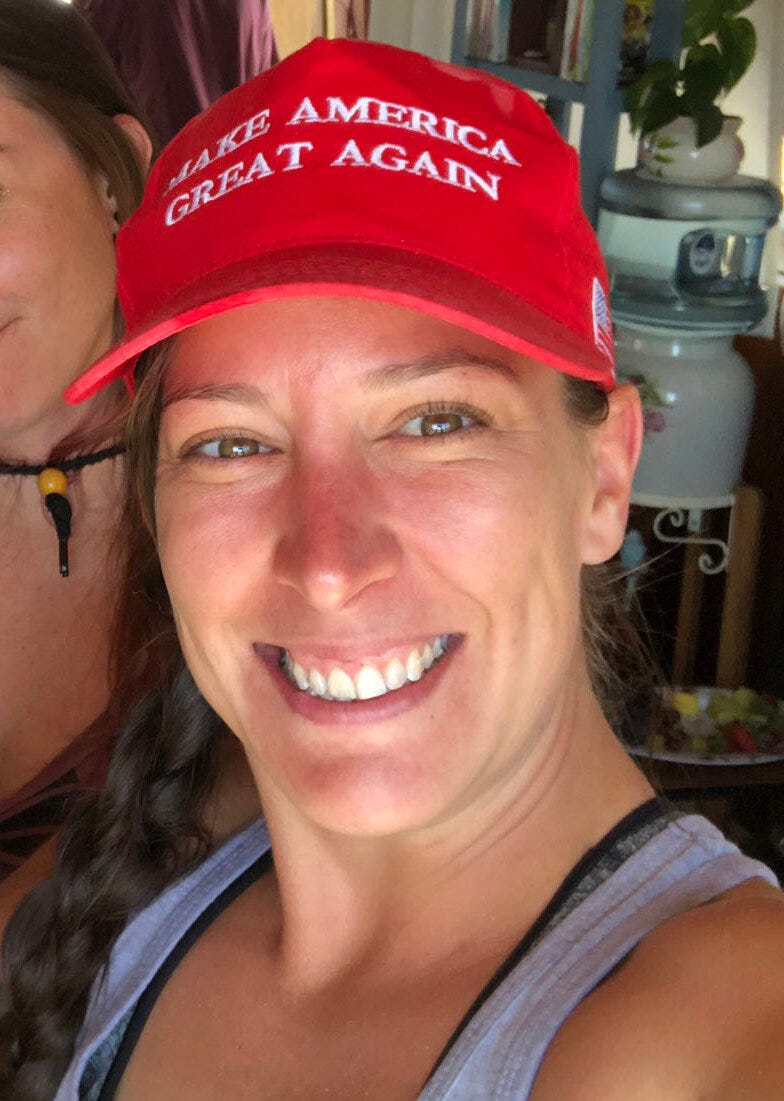
Ms. Babbitt was on my mind this week because Tuesday was the fifth anniversary of the Capitol insurrection on January 6, 2021. She was, of course, the sole fatality of that riot, and the anniversary of her killing inspired a fresh round of discussion about her.
It was startling, then, when, the very next day, something strikingly similar happened to another young woman, one Renee Good, right here in the Twin Cities.
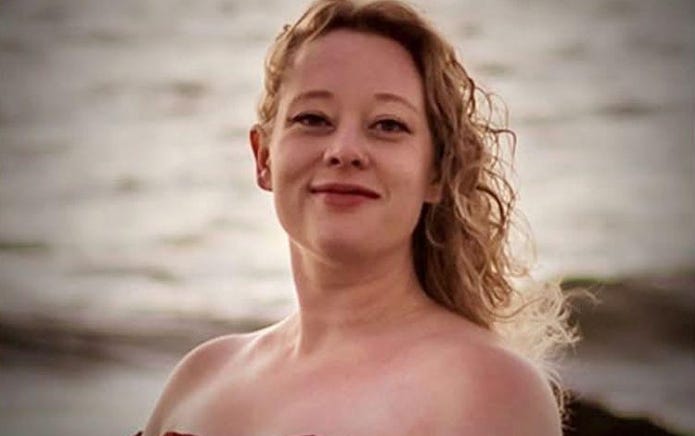
There were differences. Babbitt had a small knife, Good a large car. The exact positions and timings are different, as the details always are. Still, the overarching similarities are striking. You could almost read this whole post up until the part where I said Ms. Babbitt’s name and think I was talking about Ms. Good!
It is therefore striking how perfectly the national narratives seem to have reversed for this killing. For the most part, the people who declared Ashli Babbitt a patriot martyr are quite convinced that the ICE agent who unloaded half a clip into Renee Good’s skull is a heroic exemplar of law and order. For the most part, the people who think Good’s “murder” proves that our government is “fascist” spent 2021 (at least as I remember it) sniggering into their sleeves about what an idiot Babbitt had been to have placed herself at the front of a riot in the first place. In both cases, two people watching exactly the same footage routinely seem to see very different things—then they see opposite things when they look at the footage from the other case.1
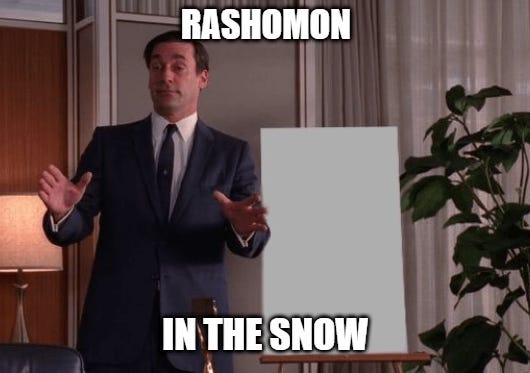
We all know why.
Babbitt was right-wing, Good left-wing. Babbitt’s insurrectionary political theory, courtesy of QAnon, was that the Congressional certification of the 2020 election was illegitimate. Good’s insurrectionary political theory, courtesy of BlueAnon, was that the White House’s strict enforcement of Congress’s immigration law was illegitimate. Both theories were ludicrous, but supported by partisan factions in our society. It’s almost as difficult to say “Biden won the 2020 election” (he did) in a Republican precinct caucus these days as it is to say “ICE is doing a mostly-reasonable job enforcing the clear law of the land” (it is) in a Democratic precinct caucus.
About a decade ago, five law professors ran an interesting psychological experiment. They showed 202 representative American adults—the sort of people who might end up in your jury pool—a 4-minute video of a large, tense, but ultimately peaceful protest. The law profs split their sample into two groups. They told Group A that it was film of a pro-life protest, at an abortion clinic, against abortion. They told Group B that it was film of a pro-LGBT protest at a military recruitment center, against the military’s then-current “Don’t Ask, Don’t Tell” policy. Then they asked the viewers in each group (as though they were a jury) whether the protesters had “interfered with, obstructed, intimidated, or threatened,” anyone trying to enter or exit the abortion clinic / recruitment center.
Surprise surprise: in Group A, thinking that the protesters were pro-life, the right-wingers strongly defended the protesters and the left-wingers said they were guilty of obstruction. In Group B, thinking the protesters were pro-LGBT, the left-wingers suddenly defended the protesters while the right-wingers accused them.2 That was in the early 2010s, before the age of Trump and all the bipartisan madness that has followed.
Watching the tapes of Renee Good’s death today, then, it’s hardly shocking that the two Americas are seeing two different realities. Indeed, one of the really head-turning things about it is that quite a few Americans have noticed that the other side’s reactions to Good’s and Babbitt’s deaths are hypocritical… but, somehow, they have continued not noticing their own, parallel hypocrisy!
There is only so much we can do about this. America is fraying, we all know this, and many of the forces pulling us apart are not under our control. Some of them can’t be controlled. I remain pessimistic about America’s survival. The categorical rejection of the legitimacy of both U.S. immigration law and federal immigration agents, by one of our two major tribes, represents a legitimacy crisis, which could ultimately lead to civil war.3 (For that matter, so was the other tribe’s categorical rejection of the 2020 election results.) You can’t just decide one day to embrace legitimacy, because legitimacy crises—the really dangerous ones, anyway—occur precisely in the gaps where legitimacy is not crystal-clear and is open to some interpretation. You’re going to interpret these crises through the lens of motivated cognition. That’s a guarantee. All you can do is be aware of your bias and try to correct for it.
This suggests a useful exercise in the wake of Renee Good’s death.
Try to think back to the day of the Capitol insurrection and the death of Ashli Babbitt. When she died, how did you feel about that? Not just in your brain, but in your guts?
Do you feel similarly now?
If not, why not?
Is it just because one of them was in your tribe and the other wasn’t? If it is, that’s okay. It’s human, inescapably so. We do not control our emotions. What we control is how we reason about them, and thus how we act on them. But we can’t reason about them until we acknowledge them.
If you have other reasons for feeling differently about the two killings, are those reasons real, or did your brain—deep-fried in a partisan stew lo these many years (perhaps without your even realizing it)—present them to you in a desperate attempt to stave off cognitive dissonance?
What did you think ought to happen to Babbitt’s killer? How close is that to what you think ought to happen to Renee Good’s killer?
I don’t think there’s a single, clear, right answer to What Should Happen When 30-Something Unarmed-ish Protesters Who Aren’t Quite Violent But Are Maybe Threatening And Are Definitely Breaking The Law Refuse Reasonable Police Orders And Are Then Shot Dead By Said Police.
You might take the view that law enforcement is, in general, much too quick to fire and that, in general, the law should hold them more accountable. This seems to be the view of Justin Amash, the ex-Republican libertarian:
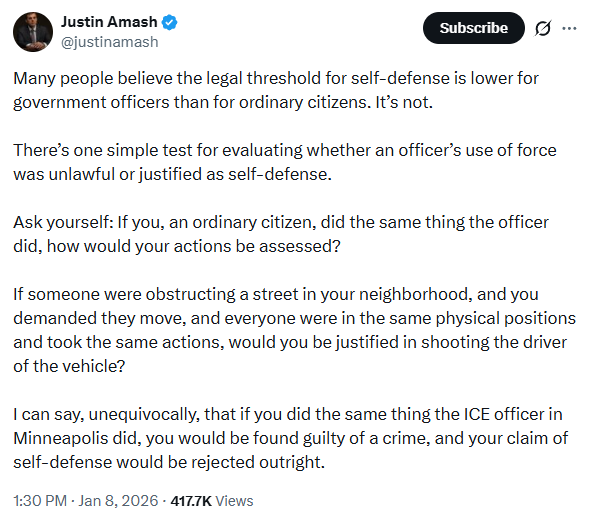
This is a rational take, even though I disagree with it. More importantly, it is the standard Amash consistently follows, regardless of the partisan valence.
Another rational but opposed take is Andy McCarthy’s. For McCarthy, someone who creates a reasonably serious threat to a federal officer, even by carelessness, is engaged in an actionable assault against that officer, and the officer may therefore defend himself. That is McCarthy’s view4 of Good’s death. It was also his view of Babbitt’s death, which he said was “justified.”
There are differences between Babbitt’s case and Good’s case, of course, which may justify some shades of difference between how you treat them. You might, for example, think Good’s shooter is guilty of third-degree murder, but that Babbitt’s shooter is guilty of only manslaughter. Or, on the other banana, you might think that Good’s shooter should get a medal, while Babbitt’s shooter should receive only a hearty handshake and a pat on the back.
What I think you can’t believe is that one of the shooters was a hero who deserves a medal and the other a murderer who deserves life in prison. What I think you can’t justify is being furious and terrified by the one while shrugging off the other as “FAFO.”5 I’ll hear out your argument, but I’m pretty skeptical.
As for me?
Renee Good is freshly dead. Her family is in mourning. She had a child, a six-year-old, whom she had just dropped off at school before going off to protest ICE. I will not speak a word against her here, because it is profoundly immoral to speak ill of the dead when the family is still planning the funeral. This was true of Charlie Kirk and it is even more true of Renee Good, who was not a public figure.
However, Ashli Babbitt has been dead long enough that I think it is okay to tell you what I thought when I heard about her death: I thought it was sad, but largely self-inflicted.
Babbitt had allowed herself to be seduced by a false, conspiratorial narrative about alleged evils in the federal government (some of which had some basis in fact, most of which did not). She was engaged in an insurrection—an attempt to prevent, by force, the execution of one or more laws of the United States for primarily political reasons. She was not herself violent, but the man with the gun didn’t know that. Even though she was caught mid-crime, she failed to obey very reasonable police instructions. Perhaps this was not out of defiance, but just because she didn’t hear, or because she panicked and reacted poorly, or because she thought the officers behind her had told her something different. Unfortunately, accompanied by a mob of other insurrectionists, which had created a very tense, precarious situation charged with fear, she had helped eliminate all margin for error. When the trigger was pulled, I think it might well have been an error; there probably were lesser actions the officer could have taken to stop Babbitt without killing her. Yet I don’t think the shooter was to blame for her death. I don’t know about giving him a promotion, but I certainly wouldn’t have charged him with a crime.
People who break the law, create confrontations with law enforcement, and then refuse to be stopped by non-violent means should have no expectation of surviving what comes next. You may have the legal right to survive, but, in my harsh view, you have forfeited the moral right. You’ll usually survive anyway (which is good!) but, sometimes, you will die. Do not put yourself in this position unless you are prepared to die.6 Ashli Babbitt should still be alive, but the most important reason she isn’t is, unfortunately, Ashli Babbitt.
However, I could be wrong! Even if my principles are correct, and my judgment of Babbitt is fair, the facts in Renee Good’s case are not yet in, no matter how many cell phone videos give you the illusion of complete information. My purpose today is not to tell you what to think about these killings; my purpose is only to help you figure out how to think about the killings.
That is no easy task these days. Your mind is not fighting against merely personal cognitive biases, which are bad enough. Your mind is fighting against principalities and powers.
I keep talking about the possibility of some future civil war, but the truth is that civil war is a spectrum, and we are already on it. We’ve been in a low-grade civil war since at least 2020. The two rival tribes that occupy the United States are vast, rich, well-organized, and well-armed. Both of them are doing everything in their power to get you to pick a side—their side. When this war gets hot, they are going to need you to kill the people on the other side, and they are trying to prepare you for that. The tribes can’t let killings like Babbitt’s or Good’s be mere tragic exercises in stupidity; they must be made into martyrdoms or domestic terrorism. If the truth gets in the way of that, the truth will have to go. What looks like truth-telling becomes recruitment.
Partisan politics is always a little like this, but even partisans (in ordinary time) are restrained from indulging their worst impulses by a shared concern for the good of the country. That’s gone. The concern is gone because the country is gone. Legally, America clings to life, but, imaginatively, America is already over. The vibe is 1852, and I’m wondering where our Bloody Kansas might pop up.
So we are alone. It’s our measly little brains against trillion-dollar decentralized propaganda machines whose input is clever half-truths and whose output is hatred. We’re all listening to Tokyo Rose, and some of us even pay a subscription. De Civ tries not to be part of those machines, but I’m immersed in the same mind control soup as you are, so all I can do is try and hope. To keep your brain intact right now is no small victory, and even the most successful of us have gone at least a little crazy.
Unfortunately, having an intact brain could mean you’re first against the wall when the Revolution does come. Sorry about that.
UPDATE 18 August 2026: Kautzmania got in touch with me to note that his meme had a typo in it. “Roshomon in the snow” should be “Rashomon in the snow.” I have corrected the meme, and he also plugged his podcast, Art of Dark, which, I mean, in exchange for a meme that good, fair enough.
Here’s a video from one of Ms. Babbitt’s compatriots in the Capitol, just after she was killed. It’s striking to compare the quotes in this video to quotes from Ms. Good’s compatriots in the anti-ICE movement after her killing:
Incidentally, the individual in this video, Thomas Burani, was later arrested and sentenced to 90 days in federal prison, followed by a year of supervised release and 60 hours of community service, plus a $500 fine. The FBI was able to identify him because, incredibly, he gave his name in this interview. Like Good and Babbitt and all their compatriots, it seems Burani really didn’t think he was doing anything wrong, and was incapable of conceiving that the consequences of actively impeding the execution of federal law might be lethal, and that lethality might be justified.
One interesting note: 76% of the left-wingers supported the left-wing protesters, but only 70% of right-wingers supported the right-wing protesters. Meanwhile, 28% of the left-wingers supported the right-wing protesters, but only 16% of the right-wingers did.
This means that left-wingers are somewhat more supportive (and more trusting) of protesters in general than right-wingers are! Right-wingers are less supportive of protests and more trusting of police, and this is visible even when the protesters are also right-wingers. When you think about it, this isn’t really surprising, but it is still interesting to see it right there in black and white. Also, the effect is not huge. It is dwarfed by the purely partisan motivated cognition.
If you’re new to De Civ, this blog’s theory is that civil war is caused by a succession of worsening legitimacy crises, culminating in a final legitimacy crisis that starts the shooting. See De Civitate’s Review of Ross Douthat’s Review of Civil War.
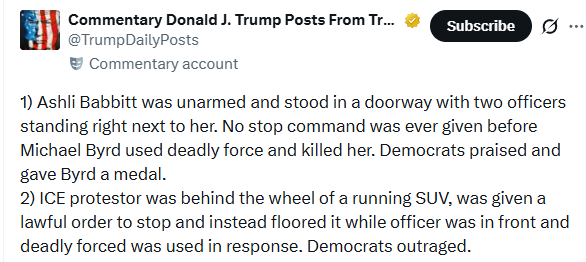
The very worst offender here is probably the White House, which posted a deranged revisionist history of January 6, 2021 (which lionized Ashli Babbitt) on Tuesday, then spent Wednesday berating Renee Good as a psychopath from whom ICE agents barely escaped with their lives (which is simply false).
This is not to say that there are no occasions where it is appropriate and correct to openly violate the written law, especially when that law is unjust. The heroic nonviolent civil disobedience of the Civil Rights Movement is America's most important example of exactly that.
There may even be situations where it is appropriate to refuse or resist even a peaceful arrest (although I am having a harder time coming up with one). If you do that, though, you must accept the possibility that you will die, and that no one will be to blame for your death but yourself. If you are the type of person who might accidentally resist arrest or escalate a situation because of panic or confusion, you should not place yourself in these situations at all.
That is only my view, though. I believe strongly in the law and the sovereign’s authority to execute it—some have said too strongly—and I recognize there is a very valid range of views on when law enforcement is justified in using lethal force. I do not seek today to defend any specific position. My goal is only to ensure that, whatever view one takes of lethal force, that view is consistent.
NIce how you led off about Ashley Babbit as though she were Renee Good. Point well taken.
I regularly do sidewalk counseling at a local abortion facility. As part of how I was trained, I do not block cars and people entering and leaving the facility. My purpose, and the purpose of those I work with, is peaceful persiasion and prayerful protest. Sometimes, that persuasion results in women changing their minds. I hope I would feel the same way about similar protests regarding causes I disagree with.
I do not agree with violent protests, no matter the cause, nor with "civil disobedience" protests that resist the legal consequences. I hoep I would feel th3 same way ab out any causee, whether I agree or disagree.
What’s really incredible is that I never heard of Ashley Babbitt, or at least forgot about her. I remember an officer dying a few days later that people were tying in, but not her. I’m a Republican too, so you think I would have heard about it from a Republican friend, but Substack didn’t have Notes at that point, and I disconnected from News sites and social media after Kavanaugh’s hearing. It’s insane that something like that happened and I was unaware. I seriously thought you were talking about Good the whole time and had to google Babbitt.
More to the point of your article, my opinion on Good is that the Officer should be fired, but not charged with Murder. I’d have to look closely at Minnesota’s manslaughter statutes to know if one of them apply. In my quick google on Babbitt, it looks like the same thing should have happened to that officer, and I am disappointed to see he was promoted, not fired. I expect the same thing will happen to Good’s killer at the end of the day.
Sending someone afraid for their life to prison because they reacted poorly feels unjust to me, but that doesn’t mean we should ever trust you with a gun and a badge again.