

Pro-choicers sometimes claim that, under Pope Innocent III, the Catholic Church allowed abortion until “quickening”:
Catholic theology, which now regards the early fetus as a person, did not always do so. The Church first adopted the belief of Aristotle, St. Jerome, St. Augustine, and St. Thomas Aquinas that ensoulment occurs several weeks after conception. Pope Innocent III, who ruled at the turn of the 13th Century, made that belief part of Church doctrine, allowing abortion until fetal animation. It was not until 1869 that the Church prohibited abortion at any time and for any reason.
—“ABORTION: Why Religious Organizations in the United States Want to Keep it Legal,” Religious Coalition for Abortion Rights, June 1978
Between 1198 and 1216, Pope Innocent III ruled abortion as “not irregular” if the fetus was not “vivified” or ”animated”; animation was then considered 80 days for a female and 40 days for a male—male fetuses apparently could develop faster then slow-poke female ones. Oddly, it has never been explained how anyone in the 12th century could tell sex differences in the womb. Or was there some early version of ultrasound back then that historians somehow missed?
— “When the Vatican was Pro-Choice,” Robin Morgan, 4 February 2019
I realize this is totally inside baseball, but I swear the Catholic Church's history was not monolithic opposition to all abortion.
Pope Innocent III, in the 13th century, said abortion was "not irregular" up to 40 days for all fetuses and 80 days for female fetuses.
Basically, Innocent III would have been fine with mifepristone, as long as you take it early enough in the pregnancy, right after a missed period. (BTW, I'm not sure how women were supposed to know if the fetus was female when they aborted.)
—Dilan Esper, unusually stubborn tweets, 5 June 2026.1

These claims are false, although there is a kernel of truth in them.
To be fair, most pro-choicers have internalized that this line of argument is both ineffective and stupid, so you don’t see this argument very often anymore. (It was much more common in the 1960s and 1970s.) Moreover, none of this inside-baseball Catholic history actually matters to the abortion debate. As I’ve written before:
When pro-lifers are discussing abortion with others, I think we should all play atheists. Abortion is not wrong because God said so; abortion is wrong because it’s murder. We didn’t learn that life begins at conception from the Bible. We learned it from modern embryology, barely a hundred fifty years ago. There is even a credible argument that the Bible points away from fetal rights. If that argument is correct, then the Bible is wrong, simple as that.
The question of ensoulment matters to Catholics, but it has little bearing on the central facts of the abortion debate: the human right to live and the fetus’s humanity.
However, this particular claim has been made often enough to irritate me. I care about obscure Catholic doctrinal history even when it isn’t relevant to the abortion debate, so I finally looked up Pope Innocent’s decision (sometimes known by its incipit, Sicut ex). Here it is:
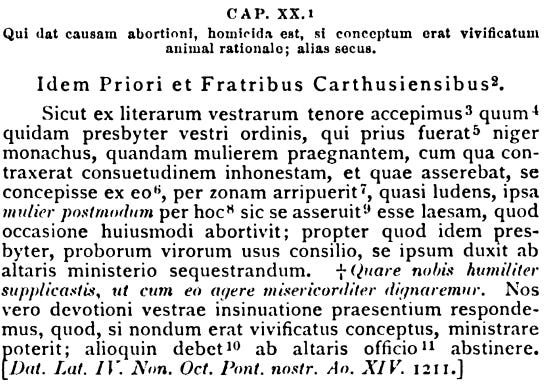
Latin text (hand-typed, apologies if typos):
Sicut ex literarum vestrarum tenore accepimus quum quidam presbyter vestri ordinis, qui prius fuerat niger monachus, quandam mulierem praegnantem, cum qua contraxerat consuetudinem inhonestam, et quae asserebat, se concepisse ex eo, per zonam arripuerit, quasi ludens, ipsa mulier postmodum per hoc sic se asseruit esse laesam, quod occasione huiusmodi abortivit; propter quod idem prebyter, proborum virorum usus consilio, se ipsum duxit ab altaris ministerio sequestrandum. Quare nobis humiliter supplicastis, ut cum eo agere misericorditer dignaremur. Nos vero devotioni vestrae insinuationed praesentium respondemus, quod, si nondum era vivificatus conceptus, ministrare poterit; alioquin debet ab altaris officio abstinere.
English translation (GPT, manually spot-checked2):
As we have learned from the contents of your letter, a certain priest of your order, who had formerly been a black monk [i.e., a Carthusian monk], seized by the belt a certain pregnant woman with whom he had entered into an illicit relationship, and who claimed that she had conceived a child by him. Although he did this as if in jest, the woman afterward asserted that she had been injured by it in such a way that, as a result of this incident, she miscarried. Therefore the same priest, having taken the advice of worthy men, considered himself to be removed from the ministry of the altar. Therefore you humbly petitioned us that we might deign to deal mercifully with him. We, in reply to your devotion by the present letter, inform you that, if that-which-was-conceived [conceptus] had not yet been endowed with life, he may perform ministry; otherwise, he ought to refrain from service at the altar.
You will notice, I trust, that this text bears little resemblance to what the pro-choicers “quoted” above. The word “irregular” does not even appear. There is no discussion of sex differences. There is no date fixed for ensoulment. There is no permission granted for abortion. I don’t know when, or why, or whether it was an accident, but the pro-choicers fabricated their quotations. We needn’t understand any further context to see that the pro-choicers here are making things up.
Nevertheless, for those not versed in medieval monks and canon law, an examination of the context might still be useful.
The Carthusian monks here have a brother who got a girl pregnant. He later grabbed her by the belt (allegedly “in jest”) and she asserted this caused her to miscarry. Thus, the Carthusian in question (allegedly) caused an accidental abortion.3 The Carthusians immediately took him out of priestly ministry, but the prior of the monastery sought a decision of the pope, asking for mercy.
The reason the prior is asking for mercy is because there was a traditional rule in canon law (stated by, inter alia, Pope John VIII) that a priest who is guilty of murder cannot ever return to priestly ministry, not even after doing penance, not even if given a special dispensation by the pope.
There was no question that abortion was a serious crime. All contemporary canonists agreed on this: Gratian, Rufinius, Bernard of Pavia, Bandinelli, John Teutonicus, plus anyone else you might come up with. It’s taken as read, both by the Carthusians and by Pope Innocent, that the monk in question will be doing penance, even for a merely accidental abortion (according to some canonists, a severe penance).
The Carthusian petition instead raises two specific questions, both of which were unsettled in canon law of the early 1200s:
Can a priest who is guilty of accidental homicide remain in ministry (after doing appropriate penance)?
If so, does it require a dispensation?
Is very early abortion, strictly speaking, homicide?
Many people are surprised to learn that there was, in fact, a range of views among Catholic canonists at the time about the severity of very early abortion. On the strict end were those who held that very early abortion was, very simply, murder. On the lax end where those who held that intentional very early abortion was not quite murder. These laxists treated very early abortion as a severe crime that ought to be punished “as for murder” (canon Si aliquis), but argued that, technically, it wasn’t actually murder, and so didn’t need to punished identically to murder. In 1942, scholar John Huser described the “lax” position:
The Decretists, notably Rufinus and Bernard of Pavia, indicated that abortion of a non-formed fetus was considered quasi-homicide, that is, the penalties were similar to but not so severe as those for true homicide.
It would never even have occurred to any of these writers that some future hostile reader would attempt to interpret their words in that way as permitting very early abortion. Every one of these men taught that a single act of deliberate masturbation condemned a man to Hell unless the sin was repented.4 The very laxest view available in the 12th century was that very early abortion was a serious crime that wasn’t quite as bad as full-on murder… but it would still definitely send you to Hell!
This debate, limited as it is, often surprises people, because the Catholic Church’s well-established position today is that, yes, abortion (even very early abortion) really is murder. Yet, while abortion was always harshly condemned as at least a quasi-homicide, the question was still open in 1211.
The reason it was still open in 1211 is because nobody knew how conception worked yet. As I explained a couple months ago:
[Medieval Europeans] believed that, after copulation, the semen encountered menstrual blood. Rather than fusing together, the semen enveloped the menstrual blood and began to reorganize its matter, similar to the way a cucumber in brine becomes pickled or (as Aristotle put it) the way milk in rennet becomes curdled. (The whole body of the eventual infant is composed of reorganized menstrual blood, with no material contribution from the man.) At the first stage of development, the semen (exercising the generative power of the father’s soul, albeit remotely) organizes the blood into a sort of an organless, nutritive paste. Then the semen destroys this paste by building enough organs to replace it with a primitive animal. At this point, the semen “is dissolved” and its active principle “ceases to exist,” as the animal-entity takes over development… at least until God kills the animal and infuses its corpse with a rational soul instead [which was withheld, to this point, because the organism was not yet biologically human, and therefore could not carry the human soul].
(A convenient overview with extensive quotations is given by Stephen Heaney (some relation) in, “Aquinas and the Presence of the Human Rational Soul in the Early Embryo”, which I have paraphrased quite liberally.)
You may wonder how Aquinas thought children ended up with traits different from their parents, since he had no concept of genetic inheritance. Astrology, of course! While taking a dim view of divination or blaming free choices on the stars, Aquinas earnestly defended the view that a child’s sex and other traits may be influenced by the constellation under which he was born (Summa Theologiae I.115.3, obj. 3 and reply), since the locomotion and heat of the celestial spheres stirred up and affected all other changes under heaven (insofar as inferior matter was disposed to receive it). These heavenly changes could affect what I will dub the “embryonic brining process,” the same way hot weather could affect a cheese-curdling process.
…I emphasize that this bizarre-sounding embryology was entirely reasonable, given scientific knowledge of the time! It was, however, wrong.
Everyone agreed, in principle, that a biological human organism received a human soul immediately upon becoming biologically human, but, as you can see, there was a lot of confusion about how and when the human body actually formed, biologically speaking.
This was a scientific question, not a theological one, so there was no way to definitively answer it until the 19th Century. Without a modern understanding of how human gestation works, there was a colorable argument that no biologically human body formed until later in pregnancy, a hypothetical milestone typically referred to as “animation.”5 As a result, the Church tried to manage the uncertainty prudently, and different canonists and popes made different prudential calculations.
Pope Innocent, for his part, issued a ruling in the case without a fully-reasoned opinion, so we can’t be certain of his precise thinking, but he seems to hold:
A priest guilty of merely accidental homicide cannot be readmitted to ministry, but
Very early, pre-“animation” abortion (though a grave crime, as held by all the canons) is not, strictly speaking, homicide, so
A priest guilty of merely accidental early abortion can be readmitted to ministry (though he must, as held by all the canons, complete appropriate penance).
This is a far cry from saying that abortion is permissible, as claimed by the pro-choicers I quoted. Consider how contorted the pro-choice interpretation is:
Suppose the Carthusian had not accidentally aborted his mistress, but rather accidentally blinded her during a robbery at knife-point. So the Carthusian’s prior writes to Rome and asks whether, after showing true contrition and performing the proper (lengthy!) penance, the priest can ever be reinstated. Under medieval canon law, a murderer was barred forever from priestly ministry, but most other criminals were not. The Pope would reply: “yes, he he may (eventually) return to ministry.” By the logic of the pro-choicers, this would prove that the Church considered robbery permissible!
Poppycock.
It is one thing to say that many very important Catholic thinkers, throughout history, have taught that “animation”6 was an important dividing line with respect to abortion. This is true!
It is also true to point out that the debate over the importance of animation was not settled until the 1860s, when modern scientific evidence proved that a new biologically human organism is formed at conception, rather than at animation. This new scientific evidence led Pope Pius IX to repeal the narrow canonical distinction between pre-animation and post-animation abortion. Indeed, even that was a merely legislative act. The full humanity of the human being from conception was well-established by science more than a century ago, but it was not infallibly established as a matter of Catholic doctrine until Pope John Paul II issued Evangelium Vitae in 1995!7 This happened within my lifetime! (Of course, I didn’t need the Pope to invoke infallibility for me to know that unborn children are babies and that it’s wrong to kill babies. I knew that already. It’s still interesting that the Church’s final decision was so recent.)
So, yes, the Catholic view of abortion has changed over the past thousand years! Not only were there legitimate doubts that early abortion was, strictly speaking, homicide, but the opinion considered common and probable was that early abortion was not homicide! Only with the advent of embryology was the matter settled, and settled in favor of the less common and less probable opinion. I grant all interlocutors this motte!
But then they try to seize the bailey. They say ludicrous things like “the Vatican was pro-choice” and “Innocent III would have been fine with mifepristone,” and then they get mad at you when you point out that they’re making stuff up. I do not know why they do this. As I said, most have developed the good sense not to. If you asked for my best speculation, I’d say that a fake history of abortion is both psychologically and legally important to abortion-rights supporters.
If abortion was a common thing that was allowed for centuries before “those ridiculous sex-hating Victorians” cracked down on it out of nowhere in the late nineteenth century, then it’s much easier to claim that abortion was a right recognized at the Founding (thus protected by the Constitution). It’s also easier to numb yourself to the killing of human beings if you can convince yourself that your culture has always been “okay” with it. Abortion advocate Cyril Means spent much of the 1960s constructing a pseudohistory along just these lines. Nobody would remember Cyril Means today if not for the fact that his fake history of abortion formed much of the basis of the Supreme Court’s opinion in Roe v. Wade. It took Dobbs to correct those errors, and, even then, many people were so wedded to Means’ fake history that they accused Dobbs of pseudo-history instead!
Whatever the reason, it is manifestly the case that certain pro-choicers do continue to defend the silly version of history where Pope Innocent III was “fine” with the abortion pill. That makes corrective posts like this one an unfortunate necessity.
If you want to read more about the treatment of abortion in canon law throughout Church history, and you have access to a good theological library (or university database), Fr. John J. Huser’s 1942 dissertation, “The Crime of Abortion in Canon Law,” gives a tidy, clear overview (in its first six chapters), with plenty of sources to drill into if you hanker for more detail.
Bonus: Effraenatam & Sedes Apostolica
…oh, what the hell. In for a penny, in for a pound.
A related claim is sometimes made about Pope Gregory XIV.
Recap: the Church spent the Middle Ages uncertain whether the early conceptus was human or not, so it was genuinely uncertain whether very early abortion was actually homicide, or merely a serious crime that was kissing cousins to homicide. It tried to prudently manage that uncertainty, and different canonists and popes made different prudential calculations.
In 1588, Pope Sixtus V issued a new law, Effraenatam, which erred on the side of caution. Evidently alarmed by a rise in prostitution and other sins connected to sex (including abortion), Pope Sixtus imposed the penalties of murder on each person:
who performed or facilitated an abortion, at any stage of pregnancy, even early abortions; or
who administered, took, or even advised about “potions and poisons of sterility” (abortifacient or contraceptive drugs, which were not easily separable in the biology of the time); or
who furnished “impediments” that prevented women from conceiving (lambskin condoms, etc.)
Pope Sixtus is obviously not making a ruling about the nature of murder itself, since anyone can tell you—even a medieval Catholic—that using a condom is not actually homicide. However, Sixtus believed that early abortion and contraception were becoming too common in Christendom, and so he ordered that early abortionists and even condom-vendors should now be treated just like murderers in both Church courts and civil courts. (Abortion after animation was, of course, already recognized as murder, so Sixtus’s decree merely restated existing law in that respect.)
In addition to extending these already-harsh penalties to early abortions and contraception, Sixtus’s decree imposed an additional, reserved excommunication on all these people, meaning they could not receive the sacraments (including confession) unless they made the journey to Rome and repented to the pope. This had never been done before, not even for post-animation abortionists. Heck, not even ordinary workaday serial killers faced this penalty! The reserved excommunication was a sweeping new punishment.
Unsurprisingly, Effraenatam caused some… disruption. Sixtus had imposed the penalties for murder on a crime he wasn’t sure was murder (early abortion) and a crime he was sure wasn’t murder (contraception)—and then he’d added a bonus excommunication on top of those already-severe penalties, a penalty that even regular murderers didn’t face. Imposing a disproportionate punishment on a crime often creates more problems than it solves, and so too here. The excommunications alone were an enormous burden for those who had sinned and repented, but who were too poor to travel to Rome to plead their cases.
Three years later, Sixtus’s successor, Pope Gregory XIV,8 found that Sixtus’s approach had failed:
…[E]xperience afterwards has shown that from such a remedy there has not resulted the utility and fruit that had been hoped for, but rather that many, induced by the malice of Satan to commit sin, having found the way to repentance rendered more difficult because the faculty of absolution had been reserved to the Apostolic See alone, have not only not been drawn back from perpetrating such wicked offenses, but have even been given occasion for very many sacrileges and most grave sins and crimes;
Gregory therefore erred in the opposite direction. He “reset” the law on contraception and early abortion to what it had been before: a serious crime, but not a crime that is legally equivalent to homicide. He relaxed the remaining excommunications by allowing any bishop (and some priests) to lift them, instead of reserving them to the papacy alone. Notably, Gregory implies that early abortion probably is a homicide, but doesn’t think it prudent to impose such heavy penalties:
…judging it more useful, where neither homicide nor an animated fetus is involved, not to impose penalties more severe than those inflicted by the sacred canons and the civil laws… [w]e have judged that the aforesaid constitution should be moderated…
The cases “where homicide is not involved” refers, of course, to Pope Sixtus’s ban on contraceptives. The cases “where… an animated fetus is not involved” refers to early abortions. The deliberate contrast drawn here strongly suggests Pope Gregory does view early abortion as a form of homicide, albeit probably a lesser one. (If he were confident that killing a non-animate fetus wasn’t homicide, he could have just written, “where homicide is not involved.”)
Once again, this shows a real tension in Catholic medieval thought on abortion! This is interesting! Sixtus and Gregory were both making prudential judgments, but it’s fair to guess that Sixtus probably thought early abortions really were true homicides, and equally fair to guess that Gregory probably had some doubts, and that their opposing views were partly responsible for the conflicting laws they passed!
In the end, Sixtus’s view was borne out scientifically. The Church now knows, along with everyone else who can read a biology textbook, that every procured abortion is a homicide. However, Gregory’s view has been borne out pastorally! The Church has indeed gradually eliminated special extra penalties for specific crimes (including murder). While an automatic excommunication for abortion remains on the books, every priest now has faculties to lift the excommunication in the confessional, (in Gregory’s words) “making easier for them the path to repentance… open[ing] to them [the Church’s] maternal bosom.”
This is true! The tensions were real!
However, the pro-choicers just have to take that baton and run it into a spike trap:
Pope Sixtus V forbade all abortions in 1588, but in 1591 Pope Gregory XIV rescinded that order, and reestablished permission to abort, this time equalizing things a bit: up to 40 days for either a male or a female fetus.
—“When the Vatican was Pro-Choice,” Robin Morgan, 4 February 2019
I quoted the literal words of the Pope that legalized pre-quickening abortion. HE said it wasn’t homicide because ensoulment hadn’t occurred. And he rejected the view of a previous Pope who agreed with you guys.
—Dilan Esper, further stupid tweet, 6 June 2026
For most of church history, theologians and popes taught that life began after conception. In 1588, Pope Sixtus V became the first pope to publicly equate abortion at all stages with homicide. His successor, Pope Gregory XIV, refuted this statement just three years later. Why? It was inconsistent with church teaching.
—“What Does the Catholic Church Say About Abortion,” Catholics for Choice, first archived September 2025
Say it with me: poppycock!
There’s just one more thing to say about Pope Gregory’s 1591 decree before I give you the full translation. There is a fake quotation floating around the internet, allegedly from this decree. One version of the quote runs:
On May 31, 1591, new regulations regarding abortions were published in the apostolic constitution Sedes Apostolica, which stated, “those who abort an inanimatus [soulless fetus] will not be guilty of homicide because they have not killed a human being in actuality.”
Needless to say, the quotation is fabricated. Neither this sentence, nor anything like this sentence, appears in Sedes Apostolica.9 Pope Gregory loosened legal protections for early fetuses, but said nothing about their humanity. I am generously assuming this fake quote arose from someone mistaking a paraphrase for a quotation and posting it somewhere, but it is cited often enough to be specifically called out and debunked.
Now, the translations:
Effraenatam, Pope Sixtus V, 1588
English (by GPT, spot-checked and compared to another translation I didn’t like as much):
Against Those Procuring Abortion in Any Manner Whatever, or Giving or Taking Potions of Sterility, and Those Affording Them Assistance, Counsel, or Favor
Sixtus, Bishop, Servant of the Servants of God, for a perpetual memorial of the matter.
Observing the unbridled audacity and license of the most depraved of men in sinning against the commandment of the divine law, “Thou shalt not kill,” an audacity repeatedly restrained by most holy laws and various constitutions, We also are compelled, placed as We are by the Lord upon the supreme throne of justice, with the strongest reason urging Us, partly by renewing and partly by enlarging the ancient laws, to restrain by the imposition of an equal penalty the savagery of those who do not fear most cruelly to kill immature fetuses still hidden within their mothers’ wombs. For who would not detest so execrable a crime, by which there follows a certain destruction not merely of bodies, but, what is more grave, even of souls?
Who would not condemn with the severest punishments the impiety of one who has excluded from the blessed vision of God a soul marked with the image of God, for whose redemption Christ our Lord shed His precious blood, capable of eternal blessedness and destined for the fellowship of the angels; who, so far as in him lay, has impeded the restoration of the heavenly ranks and has deprived God of the service of His creature? Who has deprived children of life before they could receive from nature their own light, or before they could protect themselves, under the shelter of their mother’s body, from savage cruelty? Who would not abhor the lustful cruelty or cruel lust of impious men, which has advanced so far as to procure poisons for extinguishing and expelling conceived fetuses within the womb, wickedly striving that their own offspring should perish before they live, or, if already living, should be killed before being born? Finally, who would not condemn with the severest punishments the crimes of those who, by poisons, potions, and sorceries, induce sterility in women, or by magical remedies prevent them from conceiving or bearing children?
“The sorcerers,” says the Lord to Moses, “you shall not suffer to live.” For they oppose themselves with excessive shamelessness to the will of God, who—as St. Jerome says—while nature receives the seed, cherishes what has been received, and distinguishes into members that which has been cherished and embodied, [1] while amid the confines of the womb the hand of God is ever at work, and He Himself is the creator both of body and soul, impiously despise the goodness of the potter, that is, of God, who formed man and made him as He willed. For indeed, as St. Ambrose testifies, it is no small gift of God to grant children as propagators of the race. Fruitfulness in childbearing is a divine gift, and at the same time by this dreadful offense parents who had begotten children are deprived of offspring, children who have been begotten are deprived of life, mothers of the rewards of marriage, the earth of those by whom it would be cultivated, the world of those by whom it would be known, and the Church of those by whose addition to the number of the faithful people she would rejoice.
Hence it was not without reason decreed by the Sixth Synod of Constantinople that persons who administer drugs causing abortion and those who take poisons that destroy fetuses should be subjected to the penalties of homicide. Likewise, the ancient Council of Lleida provided that those who endeavor to destroy fetuses conceived in adultery, or who by certain potions crush them in their mothers’ wombs, if they afterwards repent and return to the mercy of the Church, should devote the whole course of their lives to tears and humility; and if they are clerics, they should not be permitted to recover the office of ministry. Moreover, all ecclesiastical and civil laws punish with severe penalties those who wickedly contrive either that offspring be destroyed in the mother’s womb, or that women not conceive, or that conceived fetuses be expelled.
§1
Therefore We, having already repressed the rashness of those who presume to violate the rights of marriage and, so far as lies in them, dissolve the indissoluble bond thereof, or who are not ashamed to defile themselves with certain most shameful incestuous acts, and wishing also to eradicate this evil in our own times, insofar as We are able with the powers entrusted to Us by the Lord:
all and every person, whether man or woman, of whatever status, rank, order, or condition, including clerics, whether secular or regular of any order, however distinguished by ecclesiastical or worldly dignity and preeminence, who henceforth either personally or through intermediaries shall procure the expulsion of an abortion or immature fetus, whether animated or even inanimate, formed or unformed, by blows, poisons, medicines, potions, burdens and labors imposed upon a pregnant woman, or by any other methods, even unknown or most ingenious, provided that an abortion in fact follows therefrom; and likewise pregnant women themselves who knowingly commit the aforesaid acts—
We decree and ordain by this constitution, which shall remain perpetually in force, that they incur ipso facto all penalties established and imposed, both by divine and human law, and both by canonical sanctions and apostolic constitutions and by civil laws, against true murderers who have committed voluntary homicide actually and in fact (actu et re ipsa), the texts of all such penalties being considered by these letters as though expressly and word for word inserted herein; and We extend those penalties, laws, and constitutions to the aforesaid cases.
§2
Those who are clerics We furthermore deprive, by the fact itself, of every clerical privilege, office, dignity, and ecclesiastical benefice, which, thus becoming vacant, We perpetually reserve to Our own disposition and that of the Apostolic See; and We declare them henceforth incapable of receiving such things, so that those who have committed this offense, no differently from those who have voluntarily committed homicide according to the decrees of the Council of Trent, even if the crime has neither been proved in judicial proceedings nor become public in any other manner but remains occult, may in no way be promoted to sacred orders or minister in orders already received. Nor may any ecclesiastical benefices be conferred upon them, even if such benefices do not involve the care of souls; rather, they shall forever be deprived of every order, benefice, and office.
§3
Likewise, those who are not clerics and who commit such acts We decree and declare not only to incur the aforesaid penalties but also to be incapable of receiving orders and the other things mentioned above.
§4
We further will that those who, being subject to ecclesiastical jurisdiction as aforesaid, are found to have committed such offenses, after being deposed and degraded by an ecclesiastical judge, shall be handed over to the secular court and authority, which shall inflict upon them the punishment prescribed by divine laws and civil law against laymen who are truly murderers.
§5
Furthermore, We absolutely decree that the same penalties shall bind those who administer potions and poisons of sterility to women, who furnish impediments preventing them from conceiving a fetus, who arrange for such things to be done and carried out, or who in any way advise in such matters; and likewise the women themselves who willingly and knowingly take such potions.
§6
Accordingly, We command all and singular ordinary and delegated judges, both ecclesiastical and secular, to whom jurisdiction against criminal offenders lawfully belongs, whether by law itself or by reason of the offense or the persons involved, with due regard for rights of prior jurisdiction among them, that in these offenses, which are for the most part committed in secret, they proceed against offenders not only by accusation and denunciation, but also by inquest and simple denunciation; and that for proving such crimes they admit, at their own discretion and having regard to the persons, causes, qualities, and all circumstances involved, witnesses who would otherwise be legally incompetent; and that they finally proceed against those found guilty as We have prescribed.
§7
Moreover, in order that provision may be made for the gravity of this most monstrous offense not only by temporal but also by spiritual penalties, all and every person, of whatever status, rank, order, or condition, whether lay or clerical, secular or regular of any order, as well as secular women or women professed in any religious order, who, whether as principals or as accomplices aware of the matter, knowingly provide assistance, counsel, favor, potions, or medicines of any kind for the commission of such a crime, or who aid or advise by writing private letters or receipts (apochas), or in any other way by words or signs, We excommunicate ipso facto, now as then, in addition to the aforesaid penalties, and We declare them excommunicated.
§8
We further decree and declare that by any jubilees or indulgences granted or to be granted by Us and Our successors, whether in a jubilee year or at any other time, under the title of the Holy Crusade, the Jubilee, or any other title whatsoever; nor by any apostolic letters granted or to be granted by Us and Our successors to any princes or at their request; nor by virtue of privileges known as the Mare Magnum or by any other designation whatsoever, granted or to be granted to any congregations of religious, or to bishops by virtue of the Council of Trent or otherwise by Us or Our predecessors; persons who have thus offended and incurred excommunication as aforesaid may be absolved, except at the point of death.
Nor may dispensation from the irregularity incurred by reason of the aforesaid offenses be granted to clerics who have committed such crimes, even if their offense remains occult, either by local ordinaries or by any others exercising authority, but only by Ourselves and Our successors the Roman Pontiffs, and then only for the most urgent causes.
And We reserve exclusively to Ourselves and Our successors the faculty both of absolving and of dispensing in such cases, even in the forum of conscience.
§9
We decree that all the foregoing matters are to be judged and determined by all judges, ordinary and delegated, including the auditors of the Apostolic Palace and the cardinals of the Holy Roman Church, with any authority or faculty of judging or interpreting otherwise being removed from them and from each of them; and We declare null and void whatever may be attempted contrary hereto by anyone, knowingly or unknowingly, under any authority whatsoever.
§10
Notwithstanding apostolic constitutions and ordinances, or other laws perhaps providing otherwise concerning the foregoing matters or making distinctions in the aforesaid cases, and notwithstanding any other things whatsoever to the contrary.
§11
Moreover, We will that copies of these letters, etc.
§12
Therefore let no one at all presume to violate this page of Our constitution, statutes, ordinance, extension, decrees, etc. If anyone should presume to attempt this, etc.
Given at Rome on the Quirinal Hill, in the year of the Incarnation of the Lord 1588, on the fourth day before the Kalends of November, in the fourth year of Our pontificate.
Given on the 29th day of October, 1588, in the fourth year of the pontificate.
[1] The printed text reads: “dum natura recipit semen, receptum confovet, confotum corporatum in membra distinguit.” The syntax is somewhat compressed. A very literal rendering would be: “while nature receives the seed, cherishes what has been received, and distinguishes into members that which has been cherished and embodied.” The accompanying note (Cherub. addit corporat) suggests a textual variant in the source tradition.
Latin (from Bullarum Romanum, 1865 edition, Tomus IX, pp39-42):
Contra abortum quovis modo procurantes, aut sterilitatis potiones dantes vel sumentes, eisque auxilium, consilium sive favorem praestantes
Sixtus episcopus, servus servorum Dei, ad perpetuam rei memoriam.
Effraenatam perditissimorum hominum contra divinae legis praeceptum de non occidendo peccandi audaciam atque licentiam, sanctissimis legibus variisque constitutionibus saepius repressam animadvertentes; cogimur nos quoque, in supremo iustitiae throno a Domino constituti, iustissima ratione suadente, vetera iura partim innovando, partim ampliando, eorum etiam immanitatem, pari poena proposita, coercere, qui immaturos foetus intra materna viscera adhuc latentes crudelissime necare non verentur. Quis enim non detestetur tam execrandum facinus, per quod nedum corporum, sed, quod gravius est, etiam animarum certa iactura sequitur?
Quis non gravissimis suppliciis damnet illius impietatem, qui animam Dei imagine insignitam, pro qua redimenda Christus Dominus noster preciosum sanguinem fudit, aeternae capacem beatitudinis, et ad consortium angelorum destinatam, a beata Dei visione exclusit, reparationem caelestium sedium quantum in ipso fuit impedivit, Deo servitium suae creaturae ademit? Qui liberos prius vita privavit, quam illi a natura propriam lucem accipere, aut se materni custodia corporis ab efferata saevitia tegere potuerint? Quis non abhorreat libidinosam impiorum hominum crudelitatem vel crudelem libidinem, quae eo usque processit ut etiam venena procuret ad conceptos foetus intra viscera extinguendos et fundendos, etiam suam prolem prius interire quam vivere, aut si iam vivebat, occidi antequam nasci nefario scelere moliendo? Quis denique non damnet gravissimis suppliciis illorum scelera, qui venenis, potionibus ac maleficiis mulieribus sterilitatem inducunt, aut ne concipiant, nec pariant maleficis medicamentis impediunt?
Maleficos, inquit Dominus ad Moysen, non patieris vivere. Nimis enim impudenter contra Dei voluntatem se opponunt qui, ut S. Hieronymus ait, dum natura recipit semen, receptum confovet, confotum [Footnote1] corporatum in membra distinguit, dum inter ventris angustias Dei manus semper operatur, idemque corporis creator et animae est, impie despicit bonitatem figuli, id est Dei, qui hominem plasmavit, fecit ut voluit; siquidem, ut sanctus testatur Ambrosius, non mediocre munus est Dei dare liberos propagatores generis. Divinum donum est foecunditas parientis, eodemque tempore diro hoc flagitio privantur liberis parentes qui generaverant, vita filii qui generati sunt, matres coniugii praemiis, terra quae ab his coleretur, mundus qui ab eisdem cognosceretur, Ecclesia quae devotae numero plebis aucta gauderet.
Unde non immerito sexta synodo Constantinopolitana sancitum est, ut personae quae dant abortionem cientia medicamenta, et quae foetus necantia venena accipiunt, homicidae poenis subiiciantur; sed et veteri Concilio Ilerdensi cautum est ut qui conceptos ex adulterio foetus necare studuerint, vel in ventribus matrum potionibus aliquibus colliserint, si postea poenitentes ad Ecclesiae mansuetudinem recurrant, omni tempore vitae suae fletibus et humilitati insistant; si vero clerici fuerint, officium ministrandi eis recuperare non liceat; omnesque tam ecclesiasticae quam profanae leges gravibus poenis afficiunt eos qui in utero matris puerperium interimi, aut ne mulieres concipiant, sive ut conceptos foetus eiiciant, nefarie machinantur.
§ 1
Nos igitur, post repressam eorum temeritatem qui matrimonii iura violare, et quantum in ipsis est vinculum indissolubile dissolvere praesumunt, quive turpioribus quibusdam incestis se inquinare non erubescunt, hoc quoque malum, quantum viribus nobis a Domino traditis contendere possumus, nostris potissimum temporibus exterminare volentes; omnes et quoscumque, tam viros quam mulieres, cuiuscumque status, gradus, ordinis ac conditionis, etiam clericos, saeculares vel cuiusvis Ordinis regulares, quavis dignitate et praeeminentia ecclesiastica vel mundana fulgentes, qui de cetero per se aut interpositas personas abortus seu foetus immaturi, tam animati quam etiam inanimati, formati vel informis, eiectionem procuraverint percussionibus, venenis, medicamentis, potionibus, oneribus laboribusque mulieri praegnanti impositis, ac aliis etiam incognitis vel maxime exquisitis rationibus, ita ut re ipsa abortus inde secutus fuerit, ac etiam praegnantes ipsas mulieres, quae scienter praemissa fecerint, poenas, tam divino quam humano iure, ac tam per canonicas sanctiones et apostolicas constitutiones, quam civilia iura adversus veros homicidas, qui homicidium voluntarium actu et re ipsa patraverint, propositas et inflictas (quorum omnium tenores his nostris litteris pro expressis et ad verbum insertis habemus) eo ipso incurrere, hac nostra perpetuo valitura constitutione statuimus et ordinamus, ipsasque poenas, leges et constitutiones ad casus praefatos extendimus.
§ 2
Eos vero qui clerici fuerint, omni privilegio clericali, officiis, dignitatibus et beneficiis ecclesiasticis, quae sic vacatura nostrae et Sedis Apostolicae dispositioni perpetuo reservamus, ipso facto privamus, et in futurum inhabiles ad ea suscipienda decernimus, adeo ut illi qui hoc delictum commiserint, non secus atque ii qui sua voluntate homicidium perpetraverint iuxta concilii Tridentini decreta, etiamsi crimen id nec ordine iudiciario probatum, nec alia ratione publicum, sed occultum fuerit, ad sacros ordines promoveri, aut in susceptis ordinibus ministrare nullo modo possint, nec illis aliqua ecclesiastica beneficia, etiamsi curam non habeant animarum, conferri liceat, sed omni ordine ac beneficio et officio perpetuo careant.
§ 3
Necnon et illos qui clerici non fuerint et talia perpetraverint, non solum poenas incurrere supranarratas, sed etiam inhabiles ad ordines et alia praedicta decernimus et declaramus.
§ 4
Volentes quod hi qui foro ecclesiastico subiecti, ut praefertur, deliquisse comperti fuerint, per iudicem ecclesiasticum depositi et degradati, curiae et potestati saeculari tradantur, quae de eis illud capiat supplicium, quod contra laicos vere homicidas per divinas leges ac civilia iura est dispositum.
§ 5
Praeterea eisdem poenis teneri omnino statuimus eos qui sterilitatis potiones ac venena mulieribus propinaverint, et quo minus foetum concipiant impedimentum praestiterint, ac ea facienda et exequenda curaverint, sive quocumque modo in his consuluerint, ac mulieres ipsas quae eadem pocula sponte ac scienter sumpserint.
§ 6
Quocirca mandamus universis et singulis iudicibus ordinariis et delegatis, tam ecclesiasticis quam saecularibus, quibus contra criminum reos, etiam quoad causas huiusmodi, de iure vel ratione delicti aut personarum legitime competet iurisdictio, ita tamen ut inter eos praeventioni locus est, ut in his delictis, quae ut plurimum in occulto perpetrantur, contra quoscumque, non solum per accusationem et denuntiationem, verum etiam per inquisitionem ac simplicem denuntiationem procedant, ac ad illa probanda testes alias de iure inhabiles, eorumdem tamen iudicum arbitrio, habita ratione personarum, causarum et qualitatum illarum ac circumstantiarum quarumcumque, admittant, ac in eos qui culpabiles fuerint, prout per nos sancitum est, demum animadvertant.
§ 7
Insuper, ut immanissimi huius delicti gravitati non solum temporalibus, verum etiam spiritualibus poenis prospiciamus ac provideamus, omnes et singulos, cuiuscumque status, gradus, ordinis vel conditionis existentes, tam laicos quam clericos, saeculares et cuiuscumque Ordinis regulares, necnon mulieres saeculares vel quemcumque Ordinem professas, qui vel quae, vel uti principales vel ut sociae consciaeve ad tale facinus committendum opem, consilium, favorem, potionem vel alia cuiuscumque generis medicamenta scienter dederint, ac etiam scribendo litteras privatas vel apochas, vel alias verbis aut signis iuverint aut consuluerint, ultra supradictas poenas, ipso facto ex nunc prout ex tunc excommunicamus et pro excommunicatis declaramus.
§ 8
Decernentes ac declarantes quod per quaecumque iubilaea et indulgentias, per nos et successores nostros, etiam anno iubilaei aut alio quovis tempore, etiam cruciatae sanctae, iubilaei vel quovis alio titulo concessas et concedendas, necnon per quascumque litteras apostolicas quibusvis principibus seu ad eorum instantiam per nos et successores nostros pariter concessas et concedendas, ac etiam vigore privilegiorum Mare Magnum vel alias quomodolibet nuncupatorum, quibusvis congregationibus regularium aut episcopis vigore concilii Tridentini vel alias per nos et praedecessores nostros quomodocumque concessorum vel in futurum concedendorum, nec personae sic, ut praefertur, delinquentes et excommunicatae, praeterquam in mortis articulo, absolvi valeant; nec cum iis clericis, qui huiusmodi delicta perpetraverint, etiamsi eorum crimen occultum fuerit, super irregularitate praemissorum occasione contracta, nec per locorum ordinarios nec per alios, quavis auctoritate fungentes, quam per nos et Romanos Pontifices nostros successores, et tunc non nisi urgentissimis de causis, dispensari possit. Ac tam absolvendi quam dispensandi facultatem huiusmodi etiam quoad forum conscientiae in casibus superius expressis, nobis et successoribus nostris dumtaxat reservamus.
§ 9
Statuentes sic in praemissis universis et singulis per quoscumque iudices, ordinarios et delegatos, etiam causarum Palatii Apostolici auditores, ac sanctae Romanae Ecclesiae cardinales, sublata eis et eorum cuilibet quavis aliter iudicandi et interpretandi facultate et auctoritate, in quavis causa et instantia iudicari et definiri debere; irritumque et inane quicquid secus super his a quoquam, quavis auctoritate, scienter vel ignoranter, contigerit attentari.
§ 10
Non obstantibus constitutionibus et ordinationibus apostolicis aut aliis legibus aliter forsan circa praemissa disponentibus, aut in casibus praefatis distinguentibus, ceterisque contrariis quibuscumque.
§ 11
Volumus autem ut praesentium litterarum exemplis, etc.
§ 12
Nulli ergo omnino hominum liceat hanc paginam nostrae constitutionis, statutorum, ordinationis, extensionis, decretorum, etc. Si quis autem hoc attentare praesumpserit, etc.
Datum Romae in Monte Quirinali, anno Incarnationis dominicae millesimo quingentesimo octuagesimo octavo, quarto Kalendas Novembris, pontificatus nostri anno IV.
Dat. die 29 Octobris 1588, pontif. anno IV.
FN 1 Cherub. addit corporat (R. 1.).
Sedes Apostolica, Pope Gregory XIV, 1591
English (GPT, spot-checked by me):
Moderation of the Constitution Issued by Sixtus V Against Those Procuring Abortion in Any Manner and Their Accomplices
Gregory, Bishop, Servant of the Servants of God, for a perpetual memorial of the matter.
The Apostolic See, a loving mother, continually mindful of the burden incumbent upon it in procuring the salvation of souls redeemed by the precious blood of Christ the Lord, and becoming day by day ever more concerned, as is fitting, with the gravity and importance of a matter of such consequence, while always keeping this same excellent end before its eyes, never leaves unattempted anything that it judges pertains to directing the souls of the faithful into the way of salvation. Therefore, no one ought to find it surprising if at times it restrains the audacity of obstinate members of the faithful by the severity of punishments. Yet, if they should wish to return to their senses and humbly seek pardon for their sin, it opens to them its maternal bosom, makes easier for them the path to repentance, and tempers severity with suitable gentleness, insofar as it perceives in the Lord that this is expedient for their salvation.
§1
Some time ago, Sixtus V, Pope of happy memory, our predecessor, inflamed with zeal for justice, issued a constitution against those who procure the abortion of a fetus, whether animated or inanimate, and against the participants in and abettors of that most grave crime, as well as against those who hinder the fertility of women and provide potions or poisons causing sterility. This constitution was issued under the date of the fourth day before the Kalends of November, in the third year of his pontificate. By it, in addition to various spiritual and temporal penalties, he also, among other things, promulgated a sentence of excommunication against such persons and reserved solely to himself and his successors the faculty of absolving them, as is more fully contained in that same constitution.
§2
Since, however, experience afterwards has shown that from such a remedy there has not resulted the utility and fruit that had been hoped for, but rather that many, induced by the malice of Satan to commit sin, having found the way to repentance rendered more difficult because the faculty of absolution had been reserved to the Apostolic See alone, have not only not been drawn back from perpetrating such wicked offenses, but have even been given occasion for very many sacrileges and most grave sins and crimes; therefore We, observing that the sword of ecclesiastical discipline, especially with regard to censures and spiritual penalties, ought to be exercised in such a way as to tend toward healing and not toward the destruction of souls; and wishing, insofar as We are able with the assistance of His divine grace, to imitate the Eternal Shepherd whose place on earth We hold, who came to save the souls of men, not to destroy them, and who has never barred the way of salvation to anyone, however gravely and enormously he may have sinned, but rather has provided abundant remedies for attaining it and has left them to us; and likewise judging it more useful, where neither homicide nor an animated fetus is involved, not to impose penalties more severe than those inflicted by the sacred canons and the civil laws; having, after mature deliberation, consulted our venerable brethren, the Cardinals of the Holy Roman Church deputed for the affairs and consultations of bishops; by their counsel We have judged that the aforesaid constitution should be moderated in such a way that, with respect to the sin and excommunication therein imposed upon the persons specified, whether those who have hitherto offended or those who shall offend in the same cases after our present constitution, any priest, whether secular or of any religious order, who is authorized to hear the confessions of the faithful and who has been specifically delegated for these cases by the local Ordinary, shall have full and free faculty to absolve them in the forum of conscience only, precisely with the same authority that the said predecessor Sixtus reserved to himself and his successors.
§3
As regards the penalties contained in the aforesaid constitution against those who procure the abortion of an inanimate fetus, or who administer to women, or themselves take, poisons causing sterility, or who in any way give them assistance or counsel, We, by apostolic authority and by the tenor of these presents, reduce the aforesaid constitution in that part in which it deals with such matters, both with regard to the past and to the future, perpetually to the limits of the common law and to the provisions of the sacred canons and of the Council of Trent, just as if that constitution had never been issued in this respect.
§4
Notwithstanding the constitution of our aforesaid predecessor, which, with respect to all other matters except those contained in this our constitution, We wish to remain entirely in force, and notwithstanding any other things to the contrary whatsoever.
§5
Moreover, We will that to copies of these presents, subscribed by the hand of a public notary and sealed with the seal of an ecclesiastical prelate, there shall be accorded exactly the same faith, both in and out of court, as would be accorded to the original documents themselves if they were produced or exhibited.
§6
Therefore, let no person whatsoever be permitted to violate this page of Our moderation, reduction, and determinations, or rashly to act contrary to it. But if anyone should presume to attempt this, let him know that he shall incur the indignation of Almighty God and of His blessed Apostles Peter and Paul.
Given at Rome on the Quirinal Hill, in the year of the Incarnation of the Lord 1591, on the day before the Kalends of June, in the first year of Our pontificate.
Given on the 31st day of May, 1591, in the first year of the pontificate.
Latin (from Bullarum Romanum, 1865 edition, Tomus IX, pp430-432):
Moderatio constitutionis a Sixto V editae contra abortum quovis modo procurantes et eorum complices
Gregorius episcopus, servus servorum Dei, ad perpetuam rei memoriam.
Sedes Apostolica, pia mater, assidue sentiens ponderis sibi incumbentis in procuranda salute animarum, pretioso Christi Domini sanguine redemptarum, gravitatem et magnitudinem, in re tanti momenti, ut par est, magis in dies sollicita, eumdemque optimum finem semper ante oculos propositum habens, nihil unquam intentatum praetermittit eorum quae ad fidelium animas in viam salutis dirigendas indicat pertinere. Quare nemini mirum videri debet, si interdum quidem contumacium fidelium audaciam poenarum severitate deterret; rursus eisdem, si ad cor redire velint et peccati veniam humiliter exposcere, maternum aperit sinum viamque ad poenitentiam eis sternit faciliorem, ac mansuetudine congrua rigorem temperat, prout in Domino conspicit salubriter expedire.
§ 1. Dudum siquidem felicis recordationis Sixtus Papa V, praedecessor noster, iustitiae zelo accensus, contra procurantes abortum foetus, tam animati quam inanimis, eiusque gravissimi sceleris participes et adiutores, necnon contra eos qui mulierum fecunditatem impedirent et sterilitatis potiones seu venena praeberent, constitutionem edidit, sub data IV Kalendas Novembris, pontificatus sui anno tertio, per quam, ultra diversas spirituales et temporales poenas, etiam inter alia excommunicationis sententiam contra eos promulgavit sibique et successoribus suis tantum absolvendi facultatem reservavit, prout in eadem constitutione plenius continetur.
§ 2. Cum igitur postmodum experientia docuerit ex remedio huiusmodi non eam quae sperabatur utilitatem et fructum provenisse, verum potius multis Satanae malitia ad peccandum inductis, difficiliori, ob soli Sedi Apostolicae reservatam absolvendi facultatem, reddito ad poenitentiam aditu, eos a nefariis huiusmodi flagitiis perpetrandis non solum non retraxisse, sed etiam plurimorum sacrilegiorum gravissimorumque peccatorum et scelerum occasionem dedisse; nos propterea, animadvertentes gladium ecclesiasticae disciplinae, praesertim quoad censuras et poenas spirituales, ita exercendum esse ut ad medicinam tendat, non ad perniciem animarum; aeternumque Pastorem, Cuius vices in terris gerimus, quantum divina eius gratia adiutrice possumus, imitari volentes, Qui venit animas hominum salvare, non perdere, neminique, quantumcumque graviter et enormiter deliquerit, viam salutis praeclusit, quin potius ad eam assequendam copiosa remedia adhibuit ac nobis reliquit; et simul utilius censentes, ubi nec de homicidio nec de animato foetu agitur, poenas non imponere duriores iis quae per sacros canones et leges profanas sunt inflictae; habita super hoc cum venerabilibus fratribus nostris S. R. E. cardinalibus, super negociis et consultationibus episcoporum deputatis, matura deliberatione, de eorum consilio, constitutionem praedictam sic duximus moderandam, ut a peccato et excommunicatione contra personas ibi expressas lata, tam quoad eos qui hactenus deliquerunt quam quoad illos qui post nostram constitutionem in eisdem casibus deliquerint, quilibet presbyter, tam saecularis quam cuiusvis Ordinis regularis, ad christifidelium confessiones audiendas et ad hos casus specialiter per loci Ordinarium deputatus, plenam et liberam in foro conscientiae tantum absolvendi habeat facultatem, eamdem prorsus quam idem Sixtus praedecessor sibi ac suis successoribus reservavit.
§ 3. Quo vero ad poenas procurantium abortum foetus inanimis, aut exhibentium mulieribus vel sumentium venena sterilitatis, aut quocumque modo auxilium vel consilium eis dantium, in praedicta constitutione contentas, constitutionem praefatam, in ea parte ubi de his agit, ad terminos iuris communis ac sacrorum canonum et Concilii Tridentini dispositionem, auctoritate apostolica, tenore praesentium, tam quoad praeterita quam quoad futura, perpetuo reducimus, perinde ac si eadem constitutio in huiusmodi parte numquam emanasset.
§ 4. Non obstantibus eadem praedecessoris nostri constitutione, quam quoad reliqua omnia, praeter contenta in hac nostra constitutione, in suo robore omnino permanere volumus, ceterisque contrariis quibuscumque.
§ 5. Volumus autem ut praesentium transumptis, notarii publici manu subscriptis et sigillo praelati ecclesiastici munitis, eadem prorsus fides habeatur in iudicio et extra illud quae eisdem originalibus haberetur, si forent exhibita vel ostensis.
§ 6. Nulli ergo omnino hominum liceat hanc paginam nostrarum moderationis, reductionis et voluntatum infringere vel ei ausu temerario contraire. Si quis autem hoc attentare praesumpserit, indignationem omnipotentis Dei ac Beatorum Petri et Pauli apostolorum Eius se noverit incursurum.
Datum Romae in Monte Quirinali, anno Incarnationis Dominicae MDXCI, pridie Kalendas Iunii, pontificatus nostri anno I.
Dat. die 31 Maii 1591, pontif. an. 1.
For the rest of this series, see here:
Roundup: Translations of Some (Church) Documents

I am a strong believer in the rule that you should never translate a document into English without sharing your translation online. If everyone did this, then everything would already be translated.
UPDATE 18 June 2026 11:22 AM: Typos. Among others: corrected a stray reference to Gregory IV to Gregory XIV, another stray reference to the year 1891 to 1591, and inserted the word “remaining” into a sentence about Sedes Apostolica’s excommunication policy because I realized the sentence was unclear.
UPDATE 20 June 2026: In the comments, Tarb caught me in an error. In footnote 5, I attributed two quotations to the third book of St. Alphonsus Liguori’s Theologia Moralis. Tarb noticed that the work I was citing was not an edition of Theologia Moralis, as I believed, but a Latin-language summary and commentary on Theologia Moralis, written by one Joseph Aertnys in 1886 (not the 1750s), entitled “Theologia moralis juxta doctrinam S. Alphonsi Mariae de Ligorio.” (You can see where I got confused there, but that’s no excuse.) I’ve revised Footnote 5 accordingly, and, for the sake of disclosure, I’ve reprinted the original Footnote 5 right here,10 at Footnote 10. Fortunately, nothing I said about Liguori was load-bearing, so none of my conclusions have to be adjusted. I suppose this is God’s way of telling me not to judge (misquotations) too harshly, lest I, too, be judged.
He soon descended to calling us “pathologically dishonest” for pointing out that this was a complete misunderstanding of what happened, and that he was using fabricated quotes.
I like Dilan, but he abandoned Substack for Twitter some time ago, and has been carefully calibrating his tweets to maximize engagement. Unfortunately, he has figured out how to use Cunningham’s Law to his advantage, and so his takes have gradually moved across the fenceline from “confidently contrarian” to “confidently ignorant.” I am confident that he realizes this, because he does it in both directions. It’s a shame, but he’s still an interesting tweeter if you take a Straussian reading, and I hope he is raking in the big bucks for his trouble.

Of course, I’ve now written a 3,000-word article debunking Mr. Esper, playing right into his hands. In the words of Ben Kenobi, who is the bigger fool? The fool, or the fool who takes his engagement bait?
ChatGPT did well with this, but didn’t have the header, and thus initially mistook a Carthusian monk for a Benedictine. I did not catch this error when I hastily posted the translation on Twitter. I have discussed my use of translation assistants extensively in previous installments of the series (particularly Constantinople II, but to some extent in every installment since 2021), so I direct there all those who are curious and/or concerned about my use of LLMs for translation.
Granted, there are various competing definitions of abortion, but, for our purposes here, I’ll define abortion as “an action leading to the death of an unborn human child.” Abortion is accidental when either the action was involuntary, or the action was voluntary but was not intended to cause death or injury.
…assuming, of course, that the wank was committed with full knowledge of the gravity of the sin and full and free consent of the will to committing it anyway. Y’know, the standard conditions for mortal sin.
The general assumption in medieval canon law is that human “animation” should be presumed to have occurred by the fortieth day since the last menstrual period in male fetuses, and by the eightieth day in female fetuses. This, then, is where the pro-choicers in our original set of quotes got their “eightieth day” idea. It wasn’t stated in Pope Innocent’s letter, but it was a general background assumption of medieval biology.
This assumption did not come from the Church or its religious beliefs. Like everything else, it came from Aristotle’s biology. I don’t know Aristotle’s reasoning on this point… particularly his, um, striking idea that males animate in just 40 days while females take 80 days. I suspect it has something to do with Aristotle’s understanding of semen as the active principle that supplies the menstrual blood with the energy to transform into a baby, but I am only guessing. I’m sure it made some sense at the time, because Aristotle always had a good reason. Obviously, though, he was wrong!
By the 18th century, St. Liguori would be able to state (in Homo Apostolicus, tract 14, q20) that, “among modern experts the opinion is now widely accepted that the fetus is animated either at conception itself, or at least after a few days.” By that time, of course, the Aristotelian theory of reproduction was crumbling, thanks to Mr. van Leeuwenhoek’s discovery of human sperm in 1677. Alas, all the popes we are covering today lived between the 12th and 16th centuries, so the scientific knowledge available to St. Liguori were not available to them. They were still guessing, and Aristotle’s theory was still going strong.
The next question everyone asks (including our pro-choicers) is, “How could they tell what sex the baby was for the purposes of abortion?” This seems like a real head-scratcher if you wrongly believe (as the pro-choicers do) that this question determined whether abortion was permitted. To answer that, you would have to know the baby’s sex before the abortion, which was impossible. However, we now see that abortion was never permitted. This question didn’t determine whether abortion was permitted; it determined how abortion was punished. The only time the fetus’s sex became legally relevant was after the child was dead and expelled, so all you needed to do was check between the corpse’s legs. If the fetus was aborted at 41 days and had a penis, you were a murderer. If not, you were merely a quasi-murderer. (Fr. Huser reports that doubts were resolved in favor of the accused, so, if the fetal sex was unknown, it was presumed female.)
Pro-choicers—including the pro-choicers in our quotes—often conflate this hypothetical “animation” milestone with the modern developmental milestone of “quickening.” Quickening (in the modern definition) is when the child’s movement is first perceived by his mother, which happens at 16-20 weeks. Conflating “quickening” with “animation” allows pro-choicers to argue that the Church didn’t believe fetuses were fully human until the middle or end of the second trimester! However, as we can see, that’s wrong, too. Even under the laxest Catholic position available in medieval times, abortion became homicide in many cases by the 40th day after the last menstrual period—just under six weeks, which is approximately the same deadline as a modern heartbeat protection law. All abortions were homicide by the 80th day (close to the end of the first trimester).
And, just to repeat the point: abortions that weren’t technically homicide were still a serious moral crime, a “quasi-murder” and a mortal sin.
SIDEBAR: Although Mr. van Leeuwenhoek delivered the Aristotelian theory a mortal wound in 1677, it could not not replaced by the modern, correct theory where reproduction involves a fusion of human gametes until after Mr. von Baer discovered the human ovum in 1827. The leading scientific theory in St. Liguori’s day, then, was the “homunculus” theory, or “preformationism,” in which each individual sperm contains a a tiny inanimate human body, ready to “erupt” upon arriving inside a nurturing environment (mom’s uterus). On this new biological theory, Aristotle’s theory of delayed animation doesn’t make very much sense anymore.
Liguori himself hewed closely to the Aristotelian precedents in his writing on the legal consequences of an abortion (e.g. in Homo Apostolicus VIII.20.IV), since those precedents were still Church law. Further, he expressed strong skepticism (in Lib. III, Tract IV, Dubium IV, Q394 Qu III of his Theologia Moralis) that a child could possibly be conceived right at the moment of conception. (“Some have wrongly said that the fetus is animated at the very first instant of conception,” he writes, insisting that animation cannot happen until the body is formed. Of course, we now know that the body is formed at the moment of conception, but it is unclear what St. Alphonsus understood by “the moment of conception,” since he didn’t believe in sperm/egg fusion. He may have meant the fetus is not animated at the moment of ejaculation, which would be true enough.)
In short, Aristotle was looking shaky, but he still had legs, and would not capitulate until the nineteenth century, when we discovered how conception actually works.
For example, by 1886, a prominent commentator on Liguori, Joseph Aertnys, was taking some open swings Aristotle’s theory:
…[The] wide disparity between the animation of male and female rests on no solid foundation.
It is, however, more probable, and today commonly accepted, that [the rational soul] is infused at the very moment of conception; the rational soul, indeed, is the form which fashions the organic body (forma plasmativa corporis organici) or forms the human organism. This is confirmed by the feast of the Immaculate Conception of the Blessed Virgin Mary.)
Note again that “animation” is not “quickening,” in the modern sense of that word, but this is a forgivable technical error.
Some may object that Evangelium Vitae is not an infallible exercise of the papal magisterium. I’m not doing a sidebar on infallibility today, so I will defer to Dr. John Joy’s argument in defense of our position.
A man too cowardly to take the name Pope Sixtus VI, but I cannot abrade him for it, since I, too, lack the courage.
A vaguely similar sentence appears in Effraenatam’s first section:
We decree and ordain by this constitution, which shall remain perpetually in force, that they incur ipso facto all penalties established and imposed… against true murderers who have committed voluntary homicide actually and in fact (actu et re ipsa)…
But it’s hard to see how this sentence, which imposed the penalties for murder on early abortionists and contraception-dealers, could have been perverted by any honest game of Telephone into the false quotation I shared above.
This is the original text of Footnote 5, corrected 20 June 2026, as noted in the update note at the end of the article. I have retained this original text for full disclosure of my error, but lined it out so nobody confuses it with facts:
The general assumption in medieval canon law is that human “animation” should be presumed to have occurred by the fortieth day since the last menstrual period in male fetuses, and by the eightieth day in female fetuses. This, then, is where the pro-choicers in our original set of quotes got their “eightieth day” idea. It wasn’t stated in Pope Innocent’s letter, but it was a general background assumption of medieval biology.
This assumption did not come from the Church or its religious beliefs. Like everything else, it came from Aristotle’s biology. I don’t know Aristotle’s reasoning on this point… particularly his, um, striking idea that males animate in just 40 days while females take 80 days. I suspect it has something to do with Aristotle’s understanding of semen as the active principle that supplies the menstrual blood with the energy to transform into a baby, but I am only guessing. I’m sure it made some sense at the time, because Aristotle always had a good reason. Obviously, though, he was wrong!
Now, by the 18th century, St. Ligouri was able to frankly admit (in Theologia Moralis, Vol. III) that, “th[e] wide disparity between the animation of male and female rests on no solid foundation.” By that time, of course, the Aristotelian theory of reproduction was crumbling (thanks to Mr. van Leeuwenhoek’s discovery of human sperm in 1677). Alas, all the popes we are covering today lived between the 12th and 16th centuries, so the scientific knowledge available to St. Ligouri were not available to them. They were still guessing, and Aristotle’s theory was still going strong.
The next question everyone asks (including our pro-choicers) is, “How could they tell what sex the baby was for the purposes of abortion?” This seems like a real head-scratcher if you wrongly believe (as the pro-choicers do) that this question determined whether abortion was permitted. To answer that, you would have to know the baby’s sex before the abortion, which was impossible. However, we now see that abortion was never permitted. This question didn’t determine whether abortion was permitted; it determined how abortion was punished. The only time the fetus’s sex became legally relevant was after the child was dead and expelled, so all you needed to do was check between the corpse’s legs. If the fetus was aborted at 41 days and had a penis, you were a murderer. If not, you were merely a quasi-murderer. (Fr. Huser reports that doubts were resolved in favor of the accused, so, if the fetal sex was unknown, it was presumed female.)
Pro-choicers—including the pro-choicers in our quotes—often conflate this hypothetical “animation” milestone with the modern developmental milestone of “quickening.” Quickening (in the modern definition) is when the child’s movement is first perceived by his mother, which happens at 16-20 weeks. Conflating “quickening” with “animation” allows pro-choicers to argue that the Church didn’t believe fetuses were fully human until the middle or end of the second trimester! However, as we can see, that’s wrong, too. Even under the laxest Catholic position available in medieval times, abortion became homicide in many cases by the 40th day after the last menstrual period—just under six weeks, which is approximately the same deadline as a modern heartbeat protection law. All abortions were homicide by the 80th day (close to the end of the first trimester).
And, just to repeat the point: abortions that weren’t technically homicide were still a serious moral crime, a “quasi-murder” and a mortal sin.
SIDEBAR: Although Mr. van Leeuwenhoek delivered the Aristotelian theory a mortal wound in 1677, it could not not replaced by the modern, correct theory where reproduction involves a fusion of human gametes until after Mr. von Baer discovered the human ovum in 1827. The leading scientific theory in St. Ligouri’s day, then, was the “homunculus” theory, or “preformationism,” in which each individual sperm contains a a tiny inanimate human body, ready to “erupt” upon arriving inside a nurturing environment (mom’s uterus). This new theory made Aristotle’s theory of “delayed ensoulment” look ridiculous, even though it would struggle on for another century until modern embryology ended it. Thus, Ligouri took some swings at Aristotle’s theory in his work (though not at Aristotle himself):
It is, however, more probable, and today commonly accepted, that [the rational soul] is infused at the very moment of conception; the rational soul, indeed, is the form which fashions the organic body (forma plasmativa corporis organici) or forms the human organism. This is confirmed by the feast of the Immaculate Conception of the Blessed Virgin Mary.)
Decent article but you are wrong on the Church's position on delayed ensoulment. The Church has never condemned the position. JP2 simply condemned the killing of an unborn human being from the moment of conception which anyone who held to delayed ensoulment would also condemn. Furthermore, just 8 years earlier, the CDF said in Donum Vitae that "the Magisterium has not expressly committed itself to an affirmation of a philosophical nature [as to the time of ensoulment], but it constantly affirms the moral condemnation of any kind of procured abortion." As regards science, I would argue that modern embryology without a doubt supports delayed ensoulment. I recommend you read Damien De Pyle comprehensive defense of delayed ensoulment. https://substack.com/home/post/p-200929187.
The main philosophical argument for delayed hominization is that the rational (intellective) soul, as the substantial form of the human body, can only be infused by God when the matter is sufficiently disposed and proportionate to receive it. According to Thomistic principles, form and matter must be mutually adapted; in the order of generation the imperfect precedes the perfect, so the substantial form is the terminus rather than the principle of the process; and nature does nothing in vain. The soul is defined as the first act of a physical organic body having life in proximate potency—meaning the body must be immediately capable of exercising at least some minimal proper vital operation of that soul (nutrition for vegetative, touch for sensitive, and agent intellect operating on phantasms from the imagination for rational). Since the early embryo at fertilization lacks any developed senses or imagination necessary to produce phantasms, it possesses only a vegetative soul (and later a sensitive soul) through successive imperfect substantial forms that are subsumed into higher ones. Only when the bodily organs (especially the brain and senses) have developed sufficiently for the imagination to function does the matter become properly disposed for the rational soul to be infused.
"Now, by the 18th century, St. Ligouri was able to frankly admit (in Theologia Moralis, Vol. III) that, “th[e] wide disparity between the animation of male and female rests on no solid foundation.”
“Thus, Ligouri took some swings at Aristotle’s theory in his work (though not at Aristotle himself):”
The spelling should be Liguori in these (and other cases), but my larger question is precisely where Liguori said these. Which section of Volume 3 are you referring to for the first? (there are 80 sections to Volume 3, at least the Volume 3 I am looking at--confusingly, some editions of his works number the volumes differently) And where is the second from, which unfortunately offers no volume or section?