“Letters to My Daughters” is a series of letters I will send my children, when they are teenagers, about our (Catholic) religion. They are, of necessity, opinionated, and, in light of their audience, paint certain things as I truly see them, but without some of the nuances I would explore if aiming at the general public. Of course, your feedback and advice are welcome, or I wouldn’t be posting it in public.
My dear daughter,
There we are! Now that we’ve escaped the swamps of Mechanical Materialism, I can finally show you some of the Quest, free and clear!
But… where do we start? When I set out on my own Quest, I spent about ten years wandering around, confused. There are so many possible starting points!
Descartes: “I think; therefore, I am.”
Thales: “Everything is made of something, except the thing everything is made of.”
Kiri-kin-tha: “Nothing unreal exists.”
Hume: “All ideas are derived from impressions.”
Marx: “I’m bored at work.”
If you choose to undertake the Quest yourself, this period of wandering around is inevitable. It’s also indispensable. Many of these starting points lead to dead ends, and several of them are flat-out wrong, but you learn a great deal from the encounters anyway. (Usually. The only thing I learned from reading Karl Marx is that Karl Marx was an angry baby.) There is no single, exclusively “correct” starting point, either. One true starting point might lead you to truth about ontology, while another might lead you to the truths of ethics. This is the joy of the Quest, should you choose it for yourself.
However, since I am trying to give you a short, directed tour here, I will suggest the starting point I’ve found most useful. It was given to me by your grandparents, and now I pass it on to you. This particular starting point comes from Plato’s greatest student, a Greek scientist-philosopher named Aristotle.
As a scientist, Aristotle loved studying the world around him, so many Aristotelian starting points are observations about the world. That includes our starting point for today:
Aristotle: “Some things change.”
This seems hard to deny. Lots of things do change! A rock in a river becomes smooth. Once a year, without fail, my face becomes sunburned. (These are both changes of quality.) Every day, you grow a little, and, every time I make hamburgers, they shrink in the frying pan. (Changes of size.) When we start a bonfire in the backyard with newspapers as kindling, we create fire and ash but destroy the paper. (These are changes of substance.) When I toss Sophie or Spider Pillow across the bedroom to you because you’ve forgotten them in some god-forsaken part of the house at first tucks, they are changing velocity (and, consequently, changing position as well).
Aristotle doesn’t assume that everything changes. He never says anything like that. He simply observes that some things change.
Aristotle noticed two things about these sorts of changes. These things are obvious, but Aristotle was the first to put them into words. That made Aristotle kind of a big deal!
(DAD’S PRO TIP: If you want to make bank in philosophy, just be the first person in history to write down something really obvious! You’ll die poor, because it's impossible to make bank in philosophy, but people might name things after you when you’re dead!)
The first thing Aristotle noticed about change was that, in each change, something that possibly could be becomes something that actually is. For example, before the change, my hamburger could be smaller, then it changes, then it actually is smaller. This process of actualization takes time.1 The amount of time varies. If you drop a rough rock in a river, it will take years for the river to make it really smooth. My annual sunburn happens in hours. When I toss your guys across the room, it takes only seconds for them to cross the floor—and only milliseconds for them to stop moving (a second change!) when they hit the bed. Nevertheless, in every change, the world starts with something possible and, after some amount of time, ends with something actual.
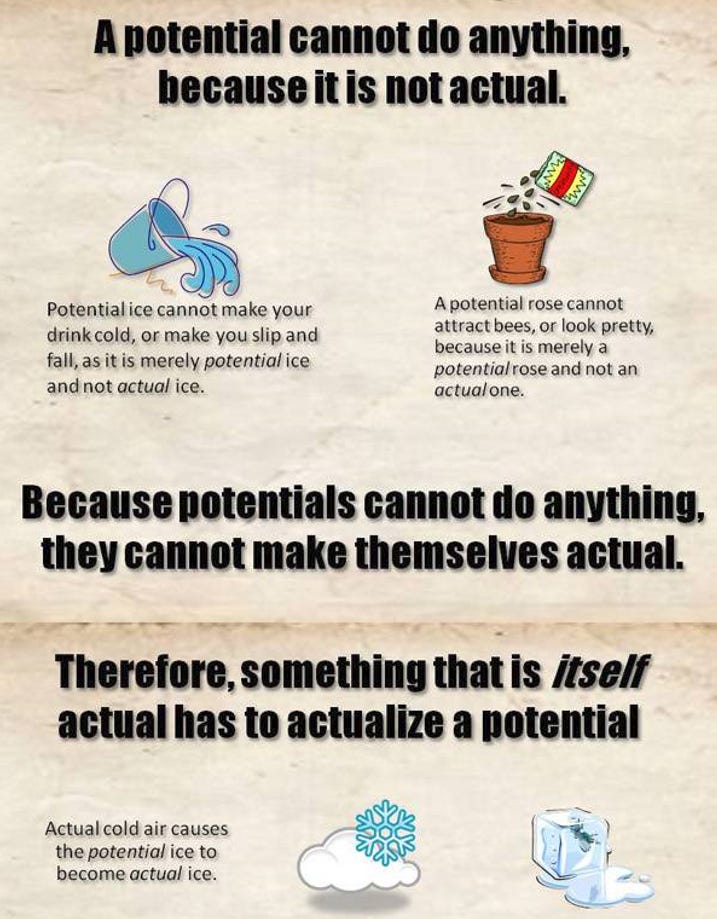
The second thing to notice is that each change requires a changer. I have pale Irish skin and poor discipline about reapplying, so I always have the possibility of sunburn, but my (possible) sunburn can’t cause itself. How could it? It doesn’t exist yet! A mere possibility cannot affect the world! Only actual things can affect the world. My possible sunburn is made actual (every single year) by actual ultraviolet radiation, emitted from the actual sun. (This is followed by Sabina telling me I should have put more sunscreen on at the safety break.)
This is true for all our examples. The rock we dropped in the river is made smooth by the (actual) river. The bonfire is lit by an (actual) burning match. Your guys are thrown by the transferred motion of my (actual) arm. The hamburgers are shrunk by (actual) heat, which causes (actual) moisture in the patty to boil off. You got tall enough to ride the roller coasters at Valleyfair because your (actual) bones got longer, because your (actual) bone cells reproduced.
I stole this from an anonymous Thomist meme because I liked the illustrations. Yes, Thomist memes exist if you look hard enough. Although, note well, while you can’t slip on potential ice, you can very much slip on actual water!
In Book VIII of his Physics, Aristotle works through several logical proofs to make sure that, yes, every single change requires at least one changer. These proofs are good fun, but also… duh!
This leads us to the question where things start to get interesting: since there are all these actual changers going around causing changes, what made the changers actual in the first place?
Logically, there are only two inescapable possibilities. Either a changer became actual because some other changer made it actual… or the changer never became actual, because it was always actual. There is no third option.
It seems like, usually, changers are made actual by some other changer. For example, you got taller because your bone cells started making more bone cells. What made that process actual? Growth hormones, which communicated with the cells to tell them to start making more cells. What made the hormones actual? The (actual) pituitary gland made them, because your (actual) nutritious diet included enough proteins to fuel production, using food grown by the (actual) sun and rain, and so on.2 For all of these changers, they were made actual by another changer. None of these changers was always actual.
However, this chain of changers cannot go backward forever.
Of course, there are some things that can go backward forever, like the list of all negative numbers, or the length of a line that you cut in half over and over again, or you guys when I tell you it’s time to get ready for bed every night.
However, a chain of changers, where each changer depends on the changer before it, isn’t one of those things that can go backward forever. If a chain of changers went backward forever, then there would be nothing to get the whole series started in the first place. It would be like a train with an infinite number of boxcars but no engine. If you saw such a train moving and asked, “What’s pulling the boxcars?” and Sir Topham Hatt said, “Each boxcar pulls the boxcar that’s behind it,” you would correctly reply, “Yes, but what’s pulling the first boxcar?”3 You know full well that there must be a first boxcar, and there must be something pulling it, because otherwise the train wouldn’t be moving at all.
Or, again, it would be like a line of dominoes extending backwards into unknown mists far in the distance. If you see the dominoes tumbling toward and past you, you know right away that, somewhere in that long chain of dominoes—even if the line is infinitely long—something caused one of the dominoes (maybe the first domino, if there is one, or maybe some other domino in the line) to fall over, strike the next domino, and begin the chain reaction. If nothing had made one of the dominoes fall over, then no dominoes would be falling, and you would not have seen the domino chain reaction fall past you.
It’s the same with all the other changes we’ve seen. Every change requires another changer, and, so far, every changer we’ve seen is only explained by yet another changer. Eventually, there has to have been something that started the whole chain going, or the domino line of changes we see in the world around us couldn’t be happening.
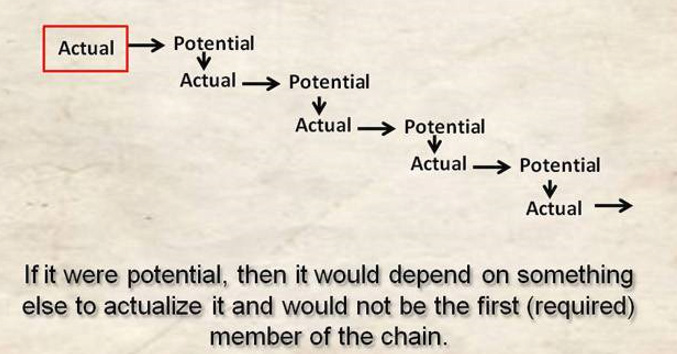
We are forced, then, to face the other possible explanation for a changer. As I said, logically, there are only two possibilities: if a changer didn’t become actual because of some other changer making it actual… then it must be the case that the changer never became actual, because it was always actual. There is still no third option. Aristotle realized that every single change we see in the world today can only be explained by something that has always been actual. When we see any change, either it is directly caused by something that has always been actual, or it is caused by some other changer. If it was caused by some other changer, then that changer must either be caused by something that has always been actual, too, and so on until—inevitably, inescapably—we arrive at some changer that has always been actual, an Unchanged Changer. Aristotle proved that at least one Unchanged Changer must have always been actual, as a bedrock logical certainty.
This is also from the anonymous Thomist meme.
“Always” is a big word. We don’t know whether time had a beginning. Some physicists think yes, others no. If time has no beginning, then any Unchanged Changer must have been actual from all eternity. If time does have a beginning, then time itself has changed, and any Unchanged Changer must have been always actual before (and therefore beyond) time itself. Science and philosophy also cannot say whether the universe has always existed, or whether it has always been changing. (Aristotle thought yes.) We have no information prior to the final 10-32 seconds of the cosmic inflation period, and it may be in principle impossible to ever find out. All we can say at this point is that, if the cosmos has always existed, any Unchanged Changer was part of it.
Now, you might be thinking, “Oh, that sounds like God. Is that God?” You might even be rolling your eyes—I can perfectly imagine your face from here, years in advance—and saying, “Yes, Dad, I know it’s God, they taught me this in sixth grade ugh you can stop trying to be so sneaky about it.”
True enough. We pay the big bucks for Catholic school so that you are exposed to these ideas early and often. Mrs. Quillan did a great job covering this in sixth-grade theology.4 However, that was the sixth-grade version. When you learned this argument, it ended here, with “…and the Unchanged Changer is God.” You simply have to take shortcuts when teaching sixth-graders philosophy. However, you’re older now, and I’m preparing you for the rest of your life, so we can’t take that shortcut today.
When I was in a ninth grade study hall period in the St. Thomas Academy library, I came across a book of collected readings in philosophy. In that book, I read a lecture by the mathematician Bertrand Russell called, “Why I Am Not A Christian.” Now, you mainly know Bertrand Russell as the inventor of Numberwang, but he was a brilliant and amiable mathematician. He was also an atheist. In his lecture, he talks about the proof I have just given you:
It is maintained that everything we see in this world has a cause, and as you go back in the chain of causes further and further you must come to a First Cause, and to that First Cause you give the name of God. […But!] If everything must have a cause, then God must have a cause. If there can be anything without a cause, it may just as well be the world as God, so that there cannot be any validity in that argument. It is exactly of the same nature as the Hindu’s view, that the world rested upon an elephant and the elephant rested upon a tortoise; and when they said, ‘How about the tortoise?’ the Indian said, ‘Suppose we change the subject.’ The argument is really no better than that.
When I was fourteen and read the whole lecture, these two points hit me hard:
“If everything has a cause, God must have a cause.” (Thanks in part to this lecture, this objection is broadly known all over the world today as “turtles all the way down.”)
“If there can be anything without a cause, it may just as well be the world as God.”
These points troubled me, and led me to abandon Aristotle’s unchanged-changer argument for several years. (I took refuge in St. Anselm, Pascal, and Descartes, who were also in that book—although I’m a bit embarrassed about it today—and in C.S. Lewis.) It was not until college that I started taking Aristotle seriously again, and it still took me months of reading to slowly become convinced he was right after all.
I hope, though, that you have already spotted the obvious hole in Russell’s first objection: Russell says that Aristotle’s argument claims that everything has a cause. That’s false! As I pointed out earlier, Aristotle’s argument simply observes that some things change, and those changes have a cause. He never assumes that everything has a cause. For Aristotle, things that don’t change don’t need causes. Russell has completely misstated this argument, to his loss! Unfortunately, I had been careless in studying this argument, so I missed Russell’s error completely. I spent years thinking a valid rebuttal to the Unchanged Changer was, “Oh, yeah? Well, who made the Unchanged Changer? It’s turtles all the way down!” If I’ve spared you that mistake, these letters are worth it for that alone.
The second objection, however, has more force. In fact, against the sixth-grade version, Russell is clearly correct. We have done absolutely nothing to show that the Unchanged Changer is God.
Indeed, Aristotle himself had no idea that the Unchanged Changer was God! Aristotle was a Greek pagan who lived 350 years before Christ. He probably never even heard of our God.5 That’s one of the things I admire so much about Aristotle: he tracked down the truth even without the benefit of revelation, with a mind unbiased by a monotheist upbringing.
Here are some of the many other things the Unchanged Changer could be:
The universe itself
Some random chunk of matter—say, one small piece of fairy cake (as used in the Total Perspective Vortex, before Zaphod Beeblebrox ate it)
The Big Bang itself
Zeus
The entire Greek pantheon (Zeus, Hera, Athena, Poseidon, the whole gang)
The Sun, worshipped as the prime creator power by several religions
A whole host of immaterial nameless omnipotent Gods outside the universe
Every single human mind could be its own Unchanged Changer. (Aristotle points out that his predecessor Anaxagoras taught exactly this.)
In the sixth-grade version, you don’t rule out any of these things. We must.
Continuing to follow Aristotle (and his medieval heir, St. Thomas Aquinas) we will continue this adventure in the next letter.
Unchangingly, Dad
UPDATE 5 August 2026: A reference to Anaximander should have said Anaxagoras. I regret the error.
De Civitate is a reader-supported publication. To receive new posts and support my work, consider becoming a free or paid subscriber.
Aristotle calls time “the number of change” or an “affection of change,” intimately linking change and time. Physics VIII.I, Bekker 251b19–23. I’m mentioning this in a footnote to you readers, not to my daughters, because I think it is sometimes overlooked, which can lead the budding philosopher into trouble, particularly when he is drawn into some of the controversies we will explore in Footnote 2. Aquinas’s arguments do not necessarily require the change occurring over time. Aristotle’s do.
At this point, some readers well-versed in cosmological arguments may fear that I am accidentally going off the rails. “Oh no!” they may say, “He is basing his argument on a causal series ordered per accidens, not per se!” That is true—in a sense. It is not an accident (haw haw).
For those less well-versed in cosmological arguments, I will fill you in on what the blazes I am talking about!
(Heads-up: this footnote is one for the philosophers, and I won’t spare the horses. This footnote has section headers. This footnote has its own internal footnotes! (These are marked by asterisks and can be found by doing a ctrl-F search for the word “Footfootnote.”) A footnote with footnotes is not going to be a short read. This is your only warning!)
Two Kinds of Causation
The medieval Scholastics identified two types of causal series: per se (“essential”) and per accidens (“accidental”). In a per se series, the causal activity of each member of the series (other than the first) is essentially (not accidentally) dependent on the causal activity of a prior member. All other causal chains are per accidens, in which members of the series depend on prior members only accidentally.
Of course, this is baffling abstract jargon, so the Thomist (or Scotist) instructor now explains via illustration. The illustration usually involves juxtaposing a linear series of loosely connected changes preceding backward in time (a per accidens series) versus a series of closely connected changes happening right now at this very moment (one form of per se series).
Causal Series Per Accidens
Your instructor might start with the classic example of the builder and his collection of hammers. At first, the builder uses one hammer, dubbed hammer1, to build a wall. Then, hammer1 breaks, so the builder goes and grabs another, hammer2, and gets back to work. Then hammer2 breaks, so the builder uses hammer3, and so on until (let’s say) hammer1337, at which point the builder has exhausted the hammer supply at Menard’s and has to take a few weeks off. (Apparently hammers broke a lot in the thirteenth century.)
In a sense, hammer1 caused the builder to use hammer2 (by breaking), and hammer2 caused the builder to use hammer3. In a sense, then, this forms a linear, causal series of hammers over time: Hammer1 → Hammer2 → Hammer3… → Hammer1337. However, hammer1 did not actually impart anything (causally speaking), to the builder or to hammer2, much less to hammer42. The fact that hammer2 was used before hammer807 is merely accidental. None of the hammers depends on any other hammer; the activity of each depends solely on the builder. That makes the series of hammers a per accidens causal series. (By contrast, the series Builder → Hammer → Nail → Wall is a per se causal series, but we’ll get to that.)
Alternatively, consider a certain ecosystem, where insects, spiders, and mammals live in perfect ecological balance. The insects eat plants, the spiders eat the insects, and the mammals eat the spiders. Ten million years later, a novel disease arises, fatal to spiders. Ten million years after that, the last spider succumbs to the disease, and both spiders and disease go extinct. Ten million years later, the insect population has exploded (because there’s no more predators) and the mammals go extinct. (The mammals tried to live on plants as an alternative food source, but were gradually crowded out by the growing insect population eating those same plants.) Ten million years later, an invasive bird species enters the ecosystem. The birds mostly eat plants, but there are few plants (the bugs eat most of them) and lots of bugs. Over the next ten million years, the birds evolve to eat insects, and the ecosystem finally finds a new balance.
In a sense, the disease is the cause of the birds evolving an ability to eat insects. However, the disease plays no direct causal role in the birds’ evolution. The disease didn’t infect the birds and mutate their genes. (It couldn’t! The disease died out twenty million years before the birds started evolving!) Nor did the disease pass anything on to the insects that the insects then passed on to the birds. All the disease did was create certain new conditions, which, accidentally, favored the birds, who accidentally (at least from the perspective of this causal chain), wandered into the ecosystem because the disease had (again accidentally) caused the extinction of the predator mammals. The final outcome probably would not have happened without the disease, but it could have, through some alternative causal mechanism. Either way, the disease’s causal power played no role in subsequent cause-effect pairs in this ecosystem.
Causal Series Per Se
The classic example of a per se causal series is a man’s hand holding a stick, which the hand uses to push a stone, which, in turn, pushes a leaf. Here, the leaf’s movement depends directly on the stone’s movement, which depends directly on the stick’s movement, which depends directly on the hand’s movement (which depends directly on certain changes in the arm muscles, and so on). The actual transmission of causal power through this chain from its first member to its last marks it off as a per se causal chain. Notice, too, how, in this example, everything is happening simultaneously. It’s not one damned thing after another. The hand is acting right now, in this moment to move the leaf, through a chain.
As I said, this simultaneity is a very useful way for instructors to force learners to grasp the difference between per se and per accidens causal series.* However, simultaneity is not essential. To illustrate, another example:
There is ice cream in my freezer. It is ice cream right now, at this moment because it is frozen. It is frozen because right now, at this moment, the air in the freezer is quite cold, which is true right now because of the refrigeration coil pulling heat out of the icebox, which is happening right now because its compressor is running on electricity, which is happening right now because electricity is flowing freely over the grid, which it’s doing right now because there’s some turbine mid-spin at the power plant in Monticello, MN right now which is producing the charge, which which is spinning because of steam from an ongoing nuclear reaction happening right now, and so on.
However, when we look more closely, we see that this is not entirely simultaneous. The electricity generated at this very instant in Monticello is not the electricity actually consumed by my compressor, since electricity only travels over the grid at the speed of light. The electricity consumed by my compressor now was generated ~0.00028 seconds ago. Those joules of electricity, once on the grid, no longer have any current (haw haw) causal dependence on the nuclear reaction. When we look closely, we can see delays of this sort at every step of transmission along the causal chain. Often, those delays are measured (as here) in microseconds, like the delay between the brain telling the hand to move the stick and the hand actually doing so.
However, sometimes, the delays are much longer. Take the case of the starlight from distant suns reflecting off telescope mirrors to create a photographic image. The stars that generated that light may have died out millions of years ago, but the light already in transit, no longer dependent on the generative power of the star, may have been striking us since before mammals evolved, and may continue to reach our surface until long after humanity has gone extinct—all without an extant causal generator. This causal chain Star → Starlight → Mirror → Photograph is nevertheless an example of a per se causal series (even after Star dies), for two closely related (but, as we will see later on,not quite congruent) reasons:
Each subsequent member of the chain is dependent on its cause as such, not accidentally (like the builder with his hammers).
If any prior member of the chain ceases its causal activity, all subsequent effects will cease—not necessarily instantly, not even necessarily within the timescale of human civilization, but eventually.
A High-Stakes Distinction
The distinction between causal series per se and per accidens is very important in the argument we are making today, because Aristotle, the Thomists, and I all argue that an infinite regress is impossible in a causal series per se—but we all accept that an infinite regress is theoretically possible in a causal series per accidens.
In fact, Aristotle positively affirms that the world is both eternal and eternally in motion, which practically entails infinite causal series per accidens. So when Aristotle, Aquinas, and I make arguments about the impossibility of infinite regress in causal series (as I am indeed about to do in this letter), it is critically important for us to be talking about per se causal series, not per accidens causal series.**
The Thomistic Tradition’s Pure Per Se
In pursuit of the purest of pure per se causal series, as far as possible from any conceivable allegation of reliance on a per accidens series (and for other reasons), Thomism as a tradition has generally construed Thomas Aquinas’s argument from motion (which is based on Aristotle’s argument from motion) as illuminating a chain of formal and material causes that exist in this very moment, and which explain the fact that anything continues in existence from one instant to the next. Each cause in this chain is truly simultaneous with its effect, and exhibits total dependence on each prior member. This form of the argument does not just prove a First Unmoved Mover, but a whole First Cause of Being, with the entire Doctrine of Divine Conservation thrown in as a side dish! Edward Feser sets out the premises of this “reconstructed” Thomist form of the argument from motion in his 2011 paper for the ACPQ (my very favorite philosophy journal), “Existential Inertia and the Five Ways”:
That the actualization of potency is a real feature of the world follows from the occurrence of the events we know of via sensory experience.
The occurrence of any event E presupposes the operation of a substance.
The existence of any natural substance S at any given moment presupposes the concurrent actualization of a potency.
No mere potency can actualize a potency; only something actual can do so.
So any actualizer A of S’s current existence must itself be actual.
A’s own existence at the moment it actualizes S itself presupposes either (a) the concurrent actualization of a further potency or (b) A’s being purely actual.
If A’s existence at the moment it actualizes S presupposes the concurrent actualization of a further potency, then there exists a regress of concurrent actualizers that is either infinite or terminates in a purely actual actualizer.
But such a regress of concurrent actualizers would constitute a causal series ordered per se, and such a series cannot regress infinitely.
So either A itself is purely actual or there is a purely actual actualizer which terminates the regress of concurrent actualizers.
So the occurrence of E and thus the existence of S at any given moment presupposes the existence of a purely actual actualizer.
The example Feser gives (in his Five Proofs of the Existence of God, p22) is coffee: coffee is composed mostly of water. Water only exists insofar as the potentials of oxygen and hydrogen are actualized right now… and so on down a chain: (coffee →) water → H2O chemical bonds → hydrogen + oxygen atoms → atomic structure → subatomic particles → […?] → some Purely Actual Actualizer.
Feser is hardly out over his skis. Feser is simply putting down on paper (more or less) how every prominent Thomist of the past century presents the First and/or Second Way: F.C. Copleston, Etienne Gilson, both of my parents, Fr. Roland Teske S.J., Dennis McInerny, and more besides. (Feser has an incomplete list in footnote 16.)
Moreover, for the record, the argument strikes me as valid and sound. Aside from some reservations about Premises #3 and #6b (both of which, my parents tell me, will be salved if I read De Ente et Essentia), I have no objection to the argument. I think the argument requires a pretty big pre-existing Scholastic metaphysical apparatus before it can go through, which makes it both harder to defend and harder to explain (especially when explaining God to a child), but I admire this argument’s elegance and its purity. Once it’s gone through, it brings with it rather strong claims about the nature of the Purely Actual Actualizer for free, which is very useful later on.
Aristotle’s Impure Per Se
Nevertheless, one is within his rights to notice that, although this “reconstructed” argument of Thomistic tradition can be coaxed into fitting the text of Aquinas’s First Way in the Summa Theologiae, Aquinas’s argument in the Summa Contra Gentiles is expressly based on Aristotle’s argument in Physics VIII—and this “reconstructed” argument bears little resemblance to the argument Aristotle makes there, an argument that is pretty clearly built around normal, everyday, available-to-the-senses causal chains like “wind moves stone into tree and tree falls down”.
Aristotle does not use these as mere analogies for how the tree itself continues in being from moment to moment thanks to an ongoing actualization at each “layer” of its material and formal causes. Aristotle literally means that the causal chain runs Tree Falls Down ← Stone Hits Tree ← Wind Blows Stone ← Wind Stirred Up by the Spinning of Heavenly Bodies ← Heavenly Bodies Spun by Unmoved Mover, who is imagined to be sitting sort of just beyond the outermost sphere of stars, right at the circumference of the universe, spinning the universe in a circle like a cook stirring a pot of pasta water.
Aristotle is deadly serious about this. Aristotle spends a large chunk of Physics VIII arguing that “locomotion is the primary motion.” He spends all of chapters 8 and 9 elaborately arguing that the Unstirred Stirrer must be stirring with specifically circular locomotion, not rectilinear locomotion. (Of course, the Unstirred Stirrer does not stir with, like, a giant cosmic spoon; it cannot, itself, move. Instead, it stirs the celestial spheres “as being loved.”)
Now, I’ve made Aristotle’s argument sound rather funny, but don’t laugh too hard, because, outdated science aside, that’s more or less the argument I plan to make today. Aquinas, too, took Aristotle extremely seriously. Whether or not St. Thomas intended to grow this rather straightforward argument into a metaphysically purer argument for Divine Conservation (as the Thomist tradition has done), I can’t say, but I certainly don’t think Aquinas considered Aristotle’s more obvious approach invalid.
Why This Footnote is Necessary
There is a certain meme in certain corners of the Internet that Feser’s reconstructed argument, above, is the only sound argument from motion, the only Thomistic argument from motion, and the only Aristotelian argument from motion, because that argument alone relies on only the purest, absolutely simultaneous, locally-sourced, pasture-raised, blue-meth-qualityper se causal series. These are very helpful people who just want you to make the best possible argument, and will assume you are making an innocent mistake if you make a different argument from motion, which they will then try to correct. (I know, because I have been this person once or twice!)
In this edition of Letters to My Daughters, I build my argument around the casual chain Bone Growth ← Cell Division ← Growth Hormone ← Pituitary Gland ← Nutrition ← Food ← The Sun and so on, a series that clearly isn’t simultaneous in the same way Feser’s reconstructed argument is. Shortly thereafter, I use an example of a falling domino line, an example that is explicitly criticized in some circles. I therefore expected a well-meaning Thomist or two to pop up in the comments to try to help me.
So let me reassure such Thomists: maybe you’re right that yours is the only sound argument from motion, and I can’t say whether it’s the only Thomistic argument from motion, but it certainly isn’t the only Aristotelian argument from motion. If I am making a mistake here, it’s anything but innocent!
In the balance of this footnote, I will argue against the factors that have led so many well-meaning Thomists to think that my bone growth argument is unsound.
Haldane’s Reviewer Problem
In Atheism and Theism (Smart & Haldane, 2002, pp116-), the prominent ThomistJohn Haldane provides a useful example of a per se causal series, which I will quote at length because, frankly, this far into the footnote, you’re already pot-committed:
A few years ago, in keeping with general developments throughout the British education system, the University of St. Andrews decided to introduce a staff appraisal scheme. This was to involve a system of ‘progress review’ according to which every member of the university would periodically be reviewed by a colleague. A draft was circulated setting out the various arrangements for the introduction of the proposed scheme. It included a section on the role and responsibilities of reviewers, from which I quote:
“The reviews of colleagues who have not been reviewed previously but are to act as reviewers will also have to be arranged… so that all reviewers can be reviewed before they review others.”
The well-intentioned point was that no staff should act as reviewers who had not themselves already been subject to the review process. Additionally the system was to be self-contained: no one’s reviewed status could result from having been reviewed out[side] the university. …If no one could conduct a review unless and until he or she had been reviewed, and that could only derive from within the system, then the process could not begin.
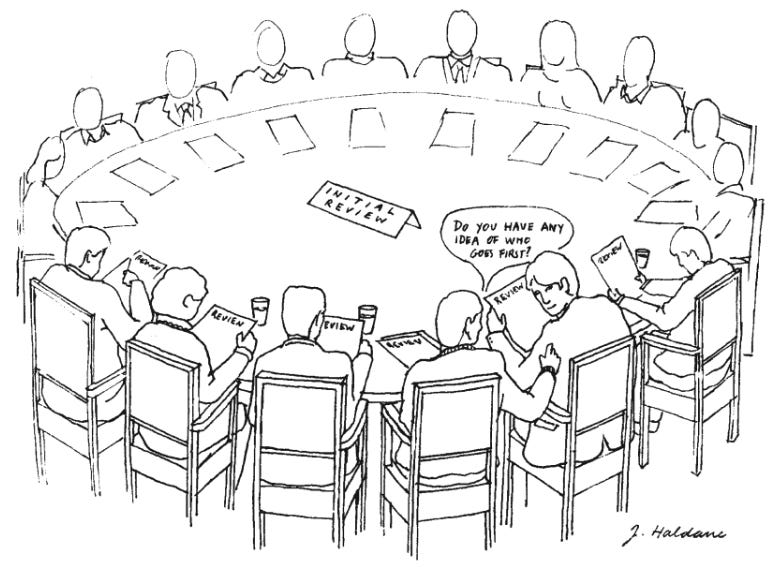
“Do you have any idea of who goes first?”
…I chose a circular seating arrangement at an initial review to highlight the problem. Suppose, however, that I had arranged the figures in a line receding into the distance, each awaiting review by his predecessor. That would have diminished the effect [of my cartoon] but would it have diminished the problem? Clearly not if the line were finite, since if the member nearest had been reviewed then given the rubric there would have to be a first reviewer (however that had been effected). Assume, though, that the review scheme was already in existence and had been for as long as the university has existed. St Andrews received its Papal Seal in 1413, so on this assumption those currently reviewing would depend in this respect on predecessors no longer existing—still there would have to have been a first reviewer (deemed such by Pope Benedict XIII, say). Suppose, however, that the university has always existed (and perhaps always will) with each reviewer having been reviewed by a predecessor and reviewing a successor ad infinitum. Given these assumptions, can one still argue that there must be a first cause of the series? …For unless there was a reviewer who had not been reviewed—an originating source of the causal power to review—how could the series exist?
The issue is not dealt with by adverting to mathematical infinities. Suppose we draw a section of the number line and just identify some point as -1, then there is a prior point -2, and its predecessor -3, and so on. That is not in dispute; what is contested is that any such infinite series could be one of intrinsic causal dependence. Here we need to distinguish between a series of items the members of which are, merely as it happened, causally related to one another, and a series whose members are intrinsically ordered as cause and effect. To adopt Aquinas’s scholastic terminology, the first is a causal series per accidens (coincidentally), the second a causal series per se (as such). We can (perhaps) imagine objects, marked off by points in the number line and receding to infinity, among which there are causal relations; but this is not an intrinsic causal series. Contrast this with the situation in which each effect is an effect of its predecessor and a cause of its successor: but for object -2, object -1 would not be, and but for object -3, object -2 would not be, etc. Here it is essential to any item’s being a cause that it is also an effect; but it is not necessary that they be temporally ordered, for in this case the terms “predecessor” and “successor” are not being used in an essentially temporal way. That is what it means to speak of a “per se causal series.” Since the existence qua cause of any item is derived from the causality of a predecessor there has to be a source of ultimate causal power from out[side] the series of dependent causes—an ultimate and non-dependent cause.
Haldane then begins the customary rant about David Hume, which, in this case, runs four well-deserved pages.
I’ve taken pains explaining Haldane’s Reviewer Problem because I have said that per se causal series are so-called for two reasons:
Each subsequent member of the chain is dependent on its cause as such, not accidentally (like the builder with his hammers).
If any prior member of the chain ceases its causal activity, all subsequent effects will cease—not necessarily instantly, not even necessarily within the timescale of human civilization, but eventually.
I have also said that these reasons are not quite congruent—and here we have an example of the incongruence.
Haldane’s Reviewer Problem poses an example of a per se causal series where each subsequent member of the chain is dependent on its cause as such, but the effects will not cease if prior members of the causal chain cease to exist. If some Prime Reviewer in 1413 (or whenever) reviews a faculty member (granting that faculty member the power to review), the reviewed faculty member will retain the power to review even if, two seconds later, the Prime Reviewer unexpectedly drops dead of myxomatosis. Put another way, the Prime Reviewer’s continued existence or non-existence is irrelevant to the reviewed faculty member’s exercise of that power. But wait!
Edward Feser, in chapter 3 of his Aquinas: A Beginner’s Guide, gives an example of what he considers a quintessential per accidens series:
On the one hand, there are causal series ordered per accidens or “accidentally,” in the sense that the causal activity of any particular member of the series is not essentially dependent on that of any prior member of the series. Take, for example, the series consisting of Abraham begetting Isaac, Isaac begetting Jacob, and Jacob begetting Joseph. Once he has himself been begotten by Abraham (and then grows to maturity, of course), Isaac is fully capable of begetting Jacob on his own, even if Abraham dies in the meantime. It is true that he would not have existed had Abraham not begotten him, but the point is that once Isaac exists he has the power to beget a son all by himself, and Abraham’s continued existence or non-existence is irrelevant to his exercise of that power. The same is true of Jacob with respect to both Abraham and Isaac, and of Joseph with respect to Abraham, Isaac, and Jacob. Given that we are considering them as a series of begetters specifically, each member is independent of the others as far as its causal powers are concerned.
It seems, then, that Haldane’s Reviewer Problem qualifies as a per se causal series on some definitions of a per se causal series… but, on others, it does not. If non-accidental causal dependence suffices, it counts. If some form of simultaneity is required, it doesn’t. This is crucial, remember, because only a per se causal series is immune to infinite regress.
Perhaps Feser and Haldane (longtime comrades in the school of Analytical Thomism) are aware of their subtle disagreement. Perhaps it has already been discussed in the literature. Perhaps I am just very confused! But, to me, this subtle (apparent) difference of opinion was a revelation, and I know I’m not the only person on the Internet who will find it so.
Feser’s view that a per se causal series must feature some degree of simultaneity (a view that seems widely shared among modern Thomists) is the reason my argument from motion is said to fail. In this letter, I rely on a causal chain (the bone growth example) that extends backwards in time, without any kind of simultaneity. I’ve admitted this is a less-pure “off-brand cola” per se causal series, but Feser’s (quite popular) view is that it isn’t a per se causal series at all, but per accidens. If it’s per accidens, it can regress to infinity without contradiction, and my whole argument falls apart. Haldane appears to disagree with Feser.
Feser, however, has an advantage: it sure looks like Aquinas agrees with him!
…it is accidental to this particular man as generator to be generated by another man; for he generates as a man, and not as the son of another man. For all men generating hold one grade in efficient causes—viz. the grade of a particular generator. Hence it is not impossible for a man to be generated by man to infinity; but such a thing would be impossible if the generation of this man depended upon this man, and on an elementary body, and on the sun, and so on to infinity.
On my view, and (it seems to me) on Haldane’s view, human beings creating other human beings is a per se series.
Here, Aquinas says that it isn’t, that begetting children is per accidens, which agrees with Feser.***
Cross-Examining the Angelic Doctor
One possible response to this is that we are Thomists, not mere Thomas-scholars. Our primary concern is the Truth, not exegesis of a dead man—even a man as wise as Thomas Aquinas. (I stole this from Ralph McInerny.) If Aquinas is wrong, he’s wrong! Oh well! It happens to everybody.****
I don’t know whether Haldane would say this, but I will: Aquinas is wrong to say that a father begetting a father is a per accidens causal series that can regress to infinity. It cannot regress to infinity, so it is a per se causal series, because each member of the series depends on the causal activity of the previous member of the series as such, not accidentally.
The act of conceiving a woman in her mother’s womb passes on to that woman the causal power to conceive a daughter in her own womb (among other causal powers). It is true that the daughter who is trying to conceive does not need any ongoing activity from her mother in order to achieve conception. Indeed, the mother does not even need to be alive for her daughter to conceive! This means, admittedly, that the moms-beget-moms causal series is less of a “pure” per se causal series than the chain of instantaneously-activated matter and form favored by modern Thomists. Nevertheless, the arguments against infinite regress still go through just fine.
To return to our examples from earlier: the daughter, when she performs the act of conceiving her mother’s grandchild, more closely resembles the starlight emitted from a dead sun than she resembles one of the hammers in the builder’s collection, or the bird evolving to eat insects. Haldane, I believe, has already shown this in the excerpt I quoted above (and in surrounding material). I intend to show it to my daughters, in simple language, in the next part of this letter. To the extent that Aquinas disagrees with me, I believe that St. Thomas Aquinas is wrong.
You may think that doesn’t sound very likely. What are the odds that I’m right about something when St. Thomas Aquinas says the opposite?
I answer that: it depends on the topic. Thomas Aquinas is rarely wrong on philosophical principles, which never change. That’s why we still pay so much attention to him! However, Thomas Aquinas is often wrong on scientific claims, because he lived in the thirteenth century, and the body of scientific knowledge has changed a lot in eight hundred years. There’s a whole cottage industry in bringing Aquinas’s principles to bear on modern knowledge!
I wish to suggest today that Aquinas claimed begetting was a per accidens causal series because Aquinas made a scientific, rather than a philosophical, error. I stand by my claim that Aquinas is mistaken either way, but I like my odds of prevailing a lot better if our disagreement is scientific.
Medieval Reproductive Biology
It is important to remember that Aquinas’s understanding of embryogenesis was radically different from our own. Aquinas believed that, after copulation, the semen encountered menstrual blood. Rather than fusing together, the semen enveloped the menstrual blood and began to reorganize its matter, similar to the way a cucumber in brine becomes pickled or (as Aristotle put it) the way milk in rennet becomes curdled. (The whole body of the eventual infant is composed of reorganized menstrual blood, with no material contribution from the man.) At the first stage of development, the semen (exercising the generative power of the father’s soul, albeit remotely) organizes the blood into a sort of an organless, nutritive paste. Then the semen destroys this paste by building enough organs to replace it with a primitive animal. At this point, the semen “is dissolved” and its active principle “ceases to exist,” as the animal-entity takes over development… at least until God kills the animal and infuses its corpse with a rational soul instead. (A convenient overview with extensive quotations is given by Stephen Heaney (some relation) in, “Aquinas and the Presence of the Human Rational Soul in the Early Embryo”, which I have paraphrased quite liberally.)
You may wonder how Aquinas thought children ended up with traits different from their parents, since he had no concept of genetic inheritance. Astrology, of course! While taking a dim view of divination or blaming free choices on the stars, Aquinas earnestly defended the view that a child’s sex and other traits may be influenced by the constellation under which he was born (Summa Theologiae I.115.3, obj. 3 and reply), since the locomotion and heat of the celestial spheres stirred up and affected all other changes under heaven (insofar as inferior matter was disposed to receive it). These heavenly changes could affect what I will dub the “embryonic brining process,” the same way hot weather could affect a cheese-curdling process. This led Aquinas (at ST I.76.1 ad. 1) to affirm Aristotle’s conclusion that “man and the sun generate man,” not the human species alone. Hence that odd last clause in Aquinas’s argument about parental causal series:
…but such a thing would be impossible if the generation of this man depended upon this man, and on an elementary body, and on the sun, and so on to infinity.
I emphasize that this bizarre-sounding embryology was entirely reasonable, given scientific knowledge of the time! It was, however, wrong.
We now know that the generation of human beings from copulation is far more immediate, and depends far more on the innate powers within semen and (surprise!) ovum, than Aquinas could have imagined. Aquinas says that, when a man generates, he “generates as a man, and not as the son of another man.” Sed contra, we now know that, in fact, when my mother generated me, she did so precisely as the daughter of her mother. I was not formed out of some generic lump of blood by semen-brine and the sun. My mother passed to me the genes and very particular blood of Merc Maloney (her mother) and Mayme Lynch (her mother) and Kate Durkin (her mother). When I, in turn, generated my children, I did so precisely as the son of Anne, grandson of Merc, great-great-grandson of Kate, and my wife simultaneously generated as the daughter of her mother and father.
We now know, as Aquinas did not, that this sperm and ovum bearing this genetic material fused together immediately on contact, destroying themselves in the process and leading, by a quick (arguably instant) process of generation, to a new organism, Sabina Rose. My seed did not hang around as a brining solution for weeks and then dissipate, its vital force expended. It underwent substantial change with the ovum and became, directly, my daughter. Sabina may, someday, generate from our blood. If she does, she will have us to thank for it, since we transmitted our own inherited generative causal power to her. (Aquinas largely denied inheritance.) Her creation of my grandchildren will depend, in part, on me—not accidentally, but essentially—even if I am dead at the time.
I like to think that, upon learning these facts, Aquinas would agree with me that begetting children is a per se causal series (which must therefore have a first member). Still, he might not. If St. Thomas still disagreed with me after all that, then I would contend that Aquinas is mistaken.
Okay, enough about Aquinas’s theory of reproduction. I went through this long digression only to suggest that Aquinas (if given updated scientific knowledge) might agree with my main argument in this footnote. That argument was:
Bring Us Home, John
There are certain causal series that cannot regress to infinity, even though the termination of prior members in the chain does not result in the cessation of subsequent members, because they are (nevertheless) per se causal series. Examples include Haldane’s Reviewer Problem, my bone growth example in this letter, and parents begetting children.
In making this claim, I do nothing at all to disparage the instantaneous divine conservation argument advanced by Edward Feser and many other Thomists, for whom my respect is as endless as a causal series with no first member. If my position is admitted, the divine conservation version of the argument still works just as well as it does today. It remains the blue-meth standard of Thomism.
My claim is merely that other versions of the argument (like Haldane’s) also succeed. Since they succeed, there are occasions where it is appropriate to use them in lieu of the divine-conservation version.
…like this letter. We now return to our regularly scheduled Letter to My Daughter and its per se causal series in progress.
*FOOTFOOTNOTE 1: Emphasizing the simultaneity of per se causal series is also—and this is no small thing—a very useful way to poke a fork in David Hume’s eye. Hume believed that all causes were temporally prior to their effects, made kind of a big deal about it, broke not just metaphysics but science in the process, and then tried to walk away whistling innocently. Many Thomist accounts of per se causal series involve a two-page rant about David Hume, with varying degrees of rudeness. Feisty Feser does it, naturally, but so does the (scrupulously reserved) “Simple-Minded Freddy” Copleston, and John Haldane even manages to do it without bringing up simultaneity in the first place! It is sometimes remarked that, for Thomists, hating Descartes is a terminal value, but Hume might rival the Frenchman for that prize.
**FOOTFOOTNOTE 2: I should note that Aristotle himself makes the per se / per accidens distinction only implicitly, since Aristotle himself never draws any essential / accidental distinction at the level of the series. He spends an enormous amount of effort distinguishing between “accidental” (κατὰ συμβεβηκὸς) and “essential” (καθ’ αὑτά) changes at the level of the individual cause. He even originates the man-holding-stick-pushing-stone example of the per se causal series in his proof of the Unmoved Mover! However, Aristotle himself never zooms out enough to expressly endorse the per se / per accidens distinction. (This means he also offers no definition of his own for it.) The fact that “per accidens” and “per se” are both in Latin, not Greek, gives you a pretty big hint that the distinction was a medieval development. Aquinas and I make this distinction, but Aristotle only hints at something like it.
Also, it’s worth noting a few differences of opinion on the world’s eternity: whereas Aristotle positively affirmed an eternal world, St. Thomas, as a Christian, rejected it in favor of the Genesis account (God created the world ex nihilo). However, Aquinas also maintained that God’s creation of the world cannot be confirmed by philosophy, and that Aristotle’s position was therefore philosophically reasonable. Aquinas held the door open for Aristotle.
For my own part, I am surprisingly agnostic about the details of the world’s beginning—much moreso than Aquinas himself, and possibly moreso than a Christian has a right to be. This is because of what we have learned in recent decades about the relativity of time, the indefinite cosmic inflation period leading up to what we know as the Big Bang, and hypotheses like Richard Dawkins’ “universe factory” that push the causal start of our own universe into entirely different—but still non-eternal—spacetimes. I’m just not quite sure what it means to say that the world “began” if time itself has a beginning, which it might. I suppose it would mean the same thing as saying that angels “began”—but, when we say that angels began, we have to qualify it pretty heavily.
***FOOTFOOTNOTE 3: A small irony here is that Aquinas himself did not believe in an infinite series of begetting and begetters. He thought the world was created ex nihilo by God at a particular time in the past. He argued for the logical possibility of an eternal world to defend the logical coherence of his BFF Aristotle, who thought the world and motion had existed from eternity.
Irony upon irony though, Aristotle’s belief in the world’s eternity does not necessarily imply that human generation is eternal, nor, to my knowledge, did Aristotle ever claim it did. The world could be timeless even if humanity had a beginning—as, I contend, it must have.
Indeed, a wide range of evidence has now established, with virtual certainty, that humanity did have a beginning. (Human beings did not exist at the Big Bang, and never met any dinosaurs!)
So this whole footnote was made necessary by an argument that, it seems to me, Aquinas never needed to make in the first place. Oh, well!
****FOOTFOOTNOTE 4: I am not the first to directly contend that Aquinas made an error when he presented begetting as a per accidens causal series. Alexander Pruss raised objections to it in 2023. However, Pruss’s objections come in from a slightly different angle, and his proposed resolutions are therefore rather different from mine as well.
WORKS NOT CITED: There are some other things I read during the months I spent researching and writing this footnote that did not end up getting expressly cited in the footnote, but which I warmly recommend anyway (whether I agreed with them or not on this particular point in question):
Several long discussions with my parents in which Mom kept excitedly shouting “habens esse!” and Dad kept saying “I’m not sure that’s in the First Way,” and I thought how lucky I am to have them for parents. (Also Mom’s lecture notes on the De ente, the cosmological argument, Hume’s objections, and replies to objections.)
If you’re trying to closely read the Physics, Aquinas’s Commentaryon thePhysics will not save you any time at all, but his no-nonsense, “First, the Philosopher states his thesis, which is… Then, he states three arguments proving the contrary absurd. Then, he makes his first argument…” structure will nevertheless clarify a great deal.
Daniel Graham’s concise, chapter-by-chapter outline of Physics VIII, near the end of his 1999 Commentary on Physics VIII.
“Tennant on Aquinas’s Second Way,” by Edward Feser on his blog. (Yes, there is a lot of Feser on this list. Feser is prolific, writes for a lay audience, and makes much of his work available for free. If you want to make bank in philosophy…)
When I got deep into the biology stuff, I also wanted to talk about Aquinas’s delineation of accidental causes and effects in De Potentia, Q3, A6, ad. 6; his discussion of infinity per accidens in De Veritate, Q2, A10; and his discussion of disease inheritance (which he denied) at De Potentia Q3 A5 ad. 7. I cut it all to streamline the argument, since none of them are quite on-point either way, but any deeper discussion of that question will likely touch on those arguments.
Dear Mrs. Quillan, as you have no doubt noticed, these letters are addressed to both my daughters, so I must respectfully request that you continue teaching sixth-grade theology at [REDACTED] until Irene is through sixth grade. That will be in Spring of 2031. Otherwise, I will have to change the reference to “Mrs. Quillan” to “some unknown lady who’s definitely not as good a theology teacher as Mrs. Quillan” when I give Irene her copy of this letter. So I just need you to give up five years of your life so I can avoid making a minor edit. That’s it. That’s all I ask. Love James
These letters have been such fun to read! I've written some responses to other sections, but let's start with this part focused on the First Cause argument. I've kept the conceit of speaking to a smart kid, a fictional version of a friend's daughter, with no thought that the real one would see this.
-----
Many philosophers around the world, and not just from the European tradition your father draws from, have conceptualized cause, effect, and change in different ways. There are many philosophies of change that don't lead to the same conclusions about first causes. What seems like a bedrock logical certainty, as sure as the Pythagorean theorem for your dad, is anything but for much of the world, including for many philosophies quite distant from what he calls mechanical materialism. Around the time I first read Aristotle, I also translated a few passages of the Buddhist philosopher Nagarjuna from Sanskrit. Let's start from there.
How do we discuss the many things that change without an external changer acting upon them? What is the cause of a radioactive substance decaying? A flower will grow with sunlight, water, and nutrients, or it will wither and die for want of any of these. If we describe their presence as the changer causing growth, does it make equal sense to refer to their absence as a changer? Your dad definitely *can* fit these examples within his preferred philosophy of cause; the point isn't that this stumps him. But Aristotle's model of change is far from the only one. Is it the most informative one? Or is it just the one that takes you to this particular argument for God, which is where you want to go?
Following Nagarjuna, the more natural way of describing many phenomena would be to say that change, rather than stasis, is the normal flow of all things. Aristotle tells us that some things change, and things that do change have changers. We might instead observe that all things change, simply at different rates and scales, and in different ways depending on their conditions.
Aristotle takes stasis as the default, absent a changer. For example, he believed movement required continuous force. This is incorrect. Objects in motion tend to stay in motion, and nothing in the universe is fixed relative to everything else. In order to argue that the line of boxcars *must* have a first boxcar to start moving, you need first to take stasis as the default. Because I lack this assumption, it took me a rereading to recognize that your dad even *made an argument* that causal regress cannot be infinite. Without sharing a lot of prior assumptions, the argument looks quite a bit like "there has to be a first train because there has to be."
In Nagarjuna's model for change, cause and effect are not discrete from each other, nor is any object, whether material or immaterial, ever self-contained or unchanging. Cause, effect, and even the identification of objects are all human simplifications. Are the molecules from those freshly baked cookies that provide your sense of smell part of the cookie? Part of you? Some definitions make more sense than others for practical use, and Nagarjuna explicitly rejected nihilistic interpretations that nothing exists at all. But no definition of anything has clear lines around it as a feature of existence.
Instead of a string of changers taking us from potentials to actuals, we might regard "actual" as a convenient fiction at best. Once you get into Einstein and relativity, it turns out there is no such time as "now" shared among reference points, nor is the freezing of an instant something that ever happens other than as a conceptual tool. There is no "actual," no fixed present, no "current" state that is not in ongoing change, and no fixed existence or essence to anything. Instead an ongoing confluence of conditions leads to variations in speed, scope, and kind of continuous change.
Recognizing the fiction of "now" takes apart traditional per se causation as well. Aquinas grants that a sequence of changes could have infinite regress, so he makes up a category of cause that he says can't. But the way that your dad needs to debate whether any given causal series falls into per accidens or per se suggests that this is a human conceptual division, and maybe not a very clear one, rather than a feature of the universe. The stick pushing the stone, for example, superimposes a "present" upon the universe that is merely human perception compressing quick changes into a singular moment. Pushing a stick to move a rock does not move the rock "now"--that movement propagates at the speed of sound.
Thomists defend per se causation by making the argument ontological rather than temporal. This strikes me as changing the subject, so that we're no longer speaking about cause or change in a familiar sense, but it runs something like this: if there is no ultimate source for existence, if existence is borrowed eternally with no ultimate lender, then nothing has existence. To that, Nagarjuna says: yes, exactly! Things exist as confluence; there is no intrinsic existence. If you stop supposing there must be, then you no longer have a problem to solve. The formulation of essence versus existence serves to create a problem in order to require the solution you desire.
We also should examine our assumptions treating time as a straight line segment. Many Indic philosophies understand time as cyclical--and some (though not most) physicists agree. What if the boxcars your father described looped the entire world? Which would be the first car? Which the last? There is no first cause in a cyclical universe, only an eternal loop. Nagarjuna goes deeper and questions the coherence of the concepts of past and future, and other cultures conceptualize time in other ways still. The First Cause argument depends on assumptions of uncurved linear time, which are not universally shared and which we have no particular reason to accept.
Your father says that the First Cause argument is as sure as the Pythagorean Theorem. He definitely knows that the Pythagorean Theorem ceases to work as soon as you draw a triangle on a curved surface. The First Cause argument is overconfident Euclidean geometry. This gets especially stark when your dad discusses the possibility that sometime before the Big Bang, time did not exist. Even if Aristotle's philosophy of change were the most savvy, all of our observations of change are inside time. There's no reason to assume that *any* logic based on those observations applies outside of time, or to the bridge between time and not-time.
Nagarjuna (and others) would find Aristotle's philosophy of change to be somewhere between limited and wrong. I have to compliment your dad for laying out the First Cause argument brick by brick, which I suspect the average Christian speaking with Bertrand Russel did not. But the first brick on which this all rests, the model of change requiring changers, is flawed.
It may come as some comfort that in some quarters, this is an argument for God, not against.



When you're done with this series it might make a half-decent book. I'd buy a hard copy at least (though obviously I'm already your audience.)
These letters have been such fun to read! I've written some responses to other sections, but let's start with this part focused on the First Cause argument. I've kept the conceit of speaking to a smart kid, a fictional version of a friend's daughter, with no thought that the real one would see this.
-----
Many philosophers around the world, and not just from the European tradition your father draws from, have conceptualized cause, effect, and change in different ways. There are many philosophies of change that don't lead to the same conclusions about first causes. What seems like a bedrock logical certainty, as sure as the Pythagorean theorem for your dad, is anything but for much of the world, including for many philosophies quite distant from what he calls mechanical materialism. Around the time I first read Aristotle, I also translated a few passages of the Buddhist philosopher Nagarjuna from Sanskrit. Let's start from there.
How do we discuss the many things that change without an external changer acting upon them? What is the cause of a radioactive substance decaying? A flower will grow with sunlight, water, and nutrients, or it will wither and die for want of any of these. If we describe their presence as the changer causing growth, does it make equal sense to refer to their absence as a changer? Your dad definitely *can* fit these examples within his preferred philosophy of cause; the point isn't that this stumps him. But Aristotle's model of change is far from the only one. Is it the most informative one? Or is it just the one that takes you to this particular argument for God, which is where you want to go?
Following Nagarjuna, the more natural way of describing many phenomena would be to say that change, rather than stasis, is the normal flow of all things. Aristotle tells us that some things change, and things that do change have changers. We might instead observe that all things change, simply at different rates and scales, and in different ways depending on their conditions.
Aristotle takes stasis as the default, absent a changer. For example, he believed movement required continuous force. This is incorrect. Objects in motion tend to stay in motion, and nothing in the universe is fixed relative to everything else. In order to argue that the line of boxcars *must* have a first boxcar to start moving, you need first to take stasis as the default. Because I lack this assumption, it took me a rereading to recognize that your dad even *made an argument* that causal regress cannot be infinite. Without sharing a lot of prior assumptions, the argument looks quite a bit like "there has to be a first train because there has to be."
In Nagarjuna's model for change, cause and effect are not discrete from each other, nor is any object, whether material or immaterial, ever self-contained or unchanging. Cause, effect, and even the identification of objects are all human simplifications. Are the molecules from those freshly baked cookies that provide your sense of smell part of the cookie? Part of you? Some definitions make more sense than others for practical use, and Nagarjuna explicitly rejected nihilistic interpretations that nothing exists at all. But no definition of anything has clear lines around it as a feature of existence.
Instead of a string of changers taking us from potentials to actuals, we might regard "actual" as a convenient fiction at best. Once you get into Einstein and relativity, it turns out there is no such time as "now" shared among reference points, nor is the freezing of an instant something that ever happens other than as a conceptual tool. There is no "actual," no fixed present, no "current" state that is not in ongoing change, and no fixed existence or essence to anything. Instead an ongoing confluence of conditions leads to variations in speed, scope, and kind of continuous change.
Recognizing the fiction of "now" takes apart traditional per se causation as well. Aquinas grants that a sequence of changes could have infinite regress, so he makes up a category of cause that he says can't. But the way that your dad needs to debate whether any given causal series falls into per accidens or per se suggests that this is a human conceptual division, and maybe not a very clear one, rather than a feature of the universe. The stick pushing the stone, for example, superimposes a "present" upon the universe that is merely human perception compressing quick changes into a singular moment. Pushing a stick to move a rock does not move the rock "now"--that movement propagates at the speed of sound.
Thomists defend per se causation by making the argument ontological rather than temporal. This strikes me as changing the subject, so that we're no longer speaking about cause or change in a familiar sense, but it runs something like this: if there is no ultimate source for existence, if existence is borrowed eternally with no ultimate lender, then nothing has existence. To that, Nagarjuna says: yes, exactly! Things exist as confluence; there is no intrinsic existence. If you stop supposing there must be, then you no longer have a problem to solve. The formulation of essence versus existence serves to create a problem in order to require the solution you desire.
We also should examine our assumptions treating time as a straight line segment. Many Indic philosophies understand time as cyclical--and some (though not most) physicists agree. What if the boxcars your father described looped the entire world? Which would be the first car? Which the last? There is no first cause in a cyclical universe, only an eternal loop. Nagarjuna goes deeper and questions the coherence of the concepts of past and future, and other cultures conceptualize time in other ways still. The First Cause argument depends on assumptions of uncurved linear time, which are not universally shared and which we have no particular reason to accept.
Your father says that the First Cause argument is as sure as the Pythagorean Theorem. He definitely knows that the Pythagorean Theorem ceases to work as soon as you draw a triangle on a curved surface. The First Cause argument is overconfident Euclidean geometry. This gets especially stark when your dad discusses the possibility that sometime before the Big Bang, time did not exist. Even if Aristotle's philosophy of change were the most savvy, all of our observations of change are inside time. There's no reason to assume that *any* logic based on those observations applies outside of time, or to the bridge between time and not-time.
Nagarjuna (and others) would find Aristotle's philosophy of change to be somewhere between limited and wrong. I have to compliment your dad for laying out the First Cause argument brick by brick, which I suspect the average Christian speaking with Bertrand Russel did not. But the first brick on which this all rests, the model of change requiring changers, is flawed.
It may come as some comfort that in some quarters, this is an argument for God, not against.