

“Letters to My Daughters” is a series of letters I will send my children, when they are teenagers, about our (Catholic) religion. They are, of necessity, opinionated, and, in light of their audience, paint certain things as I truly see them, but without some of the nuances I would explore if aiming at the general public. Of course, your feedback and advice are welcome, or I wouldn’t be posting it in public.
My dear daughter,
We have discovered that there is (at least) one Unchanged Changer.
Now, you may be inclined to think of it (or, more properly, It) as the God of Abraham and Isaac, your loving father. For today, I encourage you to put that idea out of your head. Your whole life, you have heard stories about God and how much He loves you and how you are made in His image. Inevitably, those stories humanize your understanding of the Unchanged Changer, illuminating some parts of It—but obscuring other parts. That the stories you’ve heard are all true makes not a whit of difference. They still obscure the Changer’s profoundly alien nature.
When we go stargazing at the cabin, we have to turn off our flashlights to see the stars, right? The light from our flashlights is perfectly good light, but it’s not what we’re trying to see. We want to glimpse something stranger, more distant, and harder to see.
So turn off all the stories you know about God and consider, for a little while, the strangeness of the Thing we have discovered. Try to see It directly, with your own eyes, not with the stories you have heard about It.
There is (or at least was) Something (or, perhaps, more than one Something) out there, as old as the universe or older, which simply has no further explanation. They (or It) caused all changes we observe. It was not created, did not develop, did not learn, did not move, did not change, yet is the origin of all change in the universe. It does not act because something acted upon it. It does not even act because something within Itself chose to act (like humans act), or triggered its power to act (like a bomb when its timer hits zero). The Unchanged Changer simply acted!
And this is not a small act! The results of Its act include, at minimum, all change in the universe—from the billions of subatomic particles that your body shapes into fingernails, to billions of suns exploding in billions of galaxies billions of light-years away. The universe is so immense and complicated that, if I didn’t live in it, I wouldn’t believe in it. What could cause all that?
This is utterly beyond our experience.
As you know, when I was a little kid, I could only watch Star Trek when it aired on TV (mostly after bedtime). That is… unless I had an episode on tape! We owned a tape player, so, if I had an episode on tape, I could watch it whenever I wanted!
I rented Star Trek tapes at every video store my family visited. To this day, I can tell you which episodes were at Mr. Movies and which at Shamrock Video. Whenever I had $10 (not often), I went to the next level: I bought my own tapes at Best Buy. Eventually, I owned three whole episodes! Naturally, I watched those three episodes about 470 times. One of them was called, “The Immunity Syndrome.”
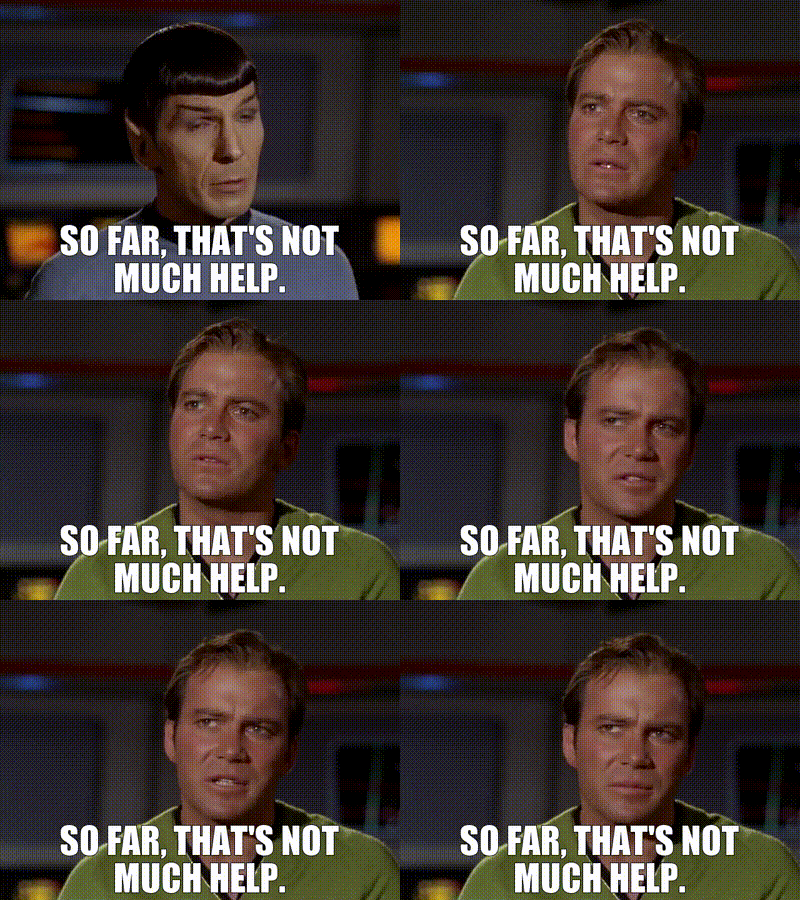
In that episode, the Enterprise crew is pursuing a mysterious “zone of darkness” in space. All scans fail. Captain Kirk asks Spock for an explanation:
KIRK: Spock, give me an update on the dark area ahead.
SPOCK: No analysis due to insufficient information.
KIRK: No speculation, no information, nothing. I've asked you three times for information on that, and you've been unable to supply it. Insufficient data is not sufficient, Mister Spock! You're the science officer. You're supposed to have sufficient data all the time!
SPOCK: I am well aware of that, Captain, but the computers contain nothing on this phenomenon. It is beyond our experience, and the new information is not yet significant.
KIRK: I don't know about you, but I'm tired. (pause) If you can't tell me what it is, let's use reverse logic. Perhaps it'll help if you tell me what it isn't.
SPOCK: It is not liquid, gaseous, or solid, despite the fact we cannot see through it.
KIRK: So far, that's not much help.
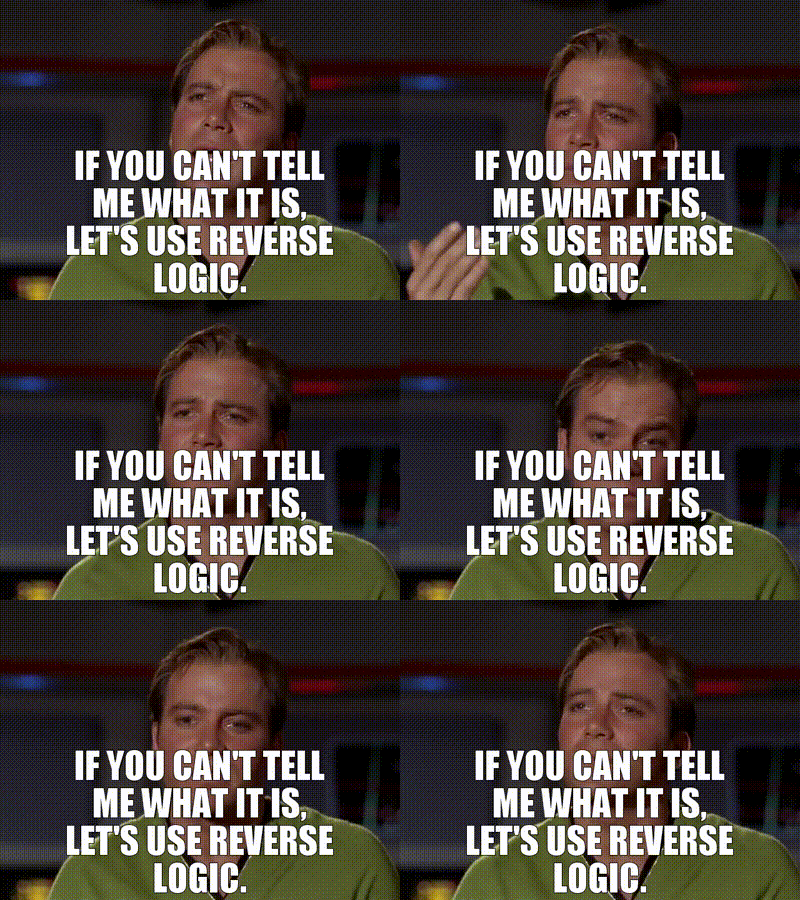
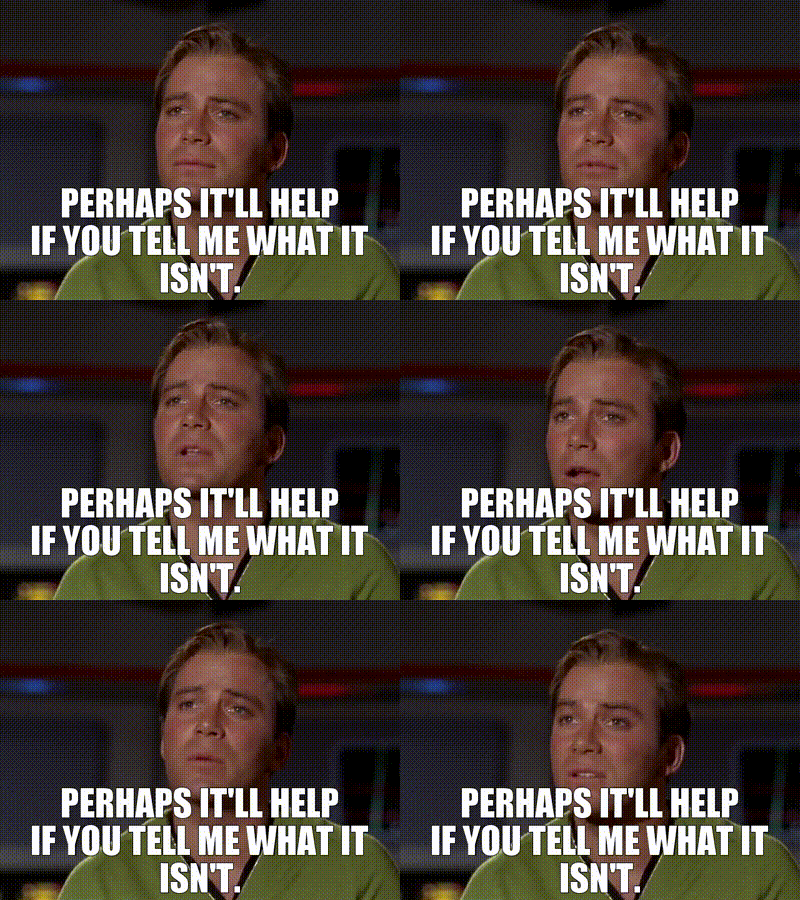
Captain Kirk was being cleverer than he realized. This “reverse logic” is a time-tested method for learning more about entities beyond our ken. St. Thomas Aquinas called it the via remotionis (“the way of removal”). According to Aquinas, this “way of removal” is the only way we can gather knowledge about Unchanged Changers.
For example, we saw in our last letter that, if Unchanged Changers had a beginning, that would mean something changed them. Therefore, Unchanged Changers have no beginning. By removing their beginning, we see that Unchanged Changers are eternal.1
We can take this further.
(For this letter, I have chosen a path I think is relatively easy. I will skip several strong arguments, just because they require too much work to understand. If you pursue The Quest yourself, you will find twistier paths to grander citadels. Even after my attempts to smooth the road, though, I think this may be the hardest letter in the whole book. Gird yourself!)
We already saw that, if time has a beginning, then time has changed, which can only be explained by an Unchanged Changer beyond time. Aristotle defined time as “the measure of change.” (If there is change, there is time, and vice versa.2) Now, change requires a “before” and an “after”, which can only exist within time. Therefore, if time has a beginning, any Unchanged Changer, existing outside of time, cannot change, and therefore cannot perish.
On the other hand, suppose time and change have no beginning. For example, perhaps the Big Bang was only the latest in an infinite series of Big Bangs, each of them explained by at least one eternal Unchanged Changer. If that were the case, then it would mean that the Unchanged Changer(s) have been setting universes in motion for all eternity. If it were possible for these Unchanged Changers to perish, it is logically necessary that they would already have done so, an infinite amount of time before now. (This is the strange but rigid logic of infinity.) Without eternal Unchanged Changers to maintain eternal change, the changes they set in motion would have eventually ceased, too, infinitely long ago. But we see that some things still do change, so this has not happened. Therefore, even if time has no beginning, Unchanged Changers still cannot perish.
Either way, all the Unchanged Changers that set the cosmos in motion are still with us today, and ever shall be.
Some have suggested that Unchanged Changers have parts. For example, one could suppose, almost coherently, that Zeus has (and has had eternally) a head, two eyes, a spleen, a mind of his own, and an innate eternal act that causes changes (in other parts of Zeus or in the external world), without itself being changed. (The Greeks themselves did not suppose this, but the Greek pagans were a lot smarter about ontology than many moderns.) A being composed of parts is called a composite. For a composite to exist, its parts must either develop (like a tree growing a branch), be joined together (like a seed fertilizing an egg, or atoms forming a bond), or in some other way be caused to unite. All of these are changes. But Unchanged Changers are not changed before their act, so they cannot be composed. By removing the possibility of composition, we see that Unchanged Changers are absolutely simple, without parts.
When Unchanged Changers set the causal chains in motion, we know that (unlike everything in our ordinary experience) they are not converting an unrealized possibility within themselves into action. They, and they alone, act without any unrealized possibility. When they act, it is pure act. Since Unchanged Changers have no parts, there is no other aspect of them that could include unrealized possibilities. Therefore, Unchanged Changers have no unrealized possibilities. By removing unrealized possibilities, we learn that Unchanged Changers are absolutely changeless, even after they kick off causation. (We already could have guessed that. As I mentioned a few paragraphs ago, if Unchanged Changers are outside time, then they already can’t change. Aristotle believed that they are eternally inside of time, but also believes they can’t change, and offers his own separate proof why.)
If Unchanged Changers were made of matter, they would have parts. They would also be changeable. (Matter can always, at the very minimum, be moved a few inches to the left, which is a kind of change.) We know that Unchanged Changers have neither parts nor change, so they must not have any matter. This means that Unchanged Changers are immaterial.
Aristotle made it this far on his own. He suggested that, since one (simple, eternal, immutable, immaterial) Unchanged Changer was enough to explain the universe, we ought to assume there really is only one, because of Occam’s Razor.3 A couple thousand years later, Thomas Aquinas went a step further:
For there to be more than one Unchanged Changer, they would have to be distinguished from one another in some way. Here in the material world, many things are distinguished by being made of different matter. For example, two #2 Ticonderoga pencils might be exactly the same in every respect, except one of them is made of these atoms and the other is made of those atoms, and so they occupy different physical space, and so they are different pencils. Other things are distinguished by having different definitions altogether. For example, dogs and chickens are different not just because each dog is made of different matter than each chicken, but also because dogs have four legs, fur, and a good sense of play, while chickens are just… kinda blah?
Unchanged Changers, however, are immaterial. Since they have no matter, the only way to distinguish them is for them to have different definitions. However, since every Unchanged Changer is necessarily a simple, immutable, eternal pure act, there’s no useful distinction to be drawn between “different” Unchanged Changers. Each attempt to describe a second Unchanged Changer collapses into another description of the first. (I am omitting the argument that the existence of an Unchanged Changer is its essence, which seals the deal here.) Therefore, there cannot be a second Unchanged Changer. Removing that possibility, we find that there is exactly one Unchanged Changer, one Pure Act, one Eternal Creator.
I’m not sure we can ever be absolutely certain of anything. It’s always possible for humans to make mistakes, even really obvious ones. However, some things are pretty close to certain, things like the Pythagorean Theorem in math, or the theory in astronomy that the Earth goes around the Sun. This Unchanged Changer we’ve discovered seems to be as certain as math. We have started from obvious empirical observations: some things change. We have followed simple, careful logic. We have drawn clear conclusions.
If we had come into this with a strong prior conviction that immaterial things are absolutely impossible, we might have gone to great lengths to resist the conclusion that an eternal, immaterial being exists. Indeed, some of our Mechanical Materialist friends, who are (like us) trying to explain why there’s something rather than nothing, would rather give up entirely than admit the existence of immaterial things!
However, we had no such prejudice against the immaterial, so we can see the argument as clearly as Aristotle did. It is not an argument that depends on complicated math and putting faith in astronomers (like the claim that Earth orbits the sun). Nor does the argument depend on complicated or surprising logic, nor on exotic metaphysical claims. If you asked me to rank some of the most certain things in my life, it would be something like:
MOST CERTAIN
2+2=4
The Unchanged Changer exists and is one, immaterial, eternal, and so on.
The square of the two side lengths of a triangle equals the length of its hypotenuse.
You love me.
Earth orbits the sun.
LESS CERTAIN (BUT STILL PRETTY CERTAIN)
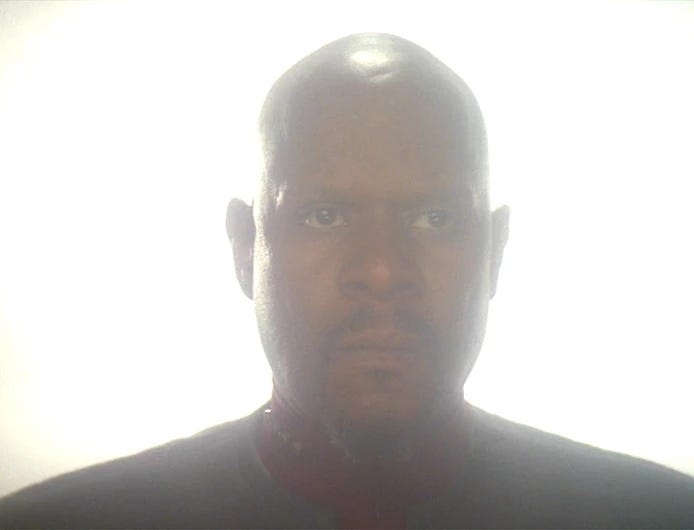
What would it be like to actually encounter this Thing, though? What would it even mean to “encounter” such an Alien? Does It even have its own experiences? If It does, how different must those experiences be from our own? It seems unlikely the Alien could ever, for example, converse with us. If It has the capacity to relate to us in any way, it would be more alien than any first-contact story in Star Trek.
By now, we have ruled out many of the candidates for Unchanged Changer that we mentioned in the last letter. Is the Unchanged Changer…
The universe itself (as Bertrand Russell argued)? No, because the universe itself is composite, material, and probably not eternal.
A small piece of fairy cake (as Trin Tragula might have speculated)? Or the Sun (as some pagan religions have believed)? Or the Big Bang itself? No, for similar reasons.
The entire Greek pantheon (Zeus, Hera, Athena, and so on)? No, since there is only one simple Unchanged Changer, not a pantheon of them.
Zeus? From the legends I’ve read, Zeus was a pretty fickle dude, and he was born from Cronus and Rhea, so he seems neither eternal nor unchangeable, and he often seems to have a material body with parts, so that’s three strikes.
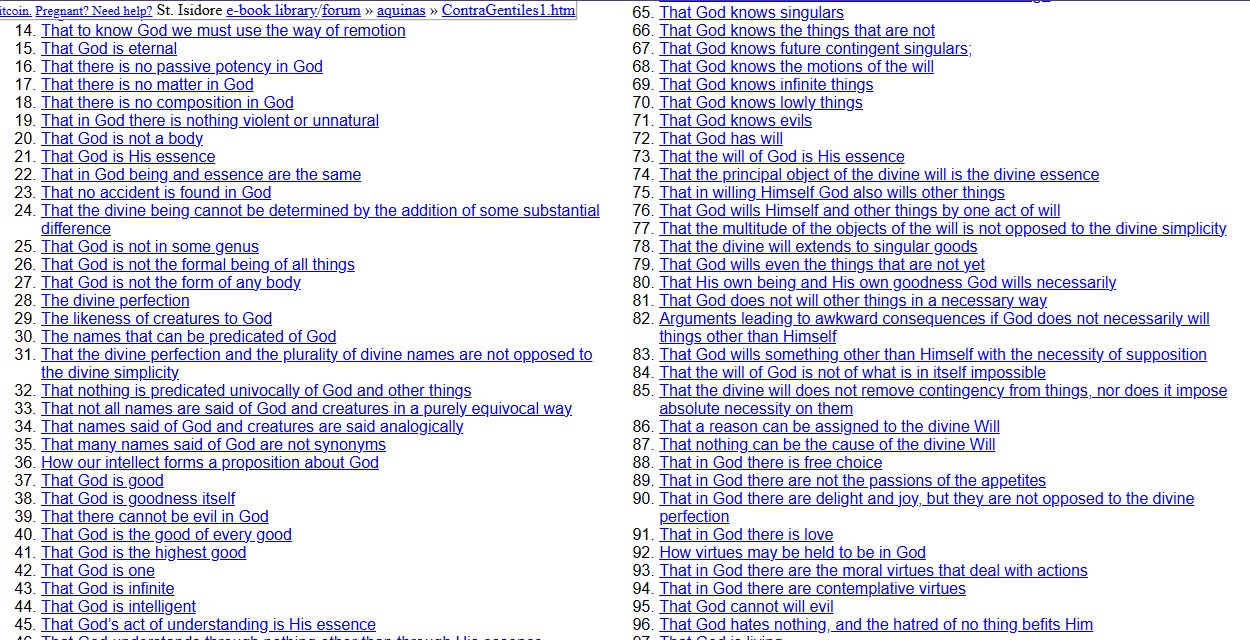
Aristotle and Aquinas go on about the attributes of the Unchanged Changer for hundreds more pages (as have their successors). There is a great deal more to be said about this bizarre entity! (Its existence is Its essence! It belongs to no genus!)
However, I wish to call your attention to just two more observations about our Alien, the Unchanged Changer.
The first is about Its knowledge.
Remember those patterns we talked about a couple of letters ago? Patterns that don’t exist in themselves, but which exist in other things? Patterns like perfect triangles and the number four? We called those patterns forms. Aquinas and Aristotle sometimes also called them ideas.4 Ideas seem to be real features of the world (no matter what the Mechanical Materialists say), but they also have no matter. When we encounter a new pattern—for example, the first time we see the color green—we come to know that pattern. We do this by acquiring the pattern itself. Our eyes do not turn green. You cannot go inside your head and find green patches sprouting up. Yet we can now call up the immaterial experience of greenness whenever we like. It need not be connected to our original experience of green, either! Once we learn green from, say, grass, we can imagine green in other places, like cars or clouds. This shows that we have acquired the immaterial pattern of green in our intellect. Our intellect must be, to some extent, immaterial. We saw this a couple of letters ago.
Now we have just discovered an alien being that is not only purely immaterial, but also a pure act. What is that act?
Aristotle says: thinking! An entirely immaterial being has even greater access to the immaterial forms than we do. If an immaterial being has any activity at all, it must be either thinking or something built on thinking (willing, desiring, and so on).
This is not too surprising, since we have pretty good reason to suspect the Unchanged Changer is the origin of forms/ideas/patterns.
Here’s what I mean by that. Plato believed that ideas simply exist, immaterially, almost as though they were in a separate dimension or “realm of ideas,” and that only immaterial intellects (like ours) are able to access that dimension. Aristotle thought that the “realm of ideas” raised more questions than it answered, though, so Aristotle argued that beings directly participate in the ideas (by being green, or whatever). But Aquinas pointed out that Aristotle’s approach had problems, too. If “horseness” only exists within actual horses, is the immaterial form destroyed when horses go extinct? How did the first horse acquire it? Aquinas solved these problems by arguing that ideas did eternally exist—not in their own realm, but as ideas in the intellect of the Unchanged Changer.
One more approach: every change involves a transition from one form to another, so, when the immaterial Unchanged Changer acts to set everything into motion, it must act through an immaterial pattern that it already, in some way, possesses. It cannot possess that pattern through matter (like a leaf might possess, to some extent, the pattern of green), since the Unchanged Changer has no matter, and it must possess the whole pattern, not just some fragment of it imprinted in something that doesn’t even exist prior to the Unchanged Changer’s pure act. Thus, the immaterial Unchanged Changer has access to immaterial patterns… which is simply to say that (like us), It has Ideas. It knows something. It is then, in some sense, intelligent… although Its intelligence is likely very alien to ours.
(If you are not wholly convinced by these arguments for the Alien’s intelligence, that is okay. I have compressed many arguments in this letter to within an inch of their lives, but this particular argument was so complicated, and involved so much philosophical overhead you aren’t yet old enough to follow, that I went past compression into actual corner-cutting. If you find weaknesses in the above, you are not imagining them, but I think it is, at least, good evidence.)
One final point about the Alien for today. I want to discuss Its goodness—if It is indeed good.
Many people will tell you that we can know, with the same logical certainty as all the other attributes we’ve just discussed, that God is Good—and, in fact, perfectly good!
When someone tells you this, ask them to define “good” before they give you the argument. You will often find that, while, yes, the Unchanged Changer is provably “good,” by your friends specific definition, that definition is rather different from the commonplace definition of “good.” Aquinas, for example, tends to define good as Being (and evil as incomplete Being), which is not the ordinary definition.
One difficulty is that, when you get right down to it, there is no commonplace, ordinary, objective definition of “good.” We treat goodness, in practice, as “I know it when I see it.” However, when dealing with an Alien this different from us, that won’t do! We can’t simply vibe our way to understanding how this Alien will react to, say, an orphan child starving to death in a war zone. Many people who object to the Alien’s existence because evil exists have not even bothered to offer an objective definition of evil, much less checked to see whether that form of evil is incompatible with what we know of the Alien.
Now, some reassurance: on closer inspection, Aquinas’s definition of good turns out to be pretty solid. There are ways to reason from that definition to something that at least closely resembles conventional Divine Omnibenevolence. We end up with very good reason to believe that, although God is not good by the ordinary definition of good, he is nevertheless something very like good, indeed better than good. However, the argument is not easy, and I cannot include it here, even cutting corners.
Even if I did, you remember the piggies in Speaker for the Dead, right? (From planet Lusitania?) The piggies were good, but what was good for them was so different from what was good for us that they took the heroic humans who studied them, tortured them to death… and thought they were doing the humans a big favor. Our situation with the Alien is not quite the same, since the piggies and humans simply didn’t understand one another, and we can be confident that the Unchanged Changer understands us. However, we do not understand It. In Its fathomless infinity, we never will. We can prove a lot about the Alien through pure logic, but to really learn about Its character, we are probably going to need to have some sort of direct contact.
In my next letter, we will begin our search for signs of contact.
DE CIV NEXT VOYAGE: I have already written an article on the Minnesota flag, uh, situation. That will post next week. I am also working on a Worthy Reads to button up the month.
I continue to avoid making any commitments on the contested question of whether time had a beginning. If time had no beginning, then an Unchanged Changer has always been, with an infinite past. If time did have a beginning, then an Unchanged Changer existed before it—and, therefore, beyond it. Either way, though, Unchanged Changers are eternal. This was all covered in the last letter.
By “eternal,” I mean only that Unchanged Changers have no beginning. I have not, at this stage of the argument, ruled out the possibility that they have an end. This leaves creative possibilities like Scott Adams’ “Gods Debris” thesis (God was real, but He exploded and we are His fragments) on the table—for now.
If I had relied on “purer” versions of the first-mover arguments in the last letter—versions more favored by Thomists, but more difficult to explain to a child and more challenging to defend from critiques like existential inertia—then I would not be at this disadvantage. Purer versions of the argument give you imperishability and immutability for free. For me and my cut-rate first-mover argument, though, at this early stage, I can only say that the Unchanged Changer did not change prior to Its act which set the most recent essentially ordered causal series in motion, which, for all we know, could reach back to the Big Bang or earlier.
I draw this distinction because there are some models of reality in which different spacetimes are nested in one another like matryoshka dolls. Our universe could be simply a bubble inside a larger superuniverse (or multiuniverse) where perceivable time flows faster, or slower, or even backwards relative to our standpoint. That superuniverse could itself be a simulation within a true universe, which in turn is embedded in a superuniverse, which is in turn embedded in another universe, and so on, all of them with different spacetimes. (I don’t say any of this is true—y’all know about my contempt for the multiverse, and simulation theory is even more daft—only that it is possible, and so must be accounted for in our argument.) Our local universe’s spacetime could have had a beginning (probably around 14 billion years ago) without time itself—the cosmological measure of change—having had a beginning.
In other words, our universe could have a finite history within a multiverse that has an infinite history. Indeed, Aristotle himself alluded to this possibility in Physics VIII.1:
Now the existence of change is asserted by all who have anything to say about nature, because they all concern themselves with the construction of the world and study the question of becoming and perishing, which processes could not come about without the existence of change. But those who say that there is an infinite number of worlds, some of which are in process of becoming while others are in process of perishing, assert that there is always change (for these processes of becoming and perishing of the worlds necessarily involve change), whereas those who hold that there is only one world, whether everlasting or not, make corresponding assumptions in regard to change.
And so we once again find that even our strangest and most esoteric modern theories about the cosmos are mere footnotes on the Greek philosophers.
Aristotle’s broad definition of “time” encompasses all these possibilities.
I know, William of Occam wouldn’t coin Occam’s Razor for another couple thousand years. Nevertheless, Aristotle knows to avoid multiplying entities beyond necessity:
We ought, however, to suppose that there is one rather than many, and a finite rather than an infinite number. When the consequences of either assumption are the same, we should always assume that things are finite rather than infinite in number, since in things constituted by nature that which is finite and that which is better ought, if possible, to be present rather than the reverse: and here it is sufficient to assume only one movent, the first of unmoved things, which being eternal will be the principle of motion to everything else. —Physics VIII.6
…as Aquinas does in Summa Theologiae I.15.1’s respondeo.
"Even if I did, you remember the piggies in Speaker for the Dead, right? (From planet Lusitania?)"
So, when are you planning on introducing your kids to Ender's Game? That's some pretty heavy stuff.