

Welcome to Worthy Reads, where I share some links that I think are worth your time. (Gift links where applicable.) Everyone gets the first half. The second half is paywalled. The paylisters keep me writing, though, and this is their special treat. If you want all-in, subscribing is cheap.
Today’s Worthy Reads soundtrack is Laurie Anderson’s “From the Air”:
“How Sad Do You Feel Right Now?” by Leah Libresco Sargeant (reviewing Abigail Shrier’s Bad Therapy):
The dangers of over-attentiveness aren’t unique to therapy. Whenever screening for an ailment becomes common, there’s the possibility of what are called “iatrogenic effects” — medical problems caused by exposure to doctors and their interventions. For example, the U.S. Preventive Services Task Force has been revising and re-revising mammogram guidelines, telling women to come in starting at forty years old, no, make that fifty, no, never mind, back to forty. Breast cancer advocacy groups push for broader, earlier, more urgently recommended screenings, focusing on the women saved by early detection. But the more low-likelihood women you invite to get screened, the more false positives you get. For some women, that means the anxiety of a follow-up mammogram, an unnecessary biopsy, or further treatment.
Similarly, asking children to turn inward and examine how they feel may filter some kids into more intensive counseling than they need. But Shrier is worried about another kind of danger that goes beyond false positives and unnecessary treatment. Some iatrogenic effects are more containable than others. A mammogram requires a visit to the doctor, but an “emotional check-in” is something teens can practice themselves, at any time. If there are downsides to self-managed therapy, they can be experienced much more frequently and intensely than something that requires a professional’s participation.
This book review is where I learned the word “iatrogenic,” and, my goodness, it’s come in handy more often than I expected.
Walker Percy’s best and strangest book, Lost in the Cosmos: The Last Self-Help Book, questioned the root of what has become “therapy culture”: the notion that there is a “self” that can be discovered or understood through observation at all. “Why is it possible,” Percy asks on the title page (this is technically one of the book’s subtitles) (it is a strange book), “to learn more in ten minutes about the Crab Nebula in Taurus, which is 6,000 light-years away, than you presently know about yourself, even though you’ve been stuck with yourself all your life”?
I have just opened to a random page and discovered one of many answers Percy offers:
Because the self in the twentieth century is a voracious nought which expands like the feeding vacuole of an amoeba seeking to nourish and inform its own nothingness by ingesting new objects in the world but, like a vacuole, only succeeds in emptying them out.1
We can sum up people we hardly know in a sentence or two, but, when we open the horoscope, we can read almost any entry and find within it a description of ourselves—even though they contradict. This is because the human self is not simply another object of knowledge. One interesting consequence is that the human heart is, changed by observation, like Heisenberg’s quantum particles. Introspection doesn’t just discover; it defines. It is iatrogenic.
To name something about yourself, and believe it, then, is a powerful act. In fact, it is dangerous. The person who believes himself a “brave” man may find himself performing brave acts, not because he is unafraid, but simply because his actions are consistent with his self-identity. He cannot conceive of acting otherwise. On the other hand, the person who labels himself “autistic” may reinforce and deepen traits that were before latent, or even imaginary. We tend to become the labels we give ourselves.
It is remarkable, then, how promiscuous we are about labeling ourselves! We should be much more cautious about this.
This is not to say that one should simply refuse introspection, deny all negative labels, and try to ride to health and virtue by the power of positive thinking. I recall once when someone I cared about a great deal was acting erratically. His overwhelming emotions bled, intermittently, into violently irrational actions. It scared him. It scared those around him. It lasted a while. Trying to fix it didn’t help. Not naming it (because we had no name for it) certainly didn’t make it go away. In fact, it made the thing scarier. When he finally sought out help, Mental Health Professionals™ (eventually, cautiously) gave him a name for his problem. His problem had its own section in the DSM-IV. It came with a list of research-backed treatments, starting with certain therapies, culminating in various pharmaceuticals.
Naming it changed nothing. His emotions were still the same when he came home that day. The behaviors were the same, too. On the other hand, naming it changed everything. It was no longer an invisible beast that leapt from the shadows to hurt him and those around him. We had its name, we knew its habits, and we had plans of attack. My friend recovered. This is a case where naming something was liberating.
However, our current therapy culture enjoys those moments of naming so much that it foolishly goes hunting for them! Too many people fail to understand that the single surest way to create monsters of the id is to start looking for monsters of the id!
Nowhere is this more dangerous than among teenage girls. This demographic was already so insecure and introspective that they invented the magazine personality quiz. Their predispositions were sharpened to the point of disaster by the rise of smartphones. So, naturally, we have surrounded teenage girls with amateurs who understand their job as encouraging them to go hunting for psychological monsters! We give them just enough therapeutic language to cause permanent harm to themselves and others, and—under the guise of confidentiality and privacy laws—we cut them off from the sane safe harbor of their homes and parents! (Therapy culture’s default setting is to assume that the family home is a threatening web of misery and—what else?—unexamined trauma until proved innocent.)2
A few years ago, my daughter, then age 8, was having some routine problems in her friend group. One of her friends was (I will be frank) a gossipy drama queen who lived to make trouble,3 and, since my daughter’s friends were all 8, they kept falling prey to her nonsense, despite parental advice. (8-year-old girls love drama, even as they profess to hate it. This is a common failing of the species. Percy talks about it!) I figured they’d have to learn the hard way, by fighting until either the friend group fell apart or they started listening to their parents and thereby learned to isolate the problem child’s drama.
One day, my daughter startled me by asking permission to see the school counselor about her friend group’s problems. Apparently, one of the other friends had gotten sufficiently caught up in the drama to have had the idea to appeal to the counsellor for a “facilitated conversation.” I thought it was a terrible idea, and said so, repeatedly, but my daughter insisted, and most of the rest of the group was going ahead even without her. I decided to allow it, with some conditions (like detailed reports after each session), and with the comfort that she attended a (good) Catholic school that would not allow things to get out of hand. Better, I thought, for her to get a little taste of this world now, when she was young enough that it wouldn’t be able to do any real damage. If I denied her, she might resent it as a teen and hurl herself into that world more enthusiastically. If I allowed it, she might instead build up a few antibodies against the idea that cheap psychiatry is a panacea.
On the one hand, I was right that my daughter suffered no personal ill effects. The school counselor did fine. On the other hand, the friend group shattered. The dramatic escalation from dumb playground fighting to meeting as a group with the school counselor made everything heavier and more raw. The whole thing spooked one of the kids’ parents, who separated him from the friend group. The children didn’t learn in counseling anything they didn’t already know. It took years for them to patch everything up and be friends again. That was not the outcome they had been hoping for. Counterfactuals are a dime a dozen, but I don’t think that’s how it would have ended if they’d stuck to the playground and stayed out of their own heads.
The Free Press published a whole chapter from Abigail Shrier’s Bad Therapy (the book which, you may recall, is what this item was originally about), which tends to show just how much some school environments are focusing on mental health in damaging ways that actually make things worse for kids. It’s worth a read, too.
Meanwhile, roughly the last quarter of Lost in the Cosmos is an examination of a future in which the people from that chapter of Bad Therapy are (almost) the last humans.
“Social Security Reformer,” by the Committee for a Responsible Federal Budget

Social Security provides vital income security to millions of beneficiaries, but it is on a road toward insolvency. The Social Security Trustees estimate the Social Security retirement program will run out of reserves in 2032, or in 2034 if theoretically combined with the disability program. Upon insolvency of the theoretically combined trust funds, all beneficiaries regardless of age and income will face an immediate 17 percent benefit cut, growing to 35 percent in 2100. “The Reformer” allows users to build their own plan to restore solvency. See how your choices stack up!
About once every four years or so, somebody puts out a good online “game” where players try to tweak revenues and expenses to balance the federal budget. I always enjoy playing around with those. However, it’s been a long time since the Simpson-Bowles Commission. (Look it up, kids!) For a few years there, it seemed like I was the only person who actually cared about the national debt (as opposed to exploiting it for short-term, dishonest political leverage). However, with Social Security’s X-date now less than a decade away, op-ed writers are finally starting to wake up. Places like the (studiously centrist) Committee for a Responsible Federal Budget are starting to get phone calls again. A few months ago, the CRFB put out a new online widget that covers only Social Security.
The election of 2028 will be about the usual crap. However, the election of 2032 will be about Social Security and Medicare. SS and Medicare are driving off a cliff, running such vast deficits that cutting the entire military budget, all the way to zero, couldn’t fix them. Most American voters aren’t willing to admit that. They think you can fix everything just by taxing the rich,4 or by eliminating “waste, fraud, and abuse.”
Medicare is actually the harder problem to solve, but Social Security makes a nice apéritif. Why don’t we look through the dials the CRFB makes available to us? They don’t cover every single option imaginable, since there are infinite ways to skin a cat, but they offer a good overview of the most common Social Security reforms recommended by wonks and populists alike.
Before we start, a couple words of caution:
First, the projections in this tool depend on consensus projections of future American fertility, which are almost certainly too optimistic. Social Security is in even worse shape than it looks.
Second, the projections in this tool assume that you institute these Social Security reforms today, while the Trust Fund still has nearly a decade of breathing room left in it. That isn’t going to happen. The very earliest that Congress will even consider implementing serious Social Security is probably 2031 or so, just 1-4 years before the Trust Fund is exhausted. There are some reforms (like “removing the cap,” discussed below) that could delay X-Day for almost two decades if implemented today. However, by the time they are actually implemented in the early 2030s, the Trust Fund will be so close to zero that they will stave off X-Day for only 1-3 years.
Now, on to the dials!
The last time Reddit had a discussion about Social Security, the response was nearly unanimous: we should “fix” Social Security by “removing the cap.” Today, payroll taxes are only paid on the first $184,500 in wages. If you remove that cap, the argument goes, you bring in so much fresh income for Social Security that it solves your problem, bing bang bong.
It does not, in fact, solve your problem:
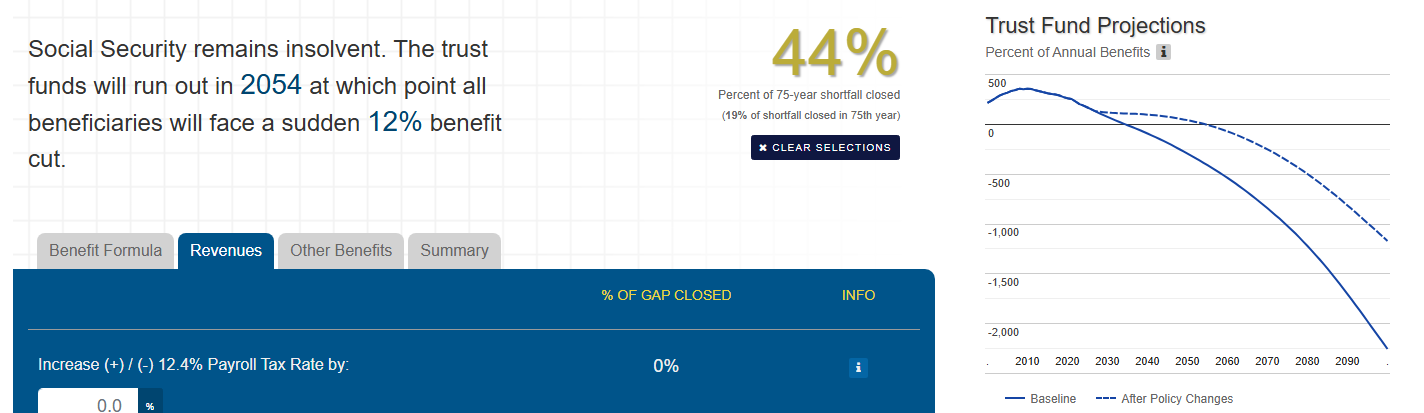
One problem is that, although Social Security is actually a welfare program and always has been, FDR deliberately designed it to look like an investment account. By law, when you pay more into the system, you get more out when you retire. Today, since the payroll tax is “capped” at $184,500, rich people’s benefits are also “capped.” If you give rich people an unlimited payroll tax today, by law, you also give them unlimited Social Security benefits tomorrow.
Of course, we could change this law! When we remove the payroll tax cap, we could just pass a second law that says, “…but rich people’s benefits stay capped right where they are.” Social Security’s proponents have always opposed doing this, though, since it would shatter the illusion that Social Security is an investment account. It would clearly become a welfare program, with rich people shouldering the rest of us.
On balance, I think that’s a good thing. I hate the lie that Social Security is an investment that retirees have somehow “earned.” This change would put a nice clean bullet hole in that lie, making it easier to adjust Social Security in the future. However, we should not overlook the fact that introducing a sharp phase-out in Social Security benefits would also create substantial disincentives to earn income. (Capping SS benefits are a form of means-testing, and De Civitate discussed the problems with means-testing at length in my 2024 article co-written with Daniel Pareja, “Give the Rich More Money!”)
Another problem with the “remove the cap” proposal is that it represents a monumental tax increase on high earners. Now, like most Americans, I believe that taxes on the rich are currently too low. It seems to me pretty clear that we are on the left side of the Laffer curve, and that raising taxes on wealthier Americans would yield significant new revenue, which they are well-equipped to bear. So I do want to raise taxes on the rich. (Note: this will hurt the economy, albeit not fatally.) However, when we raise taxes on the rich, I want to spend the money on exciting things like space exploration, baby boxes, expanded child tax credits, and (alas) paying down the national debt! I do not want to take that entire windfall and slam it directly into life support for an existing welfare program!
“Well, then, we’ll just raise taxes on the rich a second time to pay for all that other stuff, James!” You can’t! Removing the payroll tax cap is a very large tax increase for rich people. It would put many of their marginal tax rates over 60% (higher, in some high-tax states). That’s firmly on the wrong side of the Laffer curve. Once you raise taxes that high, wealthy people have such strong incentives to avoid earning more money (to avoid the taxes) that they largely stop doing so, or even reduce their earnings, with the result that the new taxes result in either very little revenue or negative revenue. So, yes, we can remove the cap, and, yes, that will help pay for Social Security… but that’s it. The effective tax capacity of rich people will be tapped out. Raising their taxes to pay for other stuff will no longer be an option.
Let’s look at our other options.
The first thing I want to say about our other options is that cutting the benefits of current Social Security seniors needs to stay on the table. In fact, as a matter of justice, it is important that seniors on the Social Security dole face broad-based cuts, rather than hiking taxes on young people or raising the retirement age for young people. This funding crisis is, collectively, their fault.
It has been known for over forty years that Social Security was in deficit. It has been known for almost as long that it would run out of money in the early 2030s, specifically. Congress succeeded in passing a patch-up job in the 1980s, but everyone knew that the patch wouldn’t last forever. All along, the voters were told, over and over again, that failing to deal with Social Security would lead to sharp benefit cuts when the money finally ran out. They had many chances to fix it. Ross Perot made balancing the national budget, including Social Security, the centerpiece of his 1992 and 1996 presidential campaigns. George W. Bush proposed a plan to save Social Security in 2005, which would have partially privatized the system. (Had it passed, the Social Security system would be safe and future retirees would have had considerable wealth to look forward to.) In 2011 and 2012, Paul Ryan and (later) Mitt Romney worked hard to raise awareness, cut spending, and balance the entitlements budget. Nothing is happening today that couldn’t have been prevented by listening to President Obama’s bipartisan Simpson-Bowles Commission in 2010!
Yet, at every turn, voters collectively said “Nah! The 2030s are way far in the future. We’ll figure it out then. Let’s keep this ship on autopilot. Let’s crash this ship into the sun.” They laughed at Perot. They crucified Bush, until he yanked himself away from Social Security reform like he’d burned his hands. They stuck their fingers in their ears to Simpson-Bowles. They accused Paul Ryan of trying to kill grandma.
That’s on them. Nearly half of Americans alive today weren’t even old enough to vote when older voters turned up their noses at the idea of saving Social Security.
My very first national election was 2008, so my age group is partially responsible for our predicament. I consistently voted to balance the budget, but my age group didn’t, and I recognize I must bear some of the consequences for our collective misdeeds. My younger peers, however, are not responsible at all, though, and my pre-teen children certainly didn’t cause this in any way. Yet many senior citizens, who did in fact ride this rocket straight into the sun, now want to escape the consequences by keeping their benefits, soaking the rich, and fobbing off the rest of the cost on their grandchildren. This makes me angry. We should not allow it. The Baby Boomers and GenX collectively refused to spend responsibly; now they must collectively pay the piper.
The default solution to Social Security’s deficit, both in law and in justice, is reducing grandma’s government paycheck. Not hiking the working man’s payroll tax, not raising his retirement age. Benefit cuts, from current beneficiaries. Every dollar of Social Security revenue that doesn’t come from benefit cuts, then, is a gift given to senior citizens from the generosity and compassion of younger generations.
Still, I don’t want my parents to eat cat food,5 so let’s consider some ways we can be generous.
All means-testing has downsides, but there’s a compromise between fully eliminating the payroll tax cap (a sharp, huge tax increase on working rich people) and doing nothing at all: means-test Social Security benefits.
We currently send huge Social Security checks to old retired rich people. (They paid a lot in, so they get a lot back out.) About a million retirees receive more than $50,000/year from Social Security alone. That doesn’t count their spouse or spousal survival benefits! It also doesn’t include their (typically large) nest eggs, pensions, and so forth. We are shoveling the equivalent of an entire American median household income into the pockets of people who don’t need it merely to maintain the pretense that Social Security isn’t a welfare program. All that money comes directly from the pockets of working families.
So cut the benefit. The widget tells me that cutting benefits in half for couples that make more than $360,000/year overall (with a phase-in starting at $120,000/year) would do a lot to close the gap all by itself. The Reformer widget assumes this means-testing is only applied to new retirees, and says that doing this closes 17% of the funding gap. I would apply it to all retirees, which would close a little more of the funding gap and (per some back-of-the-clanker math) stave off X-Day by perhaps one to three years by itself, by cutting more spending upfront. Better yet: means-testing Social Security is very popular.
By the same token, Social Security benefits are currently taxed less than ordinary income. We could adjust this so that, for individuals making over $100,000/year ($200,000/year for couples), Social Security benefits are taxed like any other income. This adjustment has a modest long-term benefit. (Insanely, many people—including the RINO who purports to be President—want to eliminate taxes on Social Security, completely. That would make all these problems much worse, and should be absolutely opposed.)
Another interesting fact about Social Security is that its annual cost-of-living adjustment is currently skewed. In 1973, when Social Security addressed cost-of-living adjustments, there was only one measure of inflation available (“CPI-W”) which covers inflation for a surprisingly narrow segment of working stiffs. The more universal and accurate “CPI-U” debuted in 1978, and the yet-more-accurate “chained CPI” came out in 2002… but Social Security never switched over to using either one. It still uses CPI-W. This has allowed Social Security benefits to grow significantly faster than inflation over the past 50 years. Today’s seniors thus have more generous benefits than their parents did, and much more generous than their grandparents did.6 We can’t undo all that without benefit cuts, but we can put the genie back in the bottle by fixing the cost-of-living formula now, preventing any further growth above inflation. (This technically cuts benefits for my generation, too, of course, but we didn’t earn over-inflated Social Security payouts, either.)
Unfortunately, doing all this doesn’t come particularly close to closing the gap:

This leaves the reformer with various bad choices. Raising taxes on the rich (by doubling the payroll tax cap, without eliminating it) is probably the least politically and fiscally painful move at this point, even though you’ve hit the rich twice already (with means-testing and different tax treatment). Since you’re not eliminating the tax cap entirely, that probably still leaves a little capacity to raise taxes on rich people to pay for other programs in the future. And it’s undeniable that it really helps stabilize things:

Under these policies, seniors still absorb a 6% automatic benefit cut in the mid-2030s. That’s compared to a 17% automatic cut if we do nothing, so our generosity has already done great things to protect current retirees. I think a 6% across-the-board cut to current beneficiaries is a reasonable and just outcome. We can perhaps distribute this cut to shield the very poorest seniors from terrible consequences, but I think it’s a fine cut. Let’s keep it.
The remaining thing that worries me, at this point, is that we haven’t stabilized Social Security long-term. Because my generation is having so few children, Social Security will still tumble into the abyss after the Boomers and Xers are dead. We owe it to our grandchildren to fix that, exactly as the Boomers didn’t. This would presumably be best done by instituting a Bush-style partial privatization scheme. Alas, that wasn’t one of the options in this particular tool, so I ended up closing the rest of the long-term gap by:
Making the 6% benefit cut permanent (-6% to “initial benefits”)
Taxing more Social Security benefits like ordinary income, not just benefits over $100,000 (“Tax Benefits Like Private Pensions”)
A wonkish change to the benefit formula, applying it to annual earnings before averaging all annual earnings together. This tends to reduce final benefits for higher-income people while raising it for people who spend more years paying in (regardless of how much they earn).
Slowing benefit growth for the top 20% of earners, by making the benefit formula replace only 5% of their last chunk of income (instead of 15% like today).
An additional 5% benefit cut for future retirees, for a total of 11% in benefit cuts. (It’s either that, or increasing the payroll tax from 12.4% to 13.1%—which would hit working families hard—or raising the retirement age to 68, and I think we work long enough already.)
Again, though, partial privatization seems like a better alternative to this cocktail of cuts.
You may have your own preferences for how to deal with this, and, as you can see, making the sweaty choices is no easy task. Just remember two things:
It’s actually going to be worse than this, so whatever changes you make are going to have to be intensified later on as the fiscal outlook darkens, and
Fixing Social Security is the easy one. Medicare’s going to be much harder to save.
GL;HF!
“The Fall and Rise of Screwworm,” by Brian Potter:
Since at least the early 19th century, and likely much earlier, screwworm was a miserable fact of life for raising livestock in the Southwestern US. The screwworm fly would find and lay her eggs on even the smallest open wound, and animals had to be inspected for worms constantly. One author notes that “[p]eople would not leave home for more than a day for fear of finding their animals had been eaten alive while they were away. Anyone who didn’t check their animals at least every two days — or have someone do it for them — knew that they would pay a heavy toll in damaged or dead animals.” When worms were inevitably found, they had to be dealt with, typically by applying various insect-killing chemicals, though occasionally by manually removing the worms, a task described as “disgusting and sickening.” Often animals couldn’t be saved — an infection in a horse, for instance, was described in the late 19th century as “typically fatal.” The amount of time and effort required was such that ranchers employed ranchhands whose entire jobs were inspecting animals for screwworm.
I knew basically nothing about screwworm going into this article. I had vaguely heard of it since 2023, but I didn’t even know whether it was a bacteria or an insect until 2026, when the first modern case appeared in Texas.
My first instinct, I admit, was to blame Mr. Trump’s White House for it. Elon Musk’s ill-advised DOGE delayed and slashed anti-screwworm funding in early 2025. Less than a year later, screwworm is in our cows. However, as this fascinating little article explains, we were already screwed (har har) well before the 2024 election. The massive flows of immigrants through Central America, many of them attracted to America by President Biden’s lax border policies, seem to have played a larger role. So did other, larger factors independent of politics, like the pandemic. I don’t doubt that cutting screwworm money during that final year prior to landfall in Texas hurt us, blinded us to some extent, and slowed our eventual response. DOGE played its part in making this crisis! However, the principal parts go back much further.
For all that, though, the most interesting part of the article, to me, is not the blame game about who screwed up (har har) the screwworm more badly. It’s the earlier section, where Mr. Potter explains how we defeated screwworm in the first place—and kept it defeated for decades. It was the result of an insane-sounding government program and 1960s American “you can just do things” optimism. That sort of optimism often backfired and killed a lot of people, but not this time. America did something hitherto unheard of in world history—eradicating a an entire species from a region through simple selective breeding—and then quietly kept doing it, year in and year out, until the 2020s. Turns out the anti-screwworm program was a rare Big Government W! Let’s hope Washington can get its screwworm production facilities (yes, that’s a real thing) back online before the outbreak gets too far out of hand. Last thing America needs is food prices going up again, now because of parasitic insects.
“no data centers in my backyard,” by Jasmine Sun:
If any data center project should have gone down easy, it should’ve been Mount Pleasant’s. The infrastructure and associated debt was all already there. Microsoft is on track to pay $19.7 million in taxes in 2026. A major new development was the only way to maintain “public services like policing, road paving, and emergency medical services,” said Sean Ryan, a village representative. “Data centers can accomplish that on an unprecedented scale.”
But even more than the GM closure in Janesville, Foxconn taught many residents to never believe a tech company’s—or their local government’s—sweet-talking ever again. Yes, they might pledge jobs or infrastructure or taxes. Their PR teams know what words to say. But they can write carve-outs into the contract; they’ll go unpunished if they leave. And in that world, if it goes away, then it’s your land, your community, and your already-strained municipal government that gets left holding the bag.
I estimate about a third of my audience will be rolling their eyes because who hasn’t read this article yet, everyone’s talking about it!
Meanwhile, two-thirds of my audience will never have even heard of this article at all. It’s a very widely read article in a very narrow community (a community that overlaps quite a bit with De Civitate’s readership).
Basically, a female techbro (she used to work for Substack) went to Wisconsin to try to understand what everyone in San Francisco is having a really hard time understanding: why do people say they’d rather have a nuclear power plant in their backyard than an AI data center?
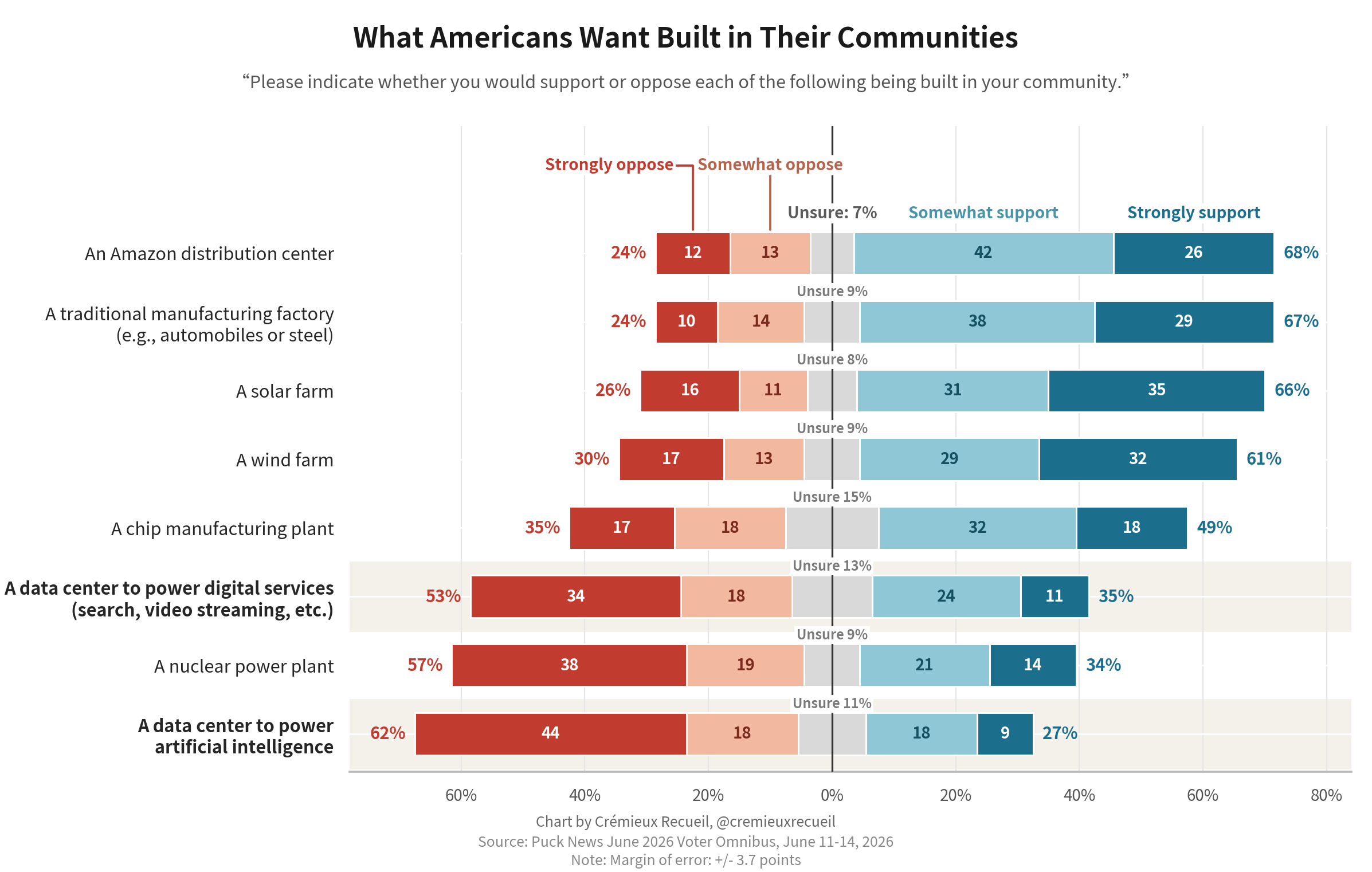
Part of the answer, of course, is that people aren’t actually mad at data centers. They’re mad at AI.
Data centers are pretty excellent “gets” for most towns. Their water use is modest compared to a factory, they can be required to generate some of their own power to offset any (tiny) increase in electric prices, and their other issues, like sound levels, have been wildly exaggerated, and are addressable through the usual zoning tools like decibel limits. While they’re being built, they generate a lot of jobs. Once they are built, the jobs go away, but they generate something even better: lucrative property taxes. Quincy, Washington now has 30 data centers paying over half of the city’s overall property tax burden. They’re not the only ones!
Yet my county (where property taxes have been going up and up) recently went insane over a modest 5 MW data center in Inver Grove Heights. People from multiple cities in the surrounding area were rallying to oppose the data center, because “it will affect you, too!” It won’t. They were even arguing that we’d be disturbed by the noise in West St. Paul, miles away! Dawg, you won’t be able to hear it at all past 2,000 feet or so, even if you’re trying!
I understand residents of homes within that boundary will want to push for more acoustic shielding, and that makes good sense, but now the city has been forced, by sheer revolt of its residents across multiple city council meetings, to impose a moratorium that (IMO) illegally blocks the data center from going up. They’re being sued for tens of millions of dollars in damages, way past the city’s insurance liability limit, in a town that I happen to know (thanks to another article I’m working on) only collects $36 million in property taxes every year!
This is a moral panic. Social media is good at generating those. There is palpable hysteria in these discussions. It has no proportion to the facts. The social media ecosystem encourages the worst offenders to become even more hyperbolic. The results are grim and irrational. I admit, at times, people have gotten so weird about data centers that I’ve thought, “This must be a psy-op organized by Chinese Communist Intelligence to make America fall behind in the AI arms race.”
On the other hand, moral panics don’t come from nowhere.
AI is transforming our society in ways we don’t understand and can’t predict. It is already very clear that its impact will be at least as significant as the rollout of the World Wide Web, probably bigger. It’s coming much faster, in a society shorn of its techno-optimism… thanks, in part, to the rollout of World Wide Web! Not only could AI take all our jobs, Silicon Valley admits that AI might take all our jobs, and adds that AI might go on to kill all humans! And it might!
Nate Silver put it nicely in a follow-up interview with Ms. Sun:
[Silicon Valley are] like, oh, we’re going to take this 90-10 gamble, where 10 percent of the time we destroy all value in the universe, but 90 percent of the time we have this utopia where no one has to work again. And I don’t want that f**king utopia! You know what I mean? I like it now, where it can be two in the morning and our model does something weird and I can feed the log into ChatGPT and it figures it out. That’s nice. I get to bed sooner. But I don’t know if I want that utopia.
Silicon Valley didn’t ask us if we actually wanted this. It just did it,7 and now our whole economy is forced to adopt or die. People feel powerless against this, and are lashing out at the only targets available: AI data centers getting built in their own backyards that require zoning variances from their own local zoning boards. They’ll fight to the last man to prevent those variances from being granted, no matter how well-founded, because this isn’t about the variances.
This is a popular explanation for data-center opposition, and I like it a lot more than the NIMBY arguments opponents actually make. I like it partly because I think it’s correct and partly because I think the citizens’ underlying antipathy toward AI is meritorious (even though I don’t fully share it). However, Jasmine Sun’s investigation uncovers one more important layer in the puzzle:
Trust.
Residents assume that tech companies and city officials are either lying, gullible, or pollyannas. The tech company says that the data center isn’t going to drive up their electricity bills, and residents roll their eyes with a, “Yeah, right.” The city says it’s going to lower everyone’s property taxes and residents say, “Not fast enough to pay off the subsidies you’re giving them before the bubble bursts!” And if the bubble does burst before the town turns a handsome profit, what then? Town’s left holding the bag, in worse shape than ever.
Neither tech companies nor (in Sun’s telling) individual cities have done a good job managing this. Many data center deals were made under cover of non-disclosure agreements, which made it look like the city council was colluding with tech to put one over on the residents. Some of the towns Ms. Sun investigates have been deceived by large companies before, and have been left holding some very expensive bags. The tech companies have no roots in the area.
Worse, they seem to have no interest in putting down any. As Josh Shapiro argues in another good piece discussing Ms. Sun’s article:
A tech company will spend $10 billion building a data center outside of a Wisconsin town but they won’t sponsor a little league team. They won’t support the local Girl Scouts. They won’t build a park. They want the land and space and they want to escape the burdensome regulations and insane anti-growth politics of California, but that doesn’t mean they actually like any of the people who live near their data centers. They don’t care if these outsiders find growth and success, they want them to get out of the way. And if paying enough taxes to reduce the overall tax burden of the local bumpkins is what placates them, fine. Whatever gets them to shut the hell up, leave us to our more important business, and accept their rightful place as the underlings of this particular arrangement. They don’t really have any place in our vision of the future.
(Between Ms. Sun’s original worthy article plus the two worthy articles discussing Ms. Sun’s original, this Worthy Reads item has turned into a three-for-one deal!)
I still think the tech companies could make a great deal of headway by literally sending each household in the city a $50 check, and a $1,000 check to each household within a fifteen hundred feet. One of the things residents desperately want is tangible benefits, and the companies are only giving them promises. Promises require faith, and why would anyone have faith in tech right now? If residents have no faith in your promises, it doesn’t matter how many future benefits you promise them. They will always assume that costs will eternally outweigh benefits, assume everything you say to the contrary is a lie or wishful thinking, and fight you to the last man.
Shapiro offers keen insight into Silicon Valley’s culture of contempt for normies, which sharpens the issue, but these residents don’t trust their own elected small-town officials, either, so the issue is bigger than Silicon Valley.
Thus, I learn, as I reach the end of this item, that this goes back to a problem Worthy Reads has examined again and again: we are transitioning from a high-trust society to a low-trust society. We don’t fully understand why this is happening, but the constant lying definitely has something to do with it. We have earned the assumption that everyone will lie (or, at least, massage the truth) to get what they want. Under that assumption, citizens’ rabid opposition to data centers is rational. Indeed, too many of us use that assumption as an excuse for our own lies, which perpetuates the cycle. Trust is a very expensive good, but it’s worth it, because trust makes everything else in a society much less expensive.
Which is why a low-trust society can’t have nice things. Neither data centers nor tech-sponsored little league fields. For that matter: neither full Social Security benefits nor a balanced budget. The trust deficit is everywhere, and it’s starting to put on the squeeze.
This is the paywall! In the rest of this installment, subscribers will be reading a defense of prisons, some ‘80s seminarian humor, a biting analysis of Somali immigrant communities, and a great essay on sports gambling since it was legalized. All this plus the three8 videos of the month! Not bad for $4.17 a month!
