

By rights, I should have been the biggest fan of Annie Jacobsen’s Nuclear War: A Scenario.
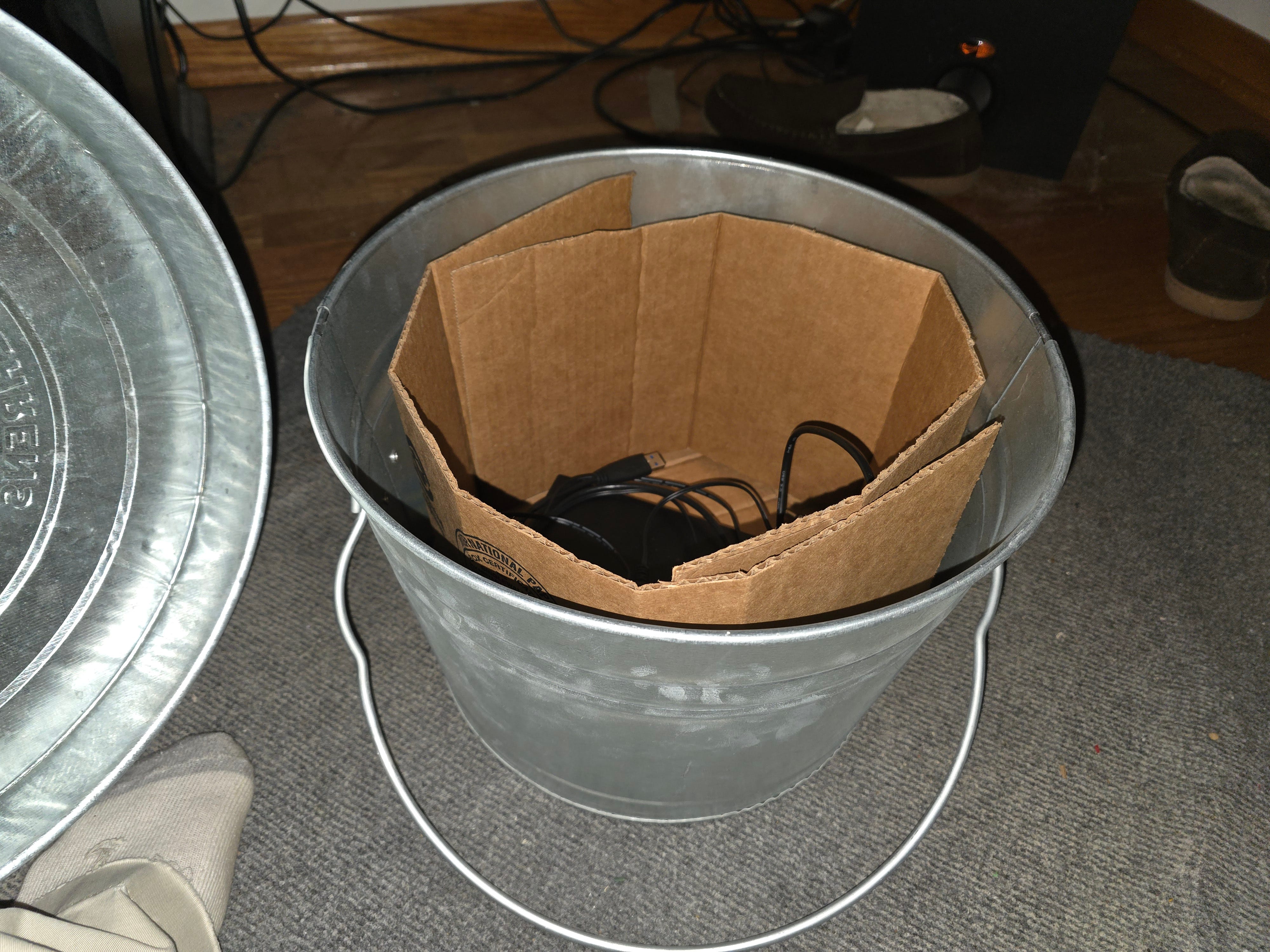
I am a Certified Nuke Worrier. We have weapons capable of rendering mankind extinct. Because we have them, someone will eventually use them. I don’t have a bunker in my backyard, but I do follow the Ready.gov nuclear war preparedness advice (you should, too!), and I keep a 5TB backup hard disk (unplugged) in a sturdy Faraday cage, so I don’t lose my family photos in the event of a high-altitude EMP nuclear attack. Of course, this only helps me in a limited nuclear war. In all-out nuclear war, I’m dead, and there’s nothing I can do about that.
Oh, yes, we have plenty of nuclear doctrines that are supposed to forestall global thermonuclear war, like Mutually Assured Destruction, but these doctrines rely on the decisions being made by well-informed, deliberative, sane men. Alas, information is not always clear, nuclear time pressure prevents deliberation, and not all world leaders are sane. For example, the current U.S. president might be ungenerously described as “a living game of Russian Roulette,” the previous president as “a drooling vegetable.” That puts America’s leaders solidly in the middle of the pack. Nothing prevents us from nuking the world except rational self-interest, which is very bad news for anyone who has ever met human beings.
Moreover, nuclear technology can only proliferate over time, and the speed of proliferation can only increase. Once a country goes nuclear, it almost never stops.1 The U.S. recently fought a war with Iran to discourage its nuclear program, and lost decisively.2 This clears the way for the mad mullahs to go nuclear—which, in turn, would set off a nuclear arms race in the Middle East, not exactly the cradle of statesmen. Speaking of statesmen, Kim Jong Un has had nuclear weapons for decades, and now likely has the capability to launch an ICBM at any target on Earth. The inexorable march of technology promises to make the tools for nuke-building ever-cheaper. (I wonder how many decades are left until the first nuclear-armed for-profit corporation.) Since the Global War on Terror ended, nobody has really cared, either! The New START Treaty, our last great disarmament effort, expired this year with nary a whisper in the press.
When the next nuclear crisis comes, cooler heads might prevail. In fact, they probably will. Think JFK withdrawing launchers from Turkey in 1962, or Lt. Col. Stanislav Petrov breaking protocol to flag the 1983 American “attack” a false alarm, thereby saving the world. However, the law of averages tells us that, eventually, cooler heads will not prevail. Someone with the power to fire a humanity-ending number of weapons will give the order, the nukes will launch, and we will die. Until humanity develops strong anti-nuclear defenses or creates self-sustaining settlements on other planets, we are on a clock. Even after the Cold War, even in the age of AI and pandemics, I still believe that, if humanity goes extinct this century, it will most likely be in mushroom clouds. I also believe we don’t worry about this enough.
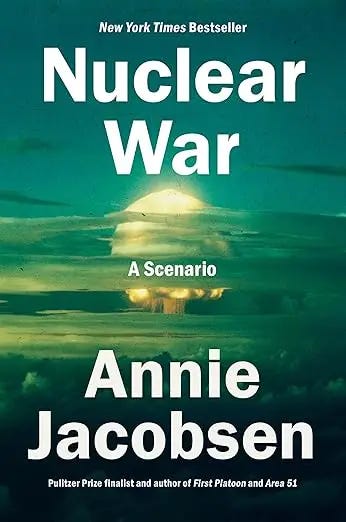
Annie Jacobsen wants you to be as scared about nukes as I am. Her taut 2024 bestseller, Nuclear War: A Scenario, follows a simple outline: after a brief overview of nuclear history (with a particular focus on U.S. nuclear weapons policy) she walks readers through each stage of an imagined nuclear exchange. Her scenario begins in Earth orbit, when America’s SBIRS satellite system detects a launch in North Korea. Her scenario lasts just 72 minutes. At the end of her scenario, everyone—everyone—is dead or dying.
Jacobsen’s research is wide-ranging and impressive. She draws a comprehensive, layman-accessible picture of the entire U.S. and Russian nuclear command-and-control programs. From the Aerospace Data Facility in Colorado to the Clear Space Force Station in Alaska to STRATCOM Headquarters in Nebraska, Jacobsen races around the globe, pointing out many pieces of our nuclear system that you’ve never heard of. (At least, I hadn’t.) She fought for on-the-record quotes from dozens of remarkably well-placed sources. She even managed to get a few things declassified specifically so she could publish them in this book! She then weaves just enough technical detail together with juicy supporting quotes from her sources to create a gripping narrative marinated in dread.
Have you seen Netflix’s A House of Dynamite? If so, you’ve already read about half this book. As far as I can tell, no one involved in Dynamite has admitted to cribbing Jacobsen’s book, probably because that would mean they’d have to pay her. However, it seems obvious to me that they relied on Jacobsen’s book a great deal (and used many of the same tricks to get the same effect). Their scenario is basically Jacobsen’s with the serial numbers filed off, and they gravitate to the same quotes as Jacobsen (“hitting a bullet with a bullet”).
Nevertheless, Jacobsen does it better. Because it is a movie, Dynamite had to rely on its characters to set the mood. We spend a lot of time looking at Rebecca Ferguson’s face as she tries not to tear up. Jacobsen, writing a book, can dispense with characters altogether, and instead explains the details Ferguson’s character was seeing on her inscrutable display screens. We don’t have to get our horror second-hand. Jacobsen feeds it to us pure. It is terrifying.
Unfortunately, she cheats.
Writing the 2020 civil war scenario for De Civ taught me something: a scenario is exactly as plausible as its second-least-plausible event. You’re allowed one plausible-but-very-improbable event, because the world is full of those, and world-shattering crises are almost always put in motion by one of ‘em. However, once you’ve had your one black swan event, you have to rigidly follow the logic of the scenario.
Of course, when writing a scenario, one will naturally come to crossroads where several things could happen, none of them overwhelmingly likely, and then the author must make a choice about how to proceed. The author will generally choose the most interesting option, even if it is not absolutely the most likely. That’s one thing. It’s quite another thing if your scenario needs a second black swan event. If it does, your scenario isn’t very plausible, and your readers are justified in setting it aside as fantasy.
Here are the key decision points in Jacobsen’s scenario:
Out of the blue, North Korea launches three nukes at the United States, flattening Washington, D.C. and irradiating a large portion of California.
The U.S. swiftly responds with an 82-missile salvo against North Korea.
The Russians misinterpret the U.S. launch as a nuclear attack on Russia.
Russia launches a full nuclear counter-attack against the United Sates.
The U.S. and allies retaliate in turn against Russia with a full nuclear counter-attack.
Then the world ends.
The initial attack makes no sense, but that is okay.
In Jacobsen’s scenario, North Korea fires a nuke at Washington and another at California. Later, too late to matter, they detonate a high-altitude EMP. Jacobsen never gives us any insight as to what plausible reason North Korea has for doing this. That’s because there isn’t one. Hitting the U.S. with three nukes would gain the Hermit Kingdom no discernible advantage, but it would gain a considerable disadvantage: the U.S.’s guaranteed retaliation would annihilate Pyongyang’s industry and government (not to mention Pyongyang itself!). Why would they do this? Jacobsen does not even attempt to explain.
Moreover, the nuclear weapon North Korea uses against Washington in this scenario has a 1-megaton yield.3 Jacobsen does not answer, or even acknowledge, another really important question: in her scenario, where did North Korea get megaton weapons?
The largest North Korean nuclear weapons test, in 2017, yielded an explosion that was, at most, 340 kilotons, probably closer to 250 kilotons—about a third to a quarter as powerful as the nuke in Jacobsen’s scenario.4 You might say, “James, it’s still a nuke! Who cares? Nobody survives a nuke!” But that’s just not true! Tonnage matters a ton!5 In a 1-megaton airburst attack on the Pentagon, the Washington Monument falls down, the White House and Capitol are destroyed (or at least severely damaged), and people standing on the street as far out as Fall’s Church, seven miles away, get third-degree flash burns. GWU hospital is destroyed and many other downtown D.C. hospitals are severely damaged. The President’s escape helicopter is very possibly downed by the electromagnetic pulse, and U.S. nuclear command-and-control comes under extreme strain.
In a 250-kiloton explosion, none of that happens. Downtown Alexandria (which is even closer to the detonation than Fall’s Church) sees every window facing the explosion shatter, but its hospitals continue functioning. The President makes a clean escape, and is able to return to the still-standing White House when the crisis is over. Casualties are much lower, both because there are fewer than half as many injuries, and because much more of the infrastructure of Washington is still functioning. The animals in the National Zoo are not all lit on fire by flash burns and then killed by radioactive fallout while no one comes to save them (as Jacobsen colorfully depicts on pages 212-213).
Jacobsen presumably wants to write about a one-megaton explosion over Washington because we spent much of the Cold War imagining megaton and multi-megaton explosions over American cities. The phenomenon is therefore well-studied in both military documents and popular cinema, which makes it easier to write about. Plus, megaton detonations are scarier! However, the Cold War is over. To our knowledge, North Korea does not currently have the capability to inflict a nightmare of that magnitude on the American homeland. A lesser nightmare, yes.)
Neglecting the tonnage distinction does the reader a particular disservice, since the major difference between a megaton-scale nuclear bomb and a kiloton-scale nuclear bomb is that you can probably survive a kiloton-scale nuclear bomb. People always make fun of “duck and cover,” like, “ha ha, what good is a flimsy desk gonna do in a nuclear fireball? we’re all gonna die anyway,” but, if you’re in the (very large) ring where a bomb does moderate-to-severe structural damage but you’re still outside the fireball, duck and cover will unironically save your life.
Still, fair is fair, and everyone gets one plausibility-straining inciting event per scenario. “Kim Jong Un builds a bigger nuke, U.S. intelligence misses it, and then he does something insane and self-defeating with it” is a black swan, but it’s not exactly unbelievable, either. Jacobsen's decision to omit any possible explanation is frustrating, but may be the best way to mask the fact that she does not have one and, according to the Laws of Scenario-Writing, does not need one.
The next hundred and fifty pages of the narrative proceed beautifully. It really is shocking how quickly one ICBM can turn a beautiful day into Hell on Earth, and Jacobsen tells that story very well.
Jacobsen also changed my mind. The first North Korean nuke strikes the Diablo Canyon nuclear power plant in California. This unleashes its own sort of hell, creating radioactive fallout that poisons the surrounding ocean, kills untold thousands of people on land for hundreds of miles around, and renders an area the size of “two New Jerseys” uninhabitable “forever.” Imagine the worst-case scenario at Chernobyl, then multiply it, then try to imagine managing it during a nuclear war. I’m very pro-nuclear power. It produces abundant energy at low cost with no carbon emissions and no environmental damage, with safeguards upon safeguards that prevent disaster as long as they are administered by an even moderately effective government. However, Jacobsen points out that there’s nothing to prevent someone from overwhelming all those safeguards in a few instants with a single nuclear device.
Much of the disaster that Jacobsen details results from the fact that, in addition to the reactors themselves, the Diablo Canyon facility also contains over 2,500 cooling pools and dry cask storage units, which contain over 2,500 highly radioactive spent nuclear fuel assemblies. All these cooling pools and casks are instantly vaporized by the North Korean nuke, sending vast quantities of radioactive fuel into the atmosphere. This occurs largely because the U.S. has abjectly failed to develop a long-term nuclear storage solution. Spent nuclear fuel is supposed to be shipped to a long-term facility (under a mountain or suchlike, which is safe because it’s where uranium came from in the first place), with cooling pools and dry-cask storage used only as a “temporary” measure. However, U.S. policy makers have, for decades, allowed local interests and “environmental activists”6 to prevent the opening of the U.S. long-term nuclear storage facility at Yucca Mountain. Jacobsen persuades me that this opposition should be crushed, by whatever means Congress and the White House have to hand.7 Every freestanding dry cask unit in the country puts us in danger.
Beyond that, Jacobsen persuades me that nuclear plant safety standards should take into account the possibility of nearby nuclear detonation, whether from a missile or a suitcase nuke. For example, upon detection of an ICBM launch projected to land within 2,000 miles of a nuclear power plant, the plant should immediately scram its reactors. Since even a scram shutdown takes hours, not minutes, relevant cooling systems should be capable of surviving nuclear attack. If they cannot, then land-based nuclear power plants may not be such a good idea after all. A technology that is utopian on most days but apocalyptic on a bad one probably does not pass a long-term cost/benefit analysis.
I admit that I find Jacobsen’s prose style irritating, at times. She has an inordinate love of sentence fragments that makes her professional work read, at times, like an action-adventure novel for pre-teen boys. Example:
The B-2 nuclear bombers… take to the air.
Which leaves the boomers. The nuclear-armed, nuclear-powered submarines. The nightmare machines. The handmaidens of the apocalypse. Unlocatable by Russian missiles and therefore unstoppable. Nuclear-armed to the teeth.
But this was a small complaint against a compelling read. After all, even I sometimes succumb to the temptation to dramatically start paragraphs with a conjunction.
However, on pages 218-226, the book suddenly falls to pieces.
It is 43 minutes since the North Koreans launched their missile. Twenty minutes ago, a nuclear weapon rendered much of Southern California uninhabitable. Ten minutes ago, Washington, D.C. was obliterated. Russia knows that North Korea launched the attack. More importantly, Russia knows that the U.S. knows North Korea launched the attack. The 82-missile retaliatory salvo, aimed at North Korea, has just blinked on to Russian radar.
Here, Jacobsen commits the cardinal sin of scenario-writing: a second, independent black swan event.
Here is the paywall. Worthy Reads and Short Reviews are the only paywalled categories at De Civ. I love every reader, but paylisters are the people who keep me writing, and they’ve earned their treats. If you’d like to read on, you can do so by subscribing here:
