

On May 11, 2024, Minnesota officially adopted its new state flag:

That new flag replaced this one:
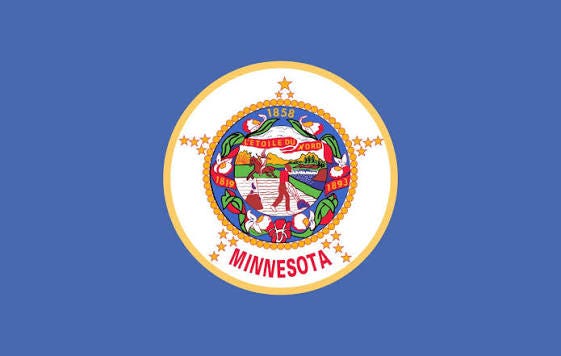
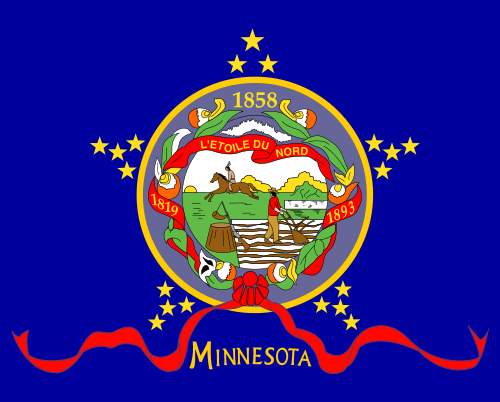
That flag, adopted in 1983, was the latest in a series of minor flag variants that dated back to the state’s original flag, the 1893 flag:
The DFL (Minnesota’s version of the Democrats) held a trifecta in Minnesota government from 2022-2024. Passing the new flag was perhaps the least consequential thing they did.
Yes, This Is Silly, But I Do Have To Tell You The Background
The DFL has long viewed the old Minnesota flag as racist, because it depicts a noble Minnesotan Indian on horseback peacefully sharing a moment with a White farmer/settler-colonialist while riding in front of a sunset.1 When I encountered the state flag for the first time, in fourth grade, I thought this was a picturesque historic scene emphasizing our Native legacy. I wouldn’t have used this language in 1998, but I understood our flag as a subtle land acknowledgment. I was not a foolish child for thinking this, either! State statute said that the meaning of the Indian was exactly what 9-year-old James thought it was:
The sun, visible on the western horizon, signifies summer in the northern hemisphere. The horizon's visibility signifies the flat plains covering much of Minnesota. The Indian on horseback… represents the great Indian heritage of Minnesota. The Indian’s horse and spear and the Pioneer’s ax, rifle, and plow represent tools that were used for hunting and labor.
The DFL’s view, however, was that it was a whitewashing—nay, a celebration!—of the 1863 expulsion of the Dakota following the short, initially justified, but savage war the Dakota launched against American Minnesotans in 1862.2 They called the flag “white supremacist”3 and even “genocidal”! Because most of the DFL thought the flag was racist, they introduced bills to change it at least once per election cycle, and had done so for most of my life. These went nowhere.
During the 2010s, however, these racism concerns began to be laundered through a weird third-party group: vexillologists, people who study flags for a living (or for fun). In 2006, the North American Vexillological Associatiation (politely) declared war on traditional American state and municipal flag design in their pamphlet, Good Flag, Bad Flag. Flags, according to NAVA, must be simple, use only two or three colors, and—this was really their central point—must never, ever include words or a state seal. Otherwise, the flag will not be identifiable at a distance, or while flopping. (They also said flags should be “distinctive,” but undercut this principle at every turn.) Too-online vexillologists started using “seal on a bedsheet” as a term of derision. The often-interesting CGP Grey became downright annoying about it, producing a whole series of flag videos, in which his affect can only be described as “the smarmiest commissar”:
Spoilers: he graded Minnesota’s flag the very worst in the entire Union.
This vexillology stuff is, of course, silly. First, lettering is very clearly identifiable at a great distance. NAVA just thought it wasn’t aesthetically pleasing (which is fine, de gustibus, I even tend to agree) and tried to make their taste an “objective” principle of flag design by pretending nobody can read.
Second, there is only one context in which a state flag actually needs to be identifiable at a distance: during a civil war, warring states need good flag design so soldiers know how to identify their units. If you’re not fighting a civil war, who cares? “The flag flying underneath the American flag” at your local library or car dealership is basically always the state flag, and state residents basically always know their state flag well enough to easily tell it apart from other local flags. In fact, you know how Minnesotans can easily tell their flag apart from Wisconsin’s?
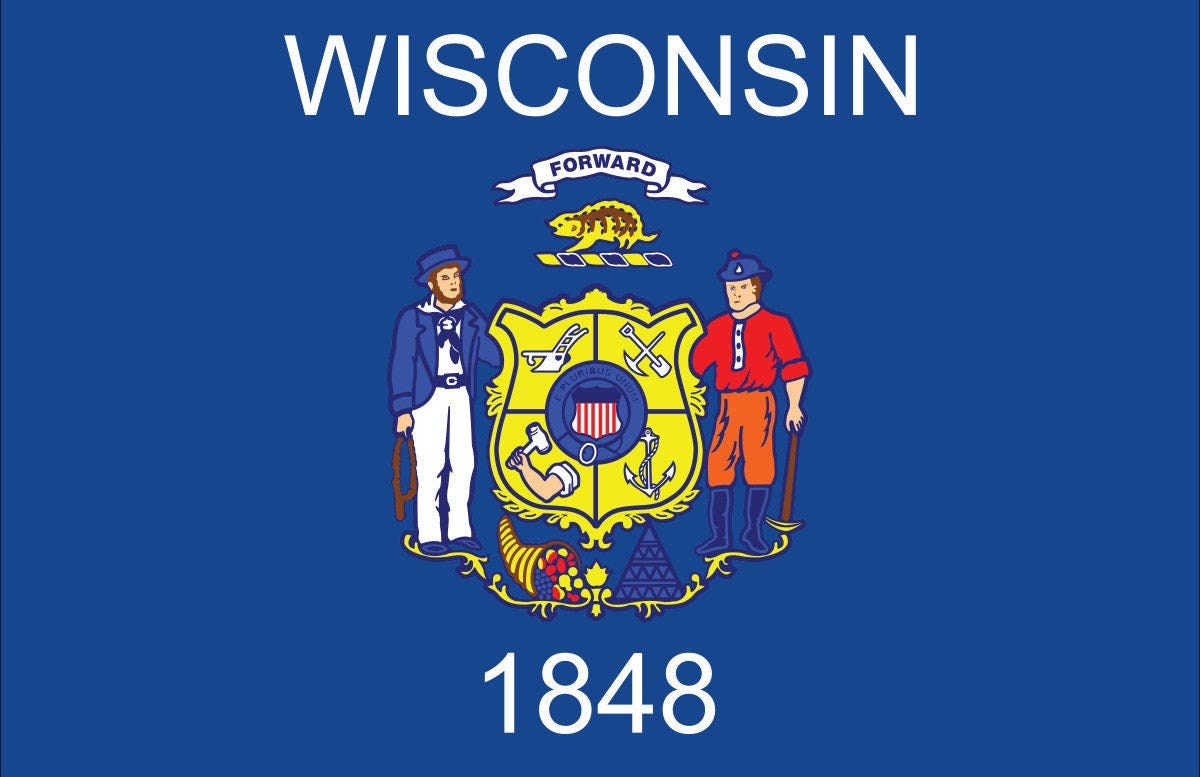
The word “WISCONSIN” is a tip-off!
Ironically, during the actual American Civil War, regiments routinely designed their flags by… printing the regimental insignia on solid blue background. “Seal on a bedsheet” design came to American state flags in the late 19th century directly from the single conflict in American history when state flags actually needed to do the things modern vexillologists insist they should always do! Vexillologists might just be full of crap!
The problem is that vexillology is not an academic field. It’s a bunch of mild autists with a shared special interest, who got together in 1962 and wrote enough letters to each other about what they liked that they declared themselves experts. That’s fine, God knows I have my little special interest communities, but then the vexillologists decided that their expert judgment should supersede popular sentiment. Bandying them about as “experts” works on the class of voters who believe that experts are always right, but, to other voters, vexillologists’ hate-on for traditional flags is only another failure of expertise, further eroding trust in experts (trust that is needed more urgently now than usual!).
The Minnesota flag had avoided redesign for decades because it required the DFL to openly pick a culture-war fight they had no need to start, and voters didn’t want that. However, the rise of the vexillologists changed that. “Vexillological concerns” over the “terribly designed” Minnesota flag gave DFL legislators from moderate districts cover to vote for a flag redesign while pretending it wasn’t a culture-war thing. (Plus, they had a trifecta! And it didn’t hurt that we were still at Peak Woke.)
Thus, in 2023, the DFL trifecta passed a bill establishing a 13-member flag selection committee, the State Emblems Redesign Commission, which would receive submissions from around the state and then select their favorite. Their favorite would then automatically become the law of the state, unless blocked by subsequent legislation. The members of the commission were:
Secretary of State Steve Simon (DFL), last seen in De Civitate’s pages villainously usurping the power of the Minnesota House (I was soon vindicated)
Three people appointed by Gov. Tim Walz (DFL)
Two Indians appointed by the Indian Affairs Council
Inexplicably, three representatives from other racial interest groups (the Council for Minnesotans of African Heritage, the Council on Asian-Pacific Minnesotans, and the Minnesota Council on Latino Affairs)
The director of the Minnesota Historical Society, a left-wing, state-funded, semi-governmental non-profit organization
Three directors and chairs from other semi-governmental non-profit organizations
You know how, when a room’s full of men, it’s called a “sausage party”? What’s the word for when, instead of men, the room’s full of Democrats? A klanbake?
To be sure, the DFL was consciously imitating the (very loose) process which led to the creation of the original 1893 flag: six volunteer women working for a state-established non-profit (the Women’s Auxiliary Board, preparing for the World’s Fair) held a statewide contest, reviewed submissions, and selected a winner.
However—and this is crucial—the WAB was not a partisan operation, and its flag did not automatically become law. It didn’t even have official sanction outside Minnesota’s World’s Fair booth! It was only after the women selected the 1893 flag that the legislature voted on it, unanimously adopting the women’s flag as the official flag of Minnesota in a bipartisan triumph. By contrast, the 2023 State Emblems Redesign Commission was established on a party-line vote, over unanimous Republican opposition, it was composed solely of Democrats, and the flag those Democrats decreed became law without any further vote of the legislature or the voters.
In Which Your Correspondent Dislikes the New Flag
I did not give a crap about any of this at the time. If someone asked me directly what I thought of the flag redesign project, I would tell them I didn’t think much of the legislature’s reasons for launching it, but that I looked forward to seeing what they came up with. I wrote nothing about it in public, even on my private Facebook page. There were much bigger fish to fry during the 2023 Minnesota legislative session. It’s a flag, for chrissakes.
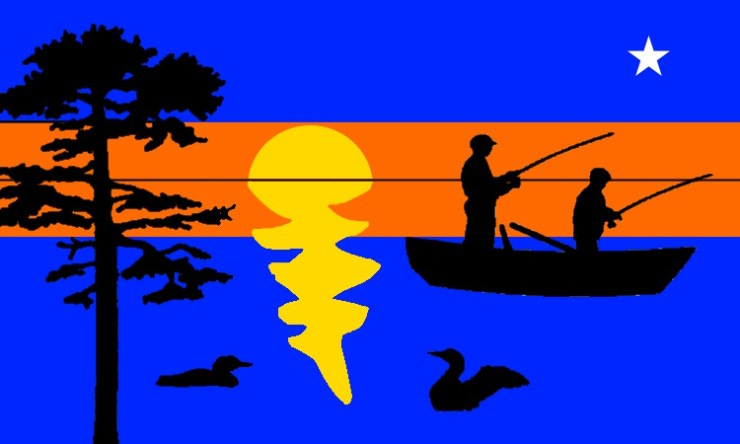
Moreover, the truth is that, as much as I liked the old flag (and I really did), I was aware that the flag made some Minnesotans feel sad or angry. This was a small minority, and their reasons were, I thought, bad reasons, but, nevertheless, this minority largely refused to fly the state flag or show it respect. A symbol of state unity, an expression of our shared republic, was instead a source of division. Forget the “white supremacy” labels, forget the “vexillology” nonsense, but this was a problem. A state’s flag should not be divisive among people who live in that state. Granted, there will always be a fraction who will hate any flag, whether because they’re oikophobes or just obstreperous, but our old flag was undeniably more controversial than it needed to be. I wouldn’t have voted to change it, but I wasn’t mad that somebody else had. I assumed the new flag would be centered around the loon (Minnesota’s ubiquitous symbol) and I thought that would be nice.
This was a nice option, IMHO:

This one would have given vexillologists a coronary, and maybe needs a second pass to tidy up the lines, but I love it:
Alas!
When this design was announced in late December 2023, I posted a quotation from National Review that summed up my feelings:
What in the world is that supposed to be? It looks like the national banner of a small, fictional Caribbean country you have to liberate from a caudillo in a first-person shooter. It’s the ensign a rebel army would hoist above the burnt-out husk of a battle-scarred parliament building. It’s the flag equivalent of Greendale Community College’s mascot, the Greendale Human Being — an anodyne expression of nothing in particular. It conveys only that the state it is supposed to represent is unremarkable.
I added one comment of my own to NR’s: “De gustibus, there’s more important things in the world to fight about than flags, but I liked our old flag better.”
Well, okay, two comments:
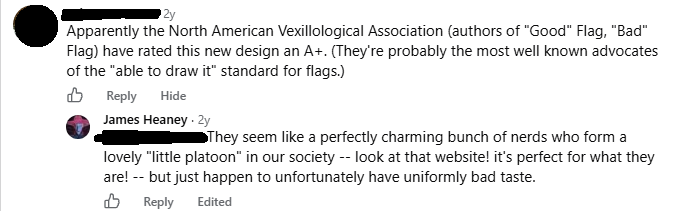
I have a demi-estranged family member who left Catholicism for progressivism. She was so delighted with the new flag that she texted the family group chat to crow about it. I said I was glad she and others were happy with it, even though I personally didn’t care for it and didn’t want to hate on the old flag. I acknowledged that the majority of Minnesotans seemed pleased and that it’s good for the majority to like its own flag. When she tried to pick a fight about the old flag, I calmly disengaged. I wrote nothing else about the flag for more than two years. I sought solace in Laser Loon:
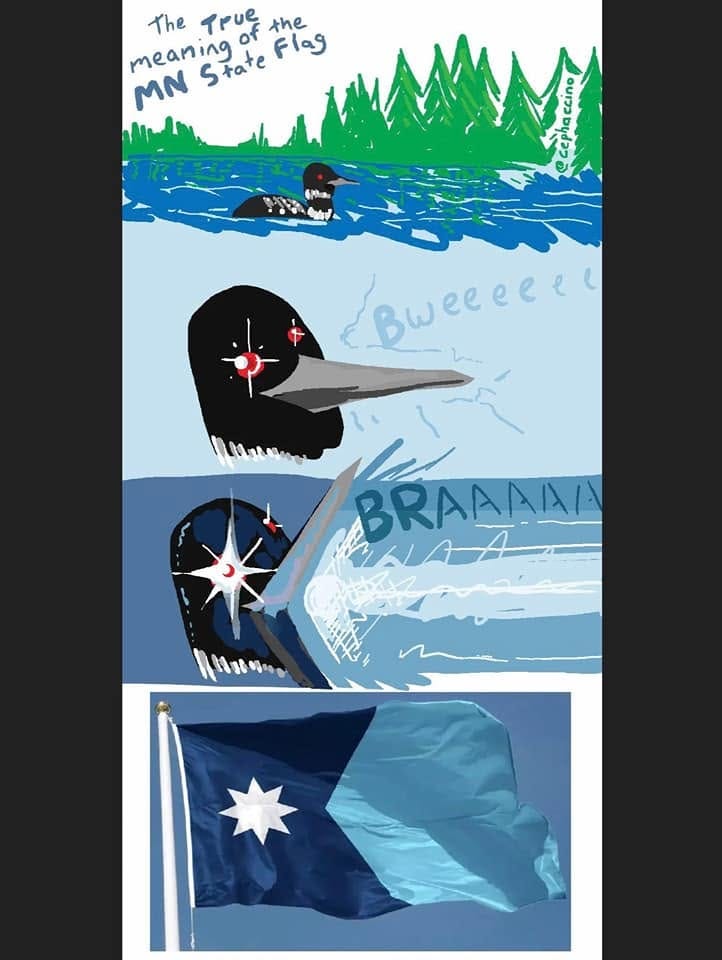
…but, again: it’s a flag, for crissakes. I didn’t expect to be writing about the state flag in 2026 because, after December 2023, I didn’t expect to be thinking about it, ever again!
Things Get Weird
As you probably remember, I resigned my very minor post in the Minnesota Republican Party in 2016 after the U.S. Republican Party nominated Mr. Trump for President. For a decade, I did not participate in any partisan political activities, on either side.

However, in 2026, I learned that there was going to be a big brawl in the Minnesota GOP about whether it would remain a pro-life party. If there isn’t a pro-life party in Minnesota for me to come back to when our current troubles are over, there is no point in politics at all.4 So, like a dog to its vomit, I returned to the GOP caucuses this spring, with one goal: protect the unborn.
I ended up getting elected as a delegate to the local district convention, which meant I saw a lot of candidates give a lot of speeches. When candidates in a contested primary courts voters at a convention, he pulls out the reddest of red meat for us delegates. I heard things that pleased me, such as several commitments to the protection of the unborn and attacks on the pro-choice candidates. I also heard things that displeased me, like moron candidates blamed Sen. Mitch McConnell (God’s single greatest gift to the GOP over the past twenty years) for blocking voter ID in Congress.
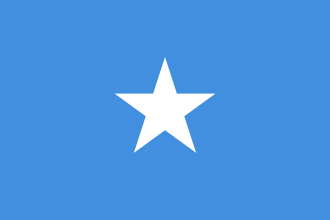
I also heard one thing that shocked me: over and over again, candidate after candidate featured the state flag as a Top 3 issue. Several give it number one top billing. Candidate websites often featured a Minnesota flag… and it was never the new Minnesota flag. Some even implied that the new Minnesota flag was based on the Somali flag, which is… a hot-button take in Minnesota right now.
Soon after, I started looking around my town. Immediately after the adoption of the new flag, of course, the old flag stayed hanging at lots of houses, but you expect that. It takes time for people to buy the new flag. But now, two years later, it seems hard to deny: a clear majority of flag-wavers are flying the old flag!
Now, I mentioned this at a local Republican meeting, and the organizer seized on it to say that there’s clearly a silent majority of Minnesotans who are angry at the direction the state’s been heading under Gov. Walz and the DFL, ready to vote them out if the GOP can just get out the vote. I tend to think that the explanation is less exciting: Republicans are prouder of their homeland, much more patriotic, and more likely to fly a flag in the first place. Thus, flags are disproportionately flown by Republicans, and Republicans seem much more likely to hate the new flag, so, among the small, skewed sample of flag-wavers, the old flag wins out. I do not believe there is a conservative silent majority in my precinct.5 Nevertheless, it is intriguing that the state symbol, whose sole purpose is to signal state patriotism, unity, and warm fellow-feeling among Minnesotans, appears to have been rejected by the majority of people who would ordinarily fly it.
Then, in April, I was shocked again. The town next door to mine, Inver Grove Heights, had a divided city council (3 to 2) vote to remove the new flag from city property and resume flying the old flag. IGH was Harris+14 in the 2024 election.
This led me to look around a little bit, and I discovered that there are 17 municipalities in Minnesota, plus 2 counties, that refuse to fly the new flag. I had heard a word or two about this on social media, but I had assumed it was limited to one or two backwoods deep-red thorps I’d never heard of. To be fair—with apologies to the doubtless noble stock of Zumbrota, MN—this was mostly true. However, one of them was Pequot Lakes (Trump+34), a town I know well from spending a week every summer relaxing on the beautiful Lower Cullen Lake. Another was Champlin (Harris+9), a metro-area town I know from their Quiz Bowl team.
Meanwhile, a progressive acquaintance of mine left this public comment for one of her county legislators:
[Support the new flag.] The new flag was decided by the people, for the people. Wherever I see the old flag flying, I know to avoid it because holding on to a racist past means that space is likely unsafe for minorities (including me). I will feel less safe and welcome in AV [Apple Valley, another nearby town] if you fly the old flag.
Her comment represented well the general tenor of Camp New Flag: it’s not just an aesthetic issue anymore. It’s a race issue. It’s a personal safety issue. Thus, the legislator who called the old flag “genocidal,” Rep. Mike Frieberg, proposed sharp funding cuts to any cities that dared to fly the old flag. This proposal did not succeed in the current legislature, but could pass next year if the DFL rebuilds its trifecta this November. (The DFL is very likely to rebuild its trifecta this November.)
So the flag has become an Issue that legislators at all levels now have to Navigate. Random city councilmembers are getting called on the carpet for supporting (or opposing) the flag—which, again, is supposed to be a symbol of state unity.
I think this raises three interesting questions:
Why did the new flag design become polarized?
Is this a legitimacy crisis?
Faced with this, what should legislators actually do?
Why Did the New Flag Get Polarized?
Before we ask why the new flag got polarized, we should verify that it actually is.
Going into this article, my assumption was that this was an 80/20 issue favoring the Democrats. My assumption was that Republicans were flying kamikaze into yet another issue where they feel very passionately, but where independent voters squarely oppose them. My assumption was that Democrats overwhelmingly supported the new flag. My assumption was that independent voters didn’t give a crap about some dumb culture war fight when the state is drowning in fraud, inflation, property tax hikes, and ICE raids. (It’s a flag, for chrissakes.)
My assumptions were wrong.
A Star Tribune/KARE 11 poll in June6 found that only 30% of Minnesotans approved of the new flag. 50% disapproved. The new flag is 20 points underwater! The (left-wing) Star Tribune’s headline? “The new Minnesota state flag is deeply unpopular.”
However, the results are, indeed, sharply polarized. The new flag really is popular with Democrats, who favored it 55-16 (+39). However, Republicans oppose it 90-2 (-88), which is an impressive level of agreement, even within a political party. Moreover, to my considerable surprise, Independents also oppose it, 52-26 (-26). No age group supports it. The only counties to support the new flag are the urban cores of Hennepin and Ramsey, which back the new flag fairly narrowly, 45-30 (+15). The rest of the state, including the metro suburbs, opposes the new flag.
We shouldn’t read too much into this poll. The poll did not ask Minnesotans whether they preferred the old flag to the new flag. It only asked whether Minnesotans approved of the new one. There are undoubtedly some Minnesotans who dislike the new flag, but hated the old one, and so disapprove of the new flag while still preferring it over the old flag. This poll can’t tell us how large this camp is. However, a 2024 poll by the Center for the American Experiment found that, given a choice between keeping the old flag, using the new flag, or going back to the drawing board, a majority supported the old flag. That means this camp is probably fairly small. (I suspect some of them answered “not sure” to the Star Tribune poll.)
At one level, it seems obvious how we ended up here. The DFL picked a culture-war fight and won. The flag they rammed through became a symbol of the unhealthy power dynamic in our state right now, which is, basically, “the Metro doesn't care, doesn't need to care, and doesn't want to care what Outstate thinks. You will take what we give you and you'll like it!” That’s how our state was governed during the DFL trifecta. It is very likely it’s how the state will be governed again in 2027-29. Republicans have not held the governor’s mansion in twenty years (and will not win it again this fall), which makes the ruby-red Greater Minnesota feel disempowered and resentful. The new flag distills that feeling down to a colored rectangle and calls everyone who feels it a racist. This is a recipe for resentment.
This is true enough, but boring. I also don’t think it adequately explains the depth and breadth of opposition to the new flag. After all, if most opponents thought the new flag was pretty, would they really fight it? I don’t think they would. Likewise, I don’t think its supporters would have selected it if they hadn’t genuinely liked it. (They had plenty of options!) I offer a supplemental theory.
When my family member texted the family group chat with excitement about the new flag, I thought she was not deliberately picking a fight. Rather, she thought she had finally found a relatively non-political political issue we would all agree on. The text was an attempt at finding common ground, which has been in short supply of late. My theory is that her reason for liking the new flag wasn’t because it was a culture-war victory for her side. (If she had just wanted to gloat, there were plenty of other, far more consequential, opportunities for her to gloat that term.) My theory is that she liked the new flag because she thought it was pretty, and she expected everyone to agree with her that it was pretty. Unfortunately, the more right-leaning members of the group chat thought it was ugly.
I don’t think this is a coincidence. I think there has been a genuine aesthetic divergence between the Blue and Red tribes in this country. Blue tribers honestly, no posing, think flat, streamlined design is pretty. Red tribers honestly, no posing, want their baroque lines and ornament. This plays out all over the place. The famous McMansion Hell blog is literally just a smug, left-wing Johns Hopkins grad with a master’s degree dunking on what she views as uppity (right-wing) peasants with no taste, largely because they don’t want to live in trendy minimalist cubes. The tribes now watch different movies. They enjoy different TV shows.7
I think some of this happens because the tribes have different views on experts. Red-pilled people imagine that they are maintaining independent judgment in the face of expert consensus, whether the expert consensus is about vaccines, flags, or television. In reality, red-pilled people often resent and distrust experts so deeply that they will reflexively reach for whatever experts don’t recommend, and end up managing covid with only ivermectin while watching Animal Control on FOX. Meanwhile, the blue-pilled imagine they are simply giving moderate weight to expert opinion on vaccines, flags, or television, but, in reality, they robotically fall in step with whatever recognized experts have opined, and feel vaguely uneasy whenever they find themselves outside the expert consensus. They are so invested in defending expert opinion that they become its slaves, and ended up wearing masks into 2022 while loudly insisting that Star Trek Discovery was great, had lots of fans, and that they personally loved it.
However, some of it is probably just tribal sorting. The Blues have, over time, gradually pulled in everyone who thinks High Modernism is a pretty good aesthetic, and the Reds eventually acquired everyone else. The political camps are thus bound to have genuine aesthetic disagreements. These will have nothing to do with anyone’s political principles, yet will play out through polarized political trench warfare. Each tribe will suspect the other tribe of lying about their aesthetic judgments for political reasons (“because who could possibly think something that ugly looks good?”), and both tribes will be wrong to think that.8
My recommendation is to assume that your opponents on the flag question aren’t lying to you. They haven’t been brainwashed into their position—or, at least, no more than you have. They really do think the flag you hate looks better. De gustibus non est disputandum, though, so you simply have to accept their opinion. If you’re going to argue with them, you should argue about the best democratic process for choosing new flags, since you might actually make some headway there.
Is This A Legitimacy Crisis?
I’m obsessed with legitimacy crisis, so of course this was the first question I asked myself.
I have written:
[A legitimacy crisis is] a situation in which different citizens sincerely disagree, at a very basic level, about what the law is and which persons have the authority to make or enforce it. A legitimacy crisis is not a law review paper suggesting that paper money is unconstitutional; a legitimacy crisis is half the country thinking one guy is the de facto and de jure President while the other half of the country sincerely believes some other person is the President. This happens when unforeseen circumstances arise with no clear legal resolution and both sides choose to play hardball.
No, this is not a legitimacy crisis.
The law, in this case, is absolutely positively clear: there is only one flag of Minnesota, and it is the new flag selected by the DFL commission in 2023. No one seriously disputes that this is the law. The reasoning may have been dumb, the commission poorly designed, but the DFL followed the process laid out in the Minnesota Constitution for making a new law, and they had the votes to do it.
However, municipalities are not strictly required to fly the state flag, and may fly other flags if they choose, including old state flags the legislature doesn’t like. No one seriously disputes that this is the law, either. Both sides seek to make changes to the status quo through the law, according to the mutually accepted legal process. That makes this a hot-button issue, but it is the furthest thing from a legitimacy crisis.
At the same time, it is the sort of thing you would expect to see happen in a polity that is ripe for legitimacy crisis. People are taking down the lawful flag of the Capitol and flying a different flag that embodies an aesthetic (and a version of history) that the Capitol expressly rejects! When you ask them why they won’t fly the single, lawful, plainly legitimate new flag, they come up with the most strained process justifications, like, “This flag is illegitimate because there wasn’t a statewide referendum.” Dawg, no Minnesota flag has ever been put to a statewide referendum. If you wanted that to be a rule, you should have put it in the Constitution, but we have a republic, not a democracy.
Meanwhile, ask a new-flag-liker why flag-haters should wave the flag, and they rarely say, “Because we had the votes.” They say something like what my progressive acquaintance said: it was chosen “by the people, for the people,” which… simply isn’t what happened. Many supporters will even insist that the redesign commission was bipartisan. (It wasn’t!9)
If we are like this on an issue where the law and the facts are absolutely clear, and the stakes so low, imagine how quickly motivated reasoning could persuade us to angrily take up a cause in a case where the law and the facts are ambiguous, and where the stakes actually mattered.
For something like this to get so far out of hand, for citizens to rebel so fiercely against a symbol of state unity, and for the Capitol to shove it down their throats so brusquely in the first place, bespeaks a level of freestanding, unquestioned partisan hatred that was foreign to our parents’ generation. As I wrote in 2024:
Think of intensifying partisan hatred as a barrel of gasoline that has sprung a slow, slow leak in a very large room. Every time we thwart a Norm, or throw a hardball, we’re tossing a lit match into that room. Most of them will do nothing. The odds of any single one of them igniting the room are very low.
But when one of them explodes, we would be very silly if we thought there was something special about that particular match. Whatever kicks off our next war will seem unlikely, even absurd… until the moment it becomes inevitable.
The flag “crisis” adds more gasoline to the room. It encourages more match-throwing. However, it is not, itself, a match.
Knock on wood!
What Should Legislators Do?
By turning this into a salient, polarized culture-war issue, the DFL caucus at the state legislature has put themselves and future legislatures in a bind. There’s no “undo” button for this. Before this kerfuffle, the state was reasonably united around the old flag, and voters steadfastly poured water on attempts to spark a culture-war wildfire over it. However, that fire is burning merrily now, and you can’t put it out by returning to the status quo. At this point, the old flag is a symbol of the Red Tribe, just as the new flag is a symbol of the Blue Tribe, so reverting to the old flag wouldn’t reunite the tribes. It would only turn the current winners into losers and the current losers into winners. Neither the old flag nor the new flag is a viable option.
Nor is there a bipartisan third option riding to the rescue like Gandalf at Helm’s Deep. It’s possible that, before all this happened, the DFL could have included Republicans in the redesign process, made design compromises, secured GOP buy-in, and passed some other, less hideous, flag into law, like the laser loon:
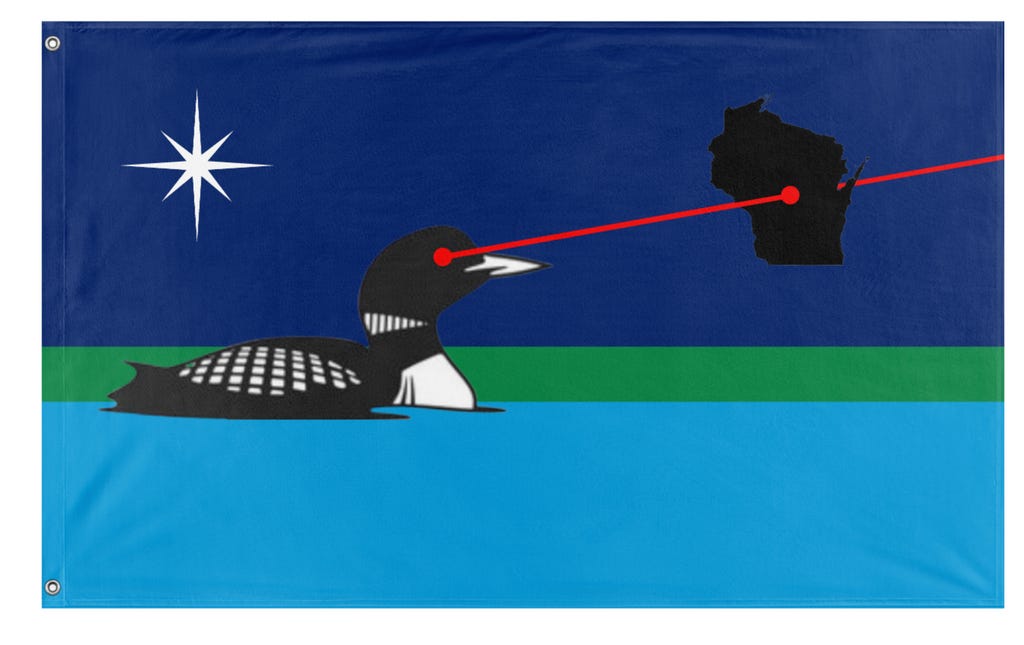
That, or something like it, might have won broad popular support, especially with endorsement from party leaders on both sides of the aisle. Unfortunately, that moment of possibility has passed. There are far too many voters now who will not accept anything but the old flag. What’s a state legislator to do?
I suggest nothing. It’s a flag, for chrissakes, and the legislature has more important business to attend to. The smart play for Democrats is to officially stand by the new flag, while, in practice, avoiding it whenever possible, both because it is unpopular and because they ought to be embarrassed about how they bungled this into a culture-war issue. Republicans, for their part, should use the flag controversy subtly and sparingly to intimate their narrative: that the DFL are as incompetent as they are tasteless, and as deaf to the voters as they are toadies to woke H.R. ladies. However, even swing voters who dislike the new flag aren’t ranking the flag as one of their actual issues, so that’s all the flag can be for the GOP: an occasional rhetorical tool, not The Issue.
Eventually, passions over the flag will cool, people will get used to the new flag, and, perhaps in a decade or two, the new flag will finally be accepted. Alternatively, the Republicans may blunderingly try to turn the flag into The Issue, and independents will go, “Oh, come on, Minnesota has more important things to work on. It’s a flag, for chrissakes,” and side with the Democrats out of exasperation. One of those is, by far, the most likely way this drama ends.
However, it is possible that the political volume on this issue will get so high in the next couple of years that legislators feel compelled to do something. Yet we’ve just seen that they can’t do anything. They’re stuck!
I hate popular referenda. Popular referenda reduce complex issues to sound bites and fundraising marketed to the lowest-common-denominator voter, and result in states adopting terrible, short-sighted, divisive policies, like California’s property-tax restrictions (which have helped lock young Californians out of the housing market), or Ohio’s abortion-to-birth amendment. We have a republic, not a democracy, precisely because our elected representatives are better able to hone complex policy, considering long-term trade-offs and making appropriate compromises to win broad support. Voters are okay at picking candidates;10 they are terrible at deciding policy. If I could revise every state constitution, I would eliminate citizen-initiated referenda of all kinds, and I would require a supermajority to approve any state constitutional amendment.
However… if you really need an issue to go away, and there’s no complexity to it, and you don’t care how it’s resolved, a referendum might be just the ticket. You could have a “flag primary” featuring the old flag, the new flag, and any other design that gets two thousand signatures in support. Top two advance to the general election. The people decide. It’s still likely to end in a divisive, culture-war victory for one side or the other, but at least it’ll be a culture-war victory with a popular imprimatur on it. Then everyone can agree “the people have spoken” and move on. This isn’t perfect, but all the perfect solutions are long gone.
In the meantime, municipal and county legislators are in more of a bind. They are currently stuck with a choice between flying a flag that signals contempt to the rural half of the state, or a flag that signals contempt to the urban core of the state.11 They can’t request a statewide referendum, but they may have the option of holding a local referendum.
That said, if the purpose of a flag is to emphasize what we hold in common, to celebrate our shared republic (emphasis on shared), local governments might consider simply flying both. Having the old flag and the new flag on the same pole says, “We don’t care which tribe you’re from. In the eyes of this city, we’re all Minnesotans, and we serve you.”
That, it seems to me, is what flags are for.
It is often contended that the Indian is riding west into the sunset. The Minnesota Legislature of 1983 said otherwise (MN Rev. Stat. 1983 1.135.5)):
The Indian on horseback is riding due south…
However, as we will see in the balance of the article, just because a legislature says something doesn’t mean people are gonna agree with it.
It remains the institutional view of the left-wing Minnesota Historical Society that the 1893 flag was celebrating that expulsion. The Star Tribune collected some evidence on either side, admittedly with a little bit of a thumb on the scale.
The author of the linked op-ed is a former Obama speechwriter.
In case I manage to publish this before Tuesday’s GOP primary election: please cast your ballots for the MCCL-endorsed pro-life ticket! That’s Lisa Demuth for Governor, Adam Schwarze for U.S. Senate, Tad Jude for Secretary of State, and Nate George for State Auditor.
Obviously, none of these candidates has much of a chance of actually winning in November. I think the GOP’s once-surprisingly-good chance at winning the Minnesota midterm election went out the window with Operation Metro Surge. The Iran War and subsequent price increases merely put nails in the coffin. Demuth has a better chance of winning than chief rival Mike Lindell, the MyPillow lunatic, but that just means she has like a 3% chance instead of a 0.5% chance. The point of voting for these candidates, however, is to deliver a clear message to the GOP, especially the NRSC (which is backing pro-choicer Tafoya): the MNGOP is pro-life. Win with us, or lose without us, no third option.
In fact, given precinct turnout in the 2024 election (around 80% of eligible voters, who cast ballots for Harris+33), it is mathematically impossible.
(Registered voter turnout was 93%, but, statewide, only about 86% of eligible voters are registered, which brings overall precinct turnout down to around 80%. I said Harris+37 earlier, but that was for the entire city; my specific precinct was Harris+33.)
Conducted by Mason-Dixon, an A- pollster according to the Silver Bulletin database.
You can usually tell which ones by comparing number of viewers to volume of media coverage. Shows with more viewers than you’d expect from the scant media coverage, like Yellowstone and Tracker, lean red. Shows with no viewers but lots of media coverage, like Girls and The Late Show with Stephen Colbert, skew blue.
I have been trying to expand this thesis into a full-length article for four years, but there’s no meat beyond the thesis. I can multiply examples of Red and Blue having different tastes with no obvious ideological reason for it, I can examine how that hardens into the dumbest kind of fandom warfare, but I can’t really do anything more with it. Don’t take pills, kids!
Four members of the legislature, including two Republicans, were allowed to attend commission meetings as observers, but had no vote. Both Republicans signed the commission’s minority report, which pointed out various defects in the “open” process the commission was supposed to follow.
Well, okay, not really, except under certain limited circumstances, but still much better at picking candidates than at setting policy.
…and, some argue, to Indians.
I'm surprised.
I don't really like either flag myself, but I'm afraid I'm one of those vexillologists: I aesthetically dislike the old one for pretty much exactly their reasons. But, alas, the Culture War has come for good flag design.
I don't really have a horse in this race, as I was raised in the state with the best State Flag (New Mexico) and it's all down hill from there. I think the old flag looks like a pain to embroider and the new flag has something wrong with the color saturation. I would have expected it to be somewhere in the realm of license plate design as far as how much the average person cared.