

Shortly after the end of the Supreme Court’s 2021-22 term, I wrote a short article called “The Most Dangerous Time To Be A Supreme Court Precedent,” where I divided the U.S. Supreme Court’s history into ten distinct “eras,” then examined the data on how much each iteration of the Court honored precedent and stare decisis.
Bottom line? I confirmed the aphorism: “Stare decisis is an old Latin phrase that means ‘Let the wrong decisions of the Warren Court stand.’” The Warren Court turned out to be the era of the Court with the least respect for stare decisis, with subsequent eras treating precedent with much more respect (which has given the Warren Court outsized influence on American law). This is, perhaps, unsurprising, but, along the way, I explained stare decisis, explored various ways of measuring adherence to it, and put each era of the Court to the test. It was good! Here is the full article:
The Most Dangerous Time To Be A Supreme Court Precedent

“The Supreme Court has abandoned stare decisis,” is a thing you hear a lot these days. Here’s a reddit comment I came across in July:
However, the original article ended on an uncertain note. Because the conservative Barrett Court was only two terms old at the time, I couldn’t draw any firm conclusions about this newest era of the Court:
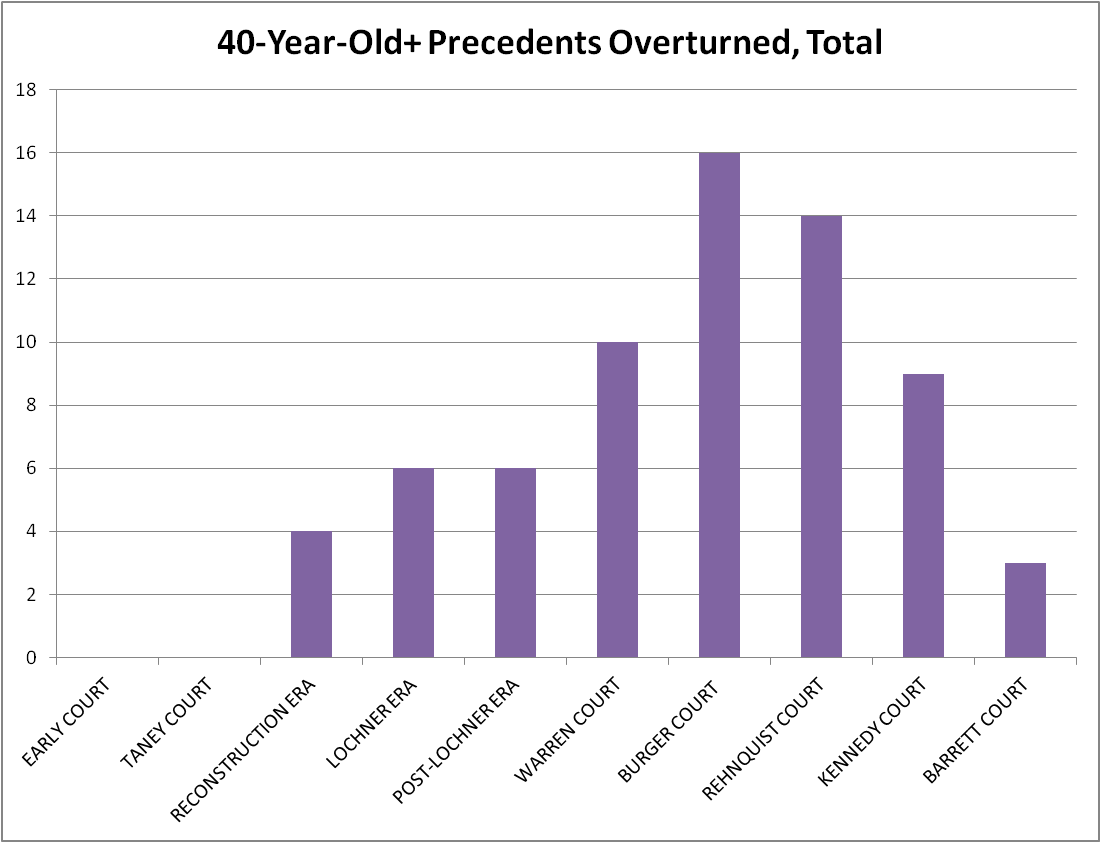
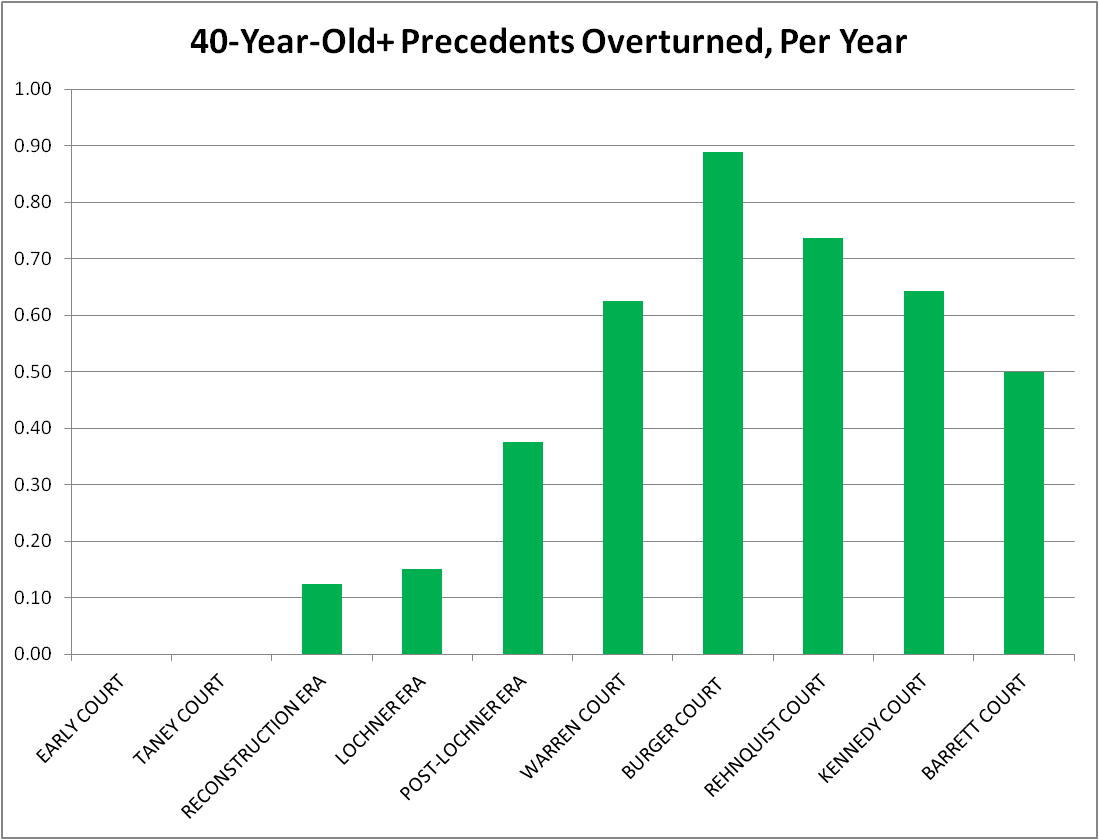
What seems clear from the charts is that, based on the very limited data we have about the Barrett Court so far, the current conservative Court has not abandoned, or even weakened, stare decisis. Indeed, we have some very limited reason to suspect that it might be somewhat more respectful of stare decisis than some of its progressive predecessors. Of course, this could change (in either direction) as we collect more data about the Barrett Court in coming terms.
The Barrett Court now has six terms under its belt (OT ‘20 through OT ‘25), which makes this a good time to update the charts and draw firmer conclusions.
As in the last article, I have used the official Library of Congress “Table of Supreme Court Decisions Overruled by Subsequent Decisions” as my data source. According to this chart, the Barrett Court has overturned precedent twice:
Roe v. Wade (1973) (and Planned Parenthood v. Casey (1992)), overturned by Dobbs v. Jackson (2022) (already tallied on the original charts)
Chevron v. NRDC (1984), overturned by Loper Bright (2024)
The list has clearly not been updated for OT 2025 yet, so I have taken the liberty of adding two more in my data sheet:
Humphrey’s Executor (1935), overturned by Trump v. Slaughter (2026)
Colorado II (2001), overturned by NRSC v. FEC (2026)
As we saw last time, the Supreme Court sometimes discards or vitiates old precedents without admitting that it has done so. For example, Lochner v. New York is clearly no longer the law of the land, but it was never formally overturned, and so does not appear on this list.
The Barrett Court has continued this ancient practice. In fact, I complained at some length that Students for Fair Admission vs. Harvard was very carefully written to avoid overturning The Regents v. Bakke, even though Bakke was a very bad, fractured, mess of a decision; even though following it forced the Court to address a constitutional question that it had no business questioning; and even though Bakke was left bleeding out on the floor anyway, because Bakke has always been unmanageable.1 This sort of artful dodge is not recorded on the Library of Congress’s list, as they frankly acknowledge in their methodology.
However, every modern era of the Court has done this, and we have no reason to believe the Barrett Court has done it more than the others, so it all comes out in the wash (or, at least, that’s the Library of Congress’s assumption).2
Anything else that needs explaining was already explained in “The Most Dangerous Time To Be A Supreme Court Precedent,” so let’s go directly to the charts, then I’ll draw some conclusions, and then we’re done.
Stare Decisis Charts, Updated for 2026
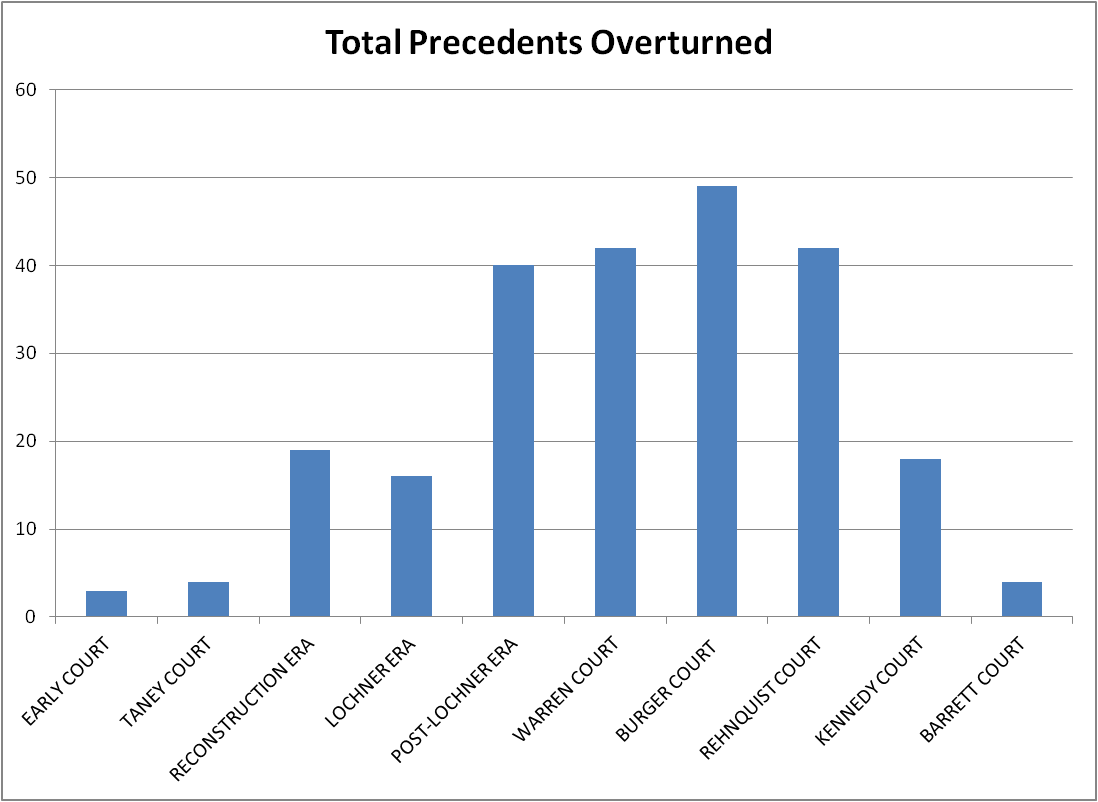
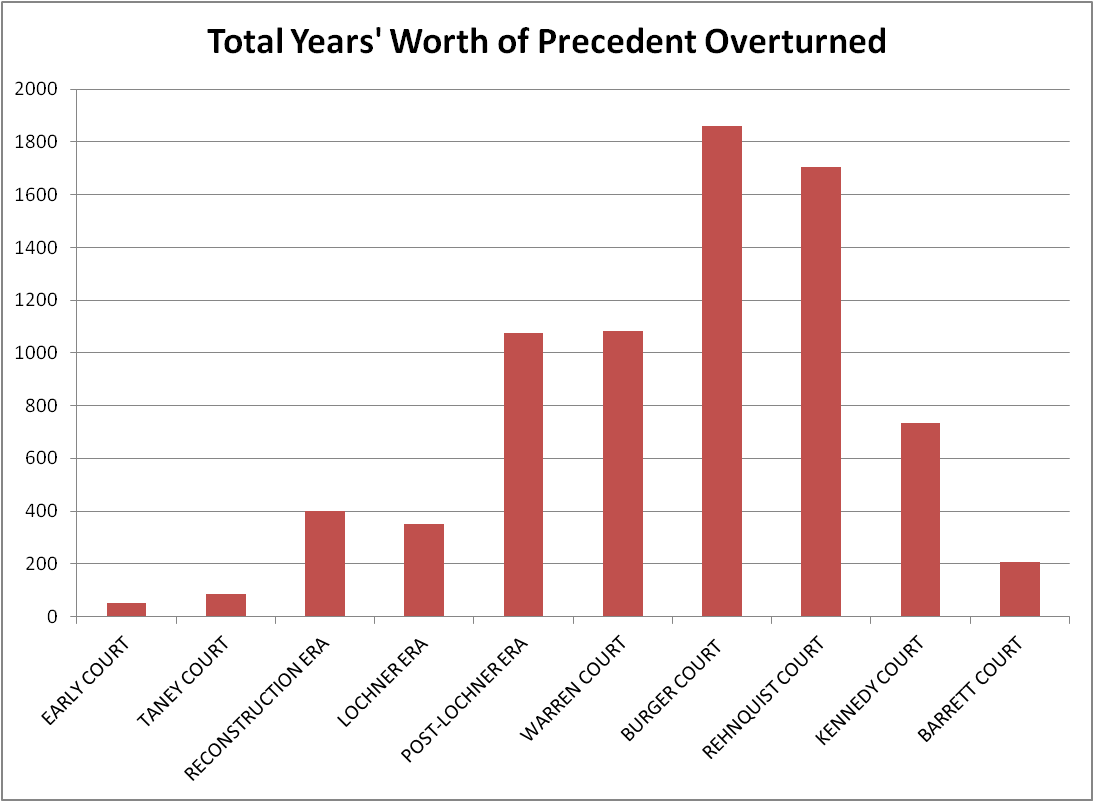
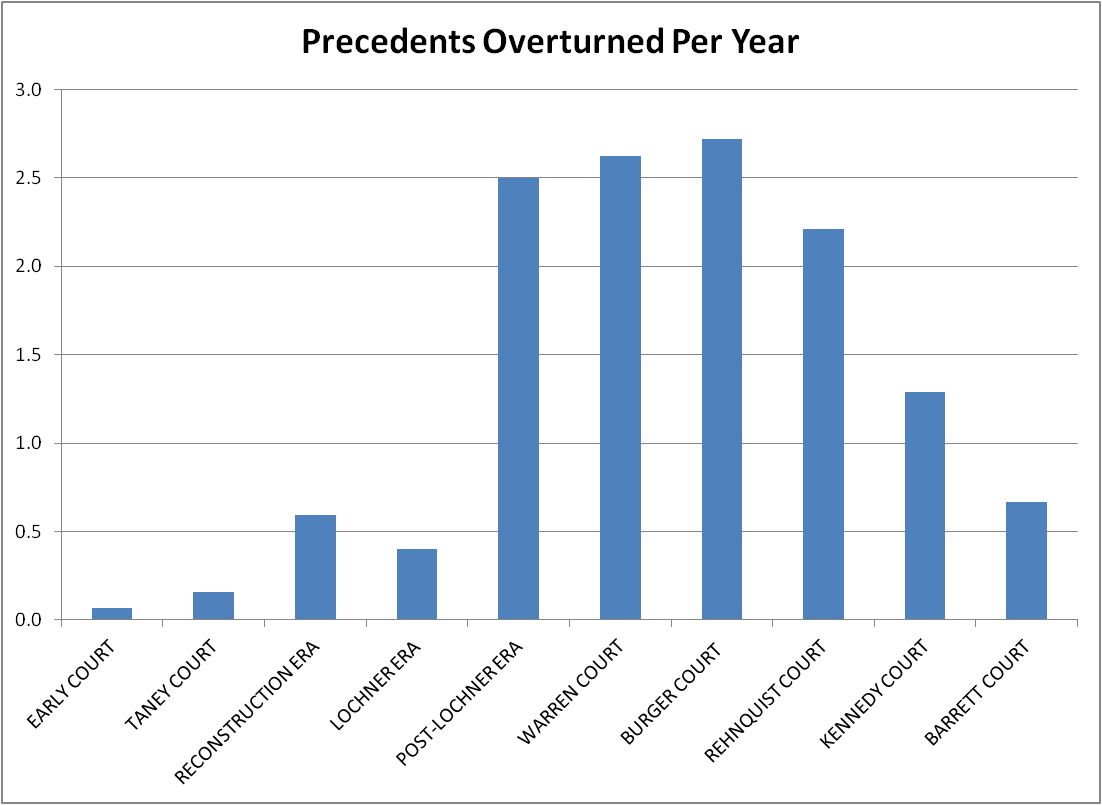
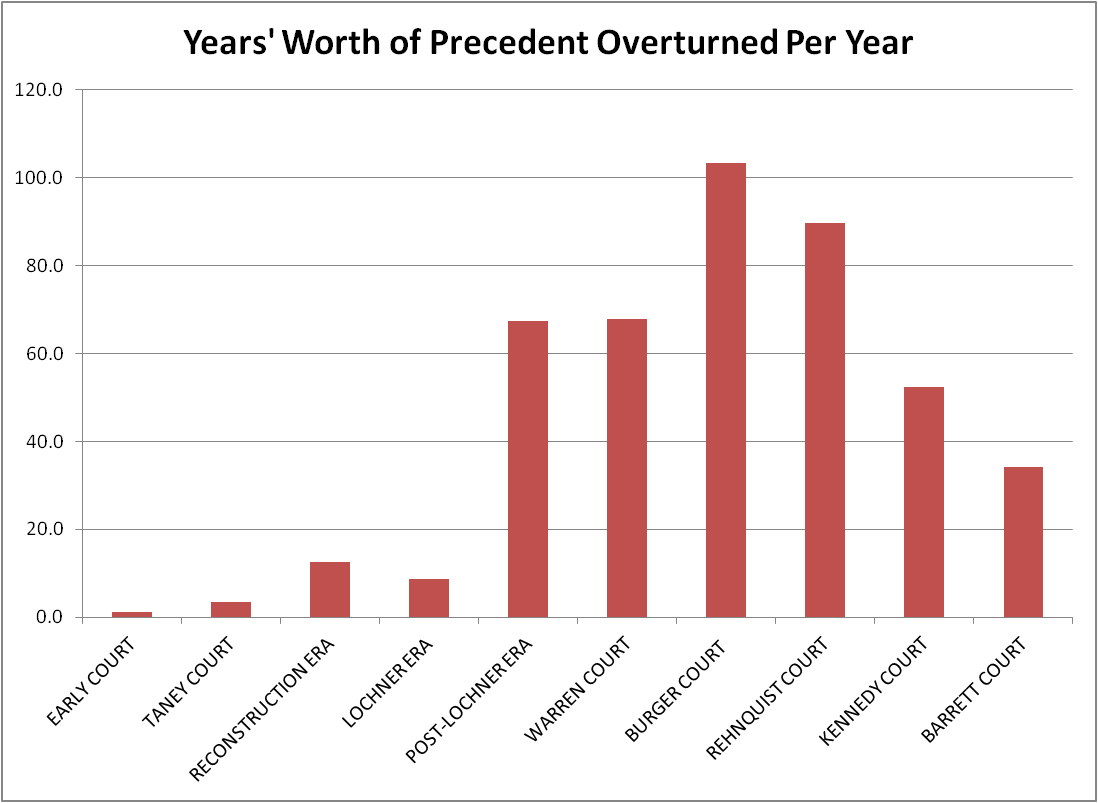
Data sheet: “Age of SCOTUS Precedents When Overruled” (Google Sheets)
I find it difficult to draw any conclusion other than this: statistically speaking, the Barrett Court remains the most restrained of the modern era, its decisions more respectful of precedent than that of any other court in the living memory of anyone under the age of about 85.
If someone under the age of 85 tells you that today’s Supreme Court is distinctly disrespectful of stare decisis, then, there are several possibilities:
They are ill-informed. There is a great deal of propaganda and disinformation in the world today. Both sides can see it clearly on the other side, but tend to fall for it when it comes from their own side. It’s a real plank-in-your-own-eye situation.3 One of the conscious current political goals of the American Left is to destroy the legitimacy of the Supreme Court so that they may justify (to themselves) extraordinary measures, such as court-packing, to “retake” it. There is therefore a constant drumbeat in left-leaning news sources about “lawlessness” and “disrespect for precedent” on the current Supreme Court, alongside various other lines of attack. The empirical observation that the current Supreme Court appears to be more respectful of stare decisis than all other recent iterations does not fit this narrative, so it is ignored. Mostly-innocent audiences thereby acquire false beliefs.
They are partisan hacks doing it on purpose. Hey, the Court isn’t going to delegitimize itself! Somebody’s gotta come up with the slogans for the newspapers, while quietly Occam’s Brooming less-convenient facts under the rug.
They are engaged in some sort of special pleading. An example of this approach might be to argue that, while the Barrett Court has (by any measure) overturned far fewer precedents than the beloved Burger Court, the precedents the Barrett Court overturned were much more important, or the Barrett Court has done a sloppier job applying four-factor stare decisis tests, or the Barrett Court’s overturnings were simply wrongly decided while the Burger Court’s were rightly decided, or that the Barrett Court has fallen short in some other (usually more subjective) way that proves their disrespect for precedent despite our data showing the opposite. It is possible that these people are correct! Special pleading does sometimes uncover more accurate ways to measure stuff!4 However, this should be treated with appropriate skepticism, because this sort of argument usually just boils down to a double standard.
They’re suffering from wishful thinking. Conservatives took control of the Supreme Court by sticking to a fifty-year intellectual and political project that built new institutions from scratch, transformed the judiciary and legal academy as a whole, and won many millions of convert voters across America. This was very hard. There were many instances of one-step-forward, two-steps-back. Conservatives lost a lot of cases in the interim. And, quite frankly, it took some very good luck for them to finally consummate their victory and install a durable 5-1-3 conservative majority on the Court in October 2020. To take back the Court, progressives would have to engage in a similar project of similar difficulty over a similar span of decades. Many progressives living today would not live to see that project completed. Many of them therefore want the Supreme Court to be illegitimate so that they can (in their minds) justify skipping all that hard work and just seizing control of the Court. They want the Barrett Court to be a historical outlier, and wanting is halfway to believing.
(You should take that one with a large grain of salt, because I’m psychologizing about my opponents, which is often wrong and always dangerous.)
They are humans, who suffer from recency bias, which is so cripplingly severe that it’s astounding that our race has ever learned a single thing from our shared past—and, indeed, arguably, we haven’t. For these people, the Barrett Court’s overturning of precedent is disproportionately important because it just happened, and who even remembers Swift v. Tyson, anyway?
They are psychics, who are able to tap directly into the conscious minds of people who lived in the 1860s, and are thereby able to remember the early Republic, when the Court really was much more deferential to Congress than it has been post-Reconstruction.
They genuinely (if unconsciously) believe the old aphorism that stare decisis means “Let the decisions of the Warren Court stand”—or, perhaps, that stare decisis applies to progressive decisions but not conservative ones. For these people, overturning Bowers v. Hardwick was a great feather in the Supreme Court’s hat, but overturning Humphrey’s Executor was practically an usurpation.
There may be other possibilities which I have not considered. I would now say something like, “Let me know what you think in the comments!” if that didn’t make me sound like a desperate YouTuber.
Postscript.
By coincidence, I find that I am posting this on the Fourth of July. Two hundred and fifty years! It’s nothing to sneeze at. The Roman Republic lasted around five hundred years, so, by historical standards, we’re only at America’s halfway point. I want to believe that very badly.
If I may make one request of you today, it is this: please find a way today to love America for what it is.
Loving America for what it was does not count. Loving America for what it will be (or could be) does not. The first is the conservative sin against patriotism. The second is the progressive sin.
Loving only, or primarily, the parts of America that correspond to your tribe does not count. If you are a red-triber, you must love the whole thing, including the blue-haired Mamdani-pilled transgenders who are trying to ruin sports and capitalism. If you are a blue-triber, you must love the whole thing, including the unvaxxed red-hat chuds who only love corruption when Mr. Trump does it.5 Find a way to think of us, for one day, as one people. The day we can no longer imagine ourselves as one people is the day we stop being one nation.
This classic 30 Rock clip is very funny, but, in retrospect, ominous.
Love America as she is, now, in 2026. Do it where your friends can hear you. Do it where your kids can hear you.
Here is Bing Cosby singing on the Fourth of July early in World War II, while the future of the Free World remained in doubt:6
Both sides of the affirmative action debate claim, ferociously, that their side is nobly carrying on the true spirit of Bakke, while their opponents are fecklessly desecrating it. The truth, if you read Bakke, is that Bakke makes no damn sense. There’s no spirit to carry on. There’s no principled way to extend the principles of Bakke to any other set of facts, even very similar facts, because the controlling opinion was Lewis Powell’s, and it’s vague and contradictory.
That being said, I repeat my challenge from last time I did this: some enterprising young lawyer or legal historian could probably get a good paper out of expanding the Library of Congress’s definition of “overturned,” generating a new list of overturned precedents, and running the same analysis. My fear, of course, is the same fear the LoC expressed when they contemplated that approach: it would be extremely difficult to keep that list consistent and objective without very clear criteria. Perhaps one could mine Westlaw by treating “red-flag” precedents as overturned, since the red-flag system has struck me as reasonably consistent (if not altogether objective).
It seems likely that I suffer from this, too, although the nature of the beast is that I don’t know what nonsense I’ve fallen for, only what nonsense you’ve fallen for.
One person suggested to me that the Barrett Court overturns precedent specifically on 5-4 or 6-3 decisions more frequently than past courts. I very much doubt this is true (my interlocutor’s “source” turned out to be vibes), but it is objectively measurable, and, if it is true, I think that would be very interesting!
If you are an originalist blogger (ahem), you must love the whole thing, even the people who say the Supreme Court is illegitimate and/or are rude to Justice Barrett.
Fred Astaire’s follow-up number is a real firecracker, too: `
RE "Barrett Court overturns precedent specifically on 5-4 or 6-3", Sarah Isghur, who another commentor mentioned, is all over that stuff. I suspect she has an article (or two or three or four or five) about it.
James,
I'm interested in replicating this with a different source for precedent overturning. Would you mind sharing how you defined the different eras? I'd like to be able to compare the two sources apples to apples.