

Eleven years ago, on my birthday, FiveThirtyEight published one of my favorite FiveThirtyEight articles ever: Leah Libresco’s1 “Evangelical Protestants are the Biggest Winners When People Change Faiths.”
Libresco’s premise was simple:
Find out how many conversions and deconversions each religion has.
Find out how many babies each religion has.
Simulate the next hundred generations (~3000 years) of American religion based on just those two numbers.2
Report the results:
The first thing that jumps out at me are the Mormons. We hear a lot about Muslims growing more influential in America through high fertility, but take a gander at them Latter-Day Saints! Libresco paints a possible future (again, a far future, which assumes nothing really changes for centuries) where (thanks to fertility effects) the Mormons outnumber the Catholics and Mainline Protestants combined, becoming America’s second-largest religious group, after Evangelicals.
Can you imagine what the country would look like if there were as many Mormons as there are Catholics or Evangelicals today? If one-quarter of Americans were members of this highly socialized, highly disciplined denomination?
I can’t! Mormons are pretty foreign to me. I know a few ex-Mormons and that’s about it. My impression is that Mormon Ascendancy would be good in some ways and bad in others.
However, it’s interesting how unsurprising this (pretty dramatic!) finding was, at least to me. We all know that Mormons are a tight-knit religious community and that they have a lot of babies. Carry that forward a few generations, especially in a world of sub-replacement fertility, and of course their share of the pie is gonna grow a whole lot!
The second thing I notice about this chart is what everybody else reading this chart in 2015 noticed: look at that Catholic collapse! This was 2015, when there was very little widespread recognition that the Catholic Church in America is headed for something resembling an extinction-level event. After a decade of parish closures and mergers, people on the ground seem to have more of a sense that things are going to get worse—but this chart contemplates a Catholic Church that has shrunk by nearly two-thirds in the far future. I still think Catholics who are dimly aware that Something Bad Is Happening are, for the most part, missing just How Bad things will get if we stay on our current course.
A third notable thing about the chart is that the Nones (Atheist/Agnostic/Nothing In Particular/Unaffiliated) get swole through conversion, but their fertility rates are so bad that they actually net out to losing ground rather than gaining it over the very long term.
Now, obviously, this isn’t what’s actually going to happen, because, obviously, conversion and fertility rates are not going to remain exactly the same for the next three thousand years. Nevertheless, I found it fascinating, because this is the direction we are currently heading. We are certain to deviate from this course, but this outcome is the baseline.
Or, at least, it was the baseline in 2015.
New Data, New Article
Libresco based her data on the 2014 Pew Religious Landscape Study, a gold-standard survey of nearly 37,000 U.S. adults.
A couple years ago, Pew released an update, the 2024 Pew Religious Landscape Study.
I’ve been looking for a chance to try my hand at a large data set for months. Its been way too long,3 and I figured (correctly) that the major barrier to entry (reading the manual) could be obviated with LLMs (which have read every manual). Replicating and building on one of my favorite articles seemed an ideal place to cut my teeth.
You see where this is going.
Running Back the Data
However, before I could update to 2024 data, I had to make sure I understood Libresco’s original project well enough to replicate it perfectly. That was step one.
When Libresco did this project, she only reported her final result: the reality 100 generations into her simulated future. Now that I’ve replicated her results, I can show you how it plays out over time!
A responsible editor would not let me do this, because the “generations” used in this algorithm are a simplification and do not truly onto actual human calendar years. Real human generations are blurry, and overlap, and run different lengths. To just arbitrarily declare that “1 generation = 28 years” would be to oversimplify a key component in an already oversimplified model.
Fortunately, I have slain my editors.4
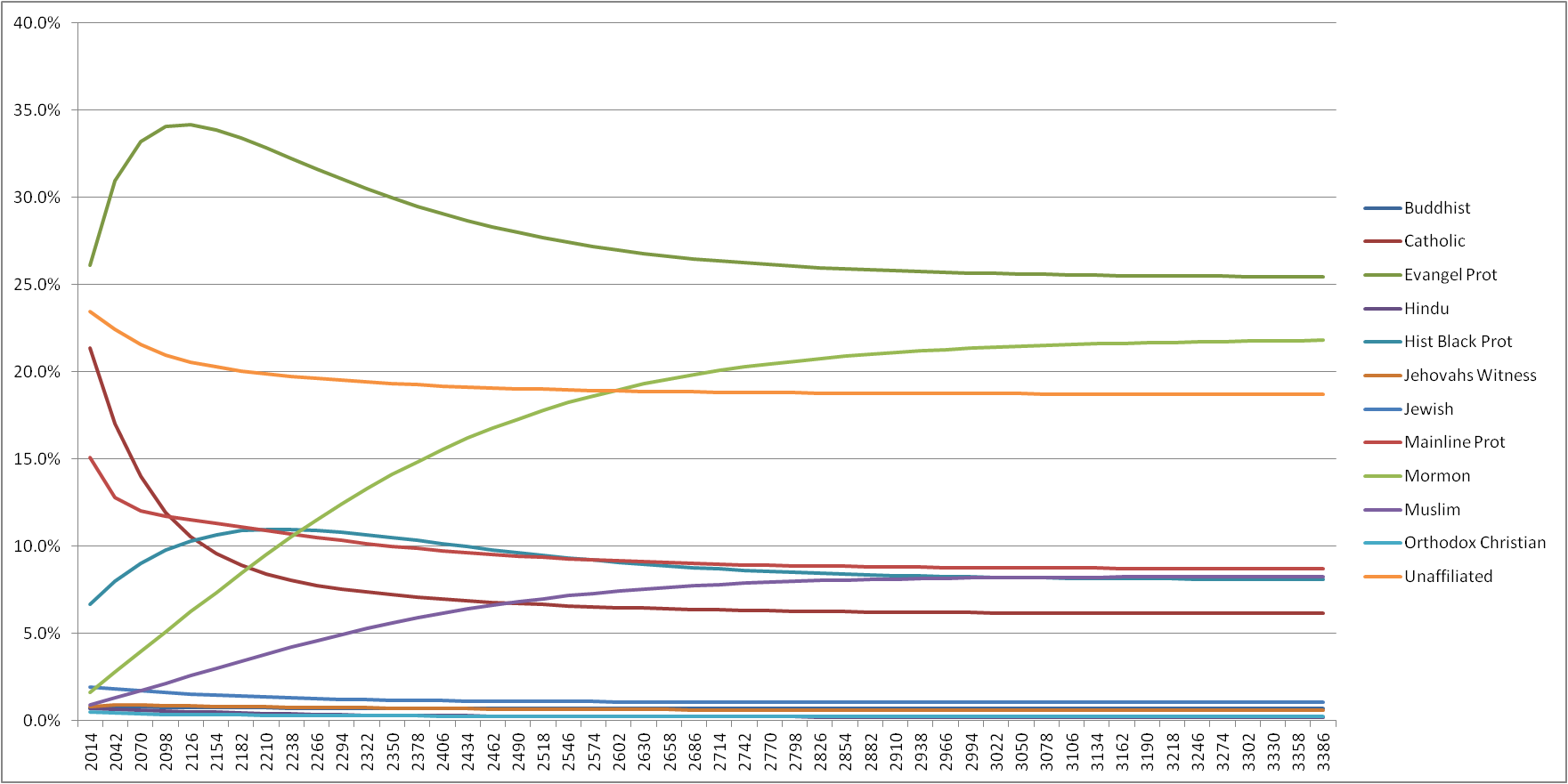
That’s the full, reconstructed line graph, using Libresco’s exact methods and data from 2014.
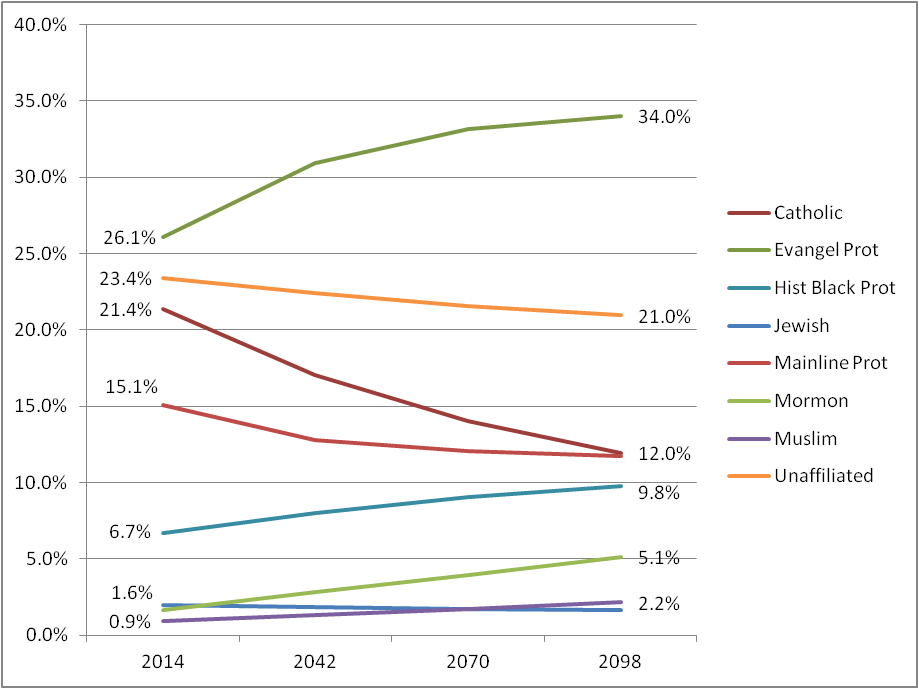
Here’s a zoomed-in look at the 21st century alone:
Here it is as a pie chart, since I’m also trying to learn Datawrapper:
So we see that, even over just the next century or so, Libresco’s method shows Catholicism collapsing, although not completely. Mormonism also grows dramatically in size… but not to the point where most people really notice. They are still a small religion at the end of my daughters’ natural lifespan. Evangelicals grow over the short term, which is interesting, because the long-term equilibrium has them shrinking. Islam grows a lot, but is starting from such a low floor it hardly matters.
Again, this is all using Libresco’s data, running Libresco’s code, none of my own. All I did was irresponsibly slap year labels on everything and show you some line graphs.
Onward to 2024!
Now you know why I spent all that time trying to figure out fertility by religion last week!

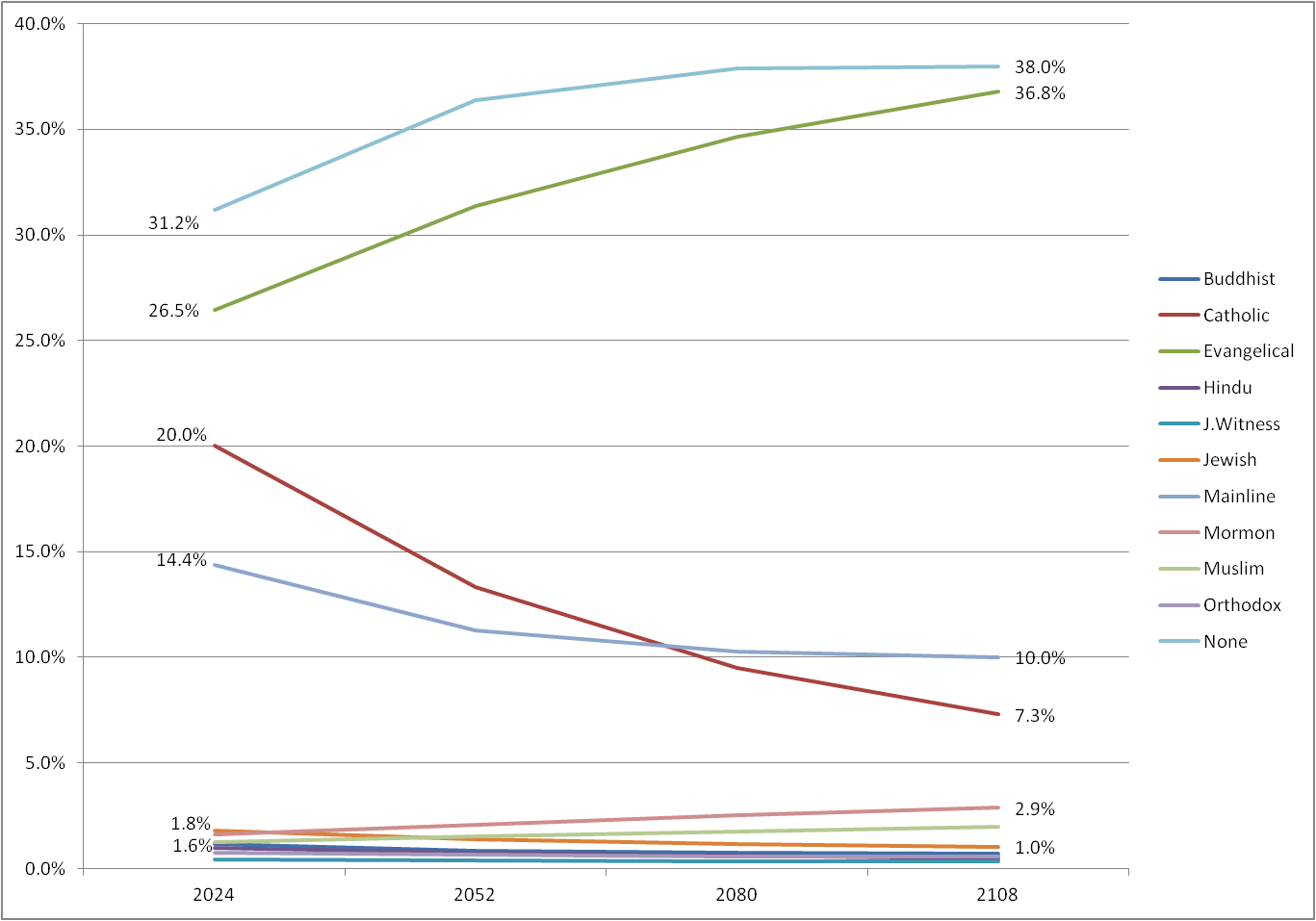
When we take the Pew Religious Landscape 2024 figures for religious conversion and combine it with my updated fertility stats, we get this view of the American religious future:
In this newly-revised visions of the future, Evangelicals still go up… but, unlike in the 2013 survey, they don’t really go back down. They overtake the Nones in about a century, hit a plateau as America’s largest religious group, and stay there forever. What accounts for the difference?
Well, probably they are being buoyed a bit by Historically Black Protestants. Libresco separated HBPs, but the 2024 dataset made it much harder to filter them out, so I just had to sort Black Protestants into the two standard groups (Evangelical and Mainline). Since members of Historically Black Protestant denominations have higher fertility and higher retention than both White Evangelicals and the White Mainline, this boosted both categories. (You can therefore expect the influence of White Evangelicals to diminish and Black Evangelicals to grow, even within Evangelicalism, although I have not quantified how large this effect might be.)
It also helped Evangelicals that, according to Pew, Evangelical retention improved substantially in the past ten years, from ~65% to 72%. As with all compound interest problems, small changes in the rate lead to big changes far down the line. Moreover, I found that Evangelical fertility is relatively higher than Libresco found in 2014.5 In this vision of the future, then, America, ever Protestant, becomes a predominantly Evangelical nation—although there are more and more Black Evangelicals.
Catholicism still collapses, according to the 2024 data. The Mainline finally stops bleeding (again boosted by Black Protestant fertility) well before the Catholic Church does. Indeed, the collapse of Catholicism is the preeminent religious fact of the 21st century, if we hold our current course:
Catholic implosion is no surprise. Catholics have mediocre fertility (1.67 children per woman), mediocre retention (only 57% of those raised Catholic still identify Catholic as adults), and pretty poor conversion rates. For example, even though Catholicism and Evangelicalism are (today) similar-sized denominations, Muslims convert to Evangelicalism at eight times the rate Muslims convert to Catholicism!6
[HOW TO READ THIS CHART: Start with the left column to pick a childhood religion. Then read that row right-to-left to see where children in that religion ended up as adults. For example, 0.5% of children raised Catholic end up Buddhist. 57.7% of Catholic kids remain Catholics as adults. 8.9% of those raised Catholic have since converted to Evangelicalism. And so forth. Looking at the Muslim row, you will notice that only 0.5% of Muslim children end up Catholic, but 3.8% of them become Evangelicals, which is about eight times as many.]
On the other hand, in this 2024 projection, the Latter-Day Saints never achieve takeoff, despite having the highest fertility in the nation! Libresco had them reaching equilibrium at nearly 25% of America, but I have them here at only 5%! This shocked me. Given the insanely high fertility I found for Mormons (3 children per woman!), I expected this chart to show even bigger and quicker Mormon Dominance. What happened to knock them so far off course since Libresco-Sergeant ran these numbers in 2014?
It’s the opposite of what happened to the Evangelicals. Pew 2024 found that Mormon retention had declined substantially, from 64% to only 54%. Insult to injury: the Mormon conversion rate (people becoming Mormon as adults) fell, too. The miracle of compound interest works in both directions, and these two trends decapitated Mormon growth expectations in America.
However, this chart, like Libresco’s original chart, doesn’t quite get at what really interests me. These are all self-identified members of each religious tradition, but many of these people are, in practice, barely attached culturally and not at all attached doctrinally. A future America where passionate, alive-for-Christ Evangelicals dominate the religious landscape is quite different from a future America dominated by a bunch of people who vaguely identify as Evangelical but have never read the Gospel—as Douthat’s most prescient tweet eternally reminds!

The Religious Landscape, Minus “Indifferents”
So I did the same thing here that I did in the fertility stats: I factored out people who don’t attend weekly services.7 I have dubbed this group “indifferent,” so that I don’t have to type out “those-attending-in-person-less-than-weekly” every time.8
It seemed likely to me (obvious, even) that, sure, the children of indifferent believers are bound to get peeled off, because (generalizing) they aren’t being taught to take it seriously in the first place. But those parents who are hauling their kids to church every Sunday, the true believers? Those parents are putting a lot of energy into passing on their faith, and therefore will have higher retention rates. When we separate the “indifferent” from the true believers, then, what we should see, over several generations, is indifferentism imploding but devoutness expanding, or at least holding its own.
When I first ran my figures, even I was astonished by how right I was. According to my calculations, 92% of Evangelical children who attended weekly services remained active, weekly+ attendees in adulthood! For Catholics, 80% did the same! And… not a single Evangelical or Catholic left religion? Out of all the thousands polled?
At this point, I realized I had made a coding error. I corrected it, reran the figures, and…
Oh, dear.
Oh, dear, dear, dear.
This is a big chart with lots to look at. For those of you who don’t want to scan through all 361 cells, I think the tale of the table can be told in one illuminating factoid:
If a child is raised Catholic, faithfully attending Mass at least once a week while growing up, he has just a 21% chance of remaining a weekly Catholic as an adult. He is exactly as likely to become an atheist/agnostic as he is to remain a devout Catholic. (Remember, this is a religion that teaches non-attendance is a mortal sin!) But the child is about twice as likely to end up in the twilight zone: still identifying as Catholic, but not attending Mass more than once or twice a month.
The Evangelicals are doing a much better job retaining their children than the Catholics, who in turn are doing a much better job than the Mainline, but this is only a relative success. The chart as a whole is a disaster for all theist religioms. The only religion that is keeping even half of its children practicing the faith on a weekly basis is Islam—and then only just! Meanwhile, the overwhelming majority of children raised in No Religion remain Nones as adults.
Maybe I’ve drawn the line in the wrong place? Maybe I’m holding the kids to too strict a standard, and the fact that they’re only coming to church once or twice a month doesn’t make them “indifferent.” Do Mainline denominations really care if you’re in the pew every week? So I tried a second test where I changed the line from “attends weekly” to “attends monthly.” It made no significant difference.9
This catastrophically bad conversion matrix produces the following cursed projection:
Here’s a zoomed-in version looking at the bottom 5% only:
This largely confirms the story we were already telling. The collapse of the Catholic Church as a wide-reaching American entity is set to be the preeminent story of 21st century religious demography. In this projection, devout Muslims outnumber devout Catholics by the 24th century. Even the devout members of the Protestant Mainline—a laughing-stock of the past generation—surpasses Catholicism in the early 22nd century. Devout Mormons do it even faster, outnumbering Catholics in the pews every Sunday by the end of this century.
You might have thought that the Nones and the Indifferents, with their terrible fertility rates, would eventually be overcome, in the very long run, by the other religions, simply by being outbred. I did! However, Nones and Indifferents win converts at the highest rate by far, and, out of all religions compared, children raised None have the lowest chance of converting to another religion by adulthood. As long as they can keep that up, they don’t need babies. They can sustain themselves as the dominant American religions with converts alone.
So, in the very long run, is devout American religion just… over?
Always In Motion, the Future Is
There are a few reasons to expect that this projection of the future is wrong.
The first is the obvious: extrapolations of the far future from current trendlines are basically always totally wrong. As G.K. Chesterton says:
The human race, to which so many of my readers belong, has been playing at children’s games from the beginning, and will probably do it till the end, which is a nuisance for the few people who grow up. And one of the games to which it is most attached is called “Keep Tomorrow Dark,” and which is also named (by the rustics in Shropshire, I have no doubt) “Cheat the Prophet.” The players listen very carefully and respectfully to all that the clever men have to say about what is to happen in the next generation. The players then wait until all the clever men are dead, and bury them nicely. They then go and do something else. That is all. For a race of simple tastes, however, it is great fun.
(You know how rarely I advise you to read the whole thing, but read the whole thing. A first-rate first chapter to a first-rate book.)
Even the most sober, calculated predictions of the far future, then, must be given with the tongue slightly in cheek.
Besides, the data I have just shown you isn’t really from the past couple years. It’s more like the past thirty. Think about it: Pew asked adults in 2023 and 2024 what religion they were as children and what they became today. That is very recent data, so all the conversion rates in this article are based on adults’ answers to those questions. But suppose Pew asked a 55-year-old the question, and the 55-year-old left his devout Evangelical faith for indifferent Mainline practice right after he graduated from college. The data may have been collected recently, but what we are really seeing in his case is a conversion that happened in 1991! This will be endemic throughout the dataset, because the average age of the representative respondent will be in his late 40s. What I have been showing you today, then, isn’t a window on present conversion rates, but a window on past conversion rates, spanning approximately the past 10-40 years. (We won’t know present conversion rates for a long while.)
This was not a particularly good 10-40 years for U.S. religions! At the start of it, the Catholic Church remained locked in vocation and doctrinal crisis, while the Evangelical world was rended by the televangelist scandals. In the middle of this period, the New Atheism arose (remember how intense that was?), and the Catholic Church was consumed by sex abuse scandals. Toward the end of the period, the sex abuse scandals spread to non-Catholic churches and Donald Trump’s alliance with religion made religion notably gender-polarized.
There is some evidence that organized religion’s Very Long Lent (1990-???), is finally slowing, or even reversing. It would take a long, sustained movement to make up even half the ground religion has lost since its 1960s peak, but my projections today might represent, not the future, but the last gasp of an irreligious recent past.
On the other hand, as Nate Silver often reminds us, the numbers always change, but they can change in either direction, at any time. This new springtime for conversions could just as easily turn out to be a dead cat bounce for organized religion.
Finally, my projections could quite easily overlook a tiny cohort within a religion that has unusually strong fertility and retention. Suppose, for example, that there is a tiny bloc of Ultra-Orthodox Jews in the United States (say, 1:10,000 Americans). This hypothetical sect has an average of 4.0 children per woman (quite high, but still lower than current Amish fertility) and keeps 73% of them in the fold as adults (same retention as Nones). My measurements couldn’t even detect this sect today, because they’d be so tiny. I’d simply interpret them as part of the already-tiny bloc of Jews with high attendance at religious services, and they would not be large enough to visibly boost that bloc’s fertility. Nevertheless, if they managed to stay on track for a few hundred years, they’d become the overwhelming majority in America:
It is not difficult to imagine this of Orthodox Jews, since Israel’s political landscape has already been substantially altered by Ultra-Orthodox fertility.10 However, it is also easy to imagine such ultra-devout movements emerging from the Latter-Day Saints, the Amish,11 or even the fraction of Catholics who reject birth control. One (or more) of them having and sustaining high fertility plus high retention would rewrite America’s future entirely.
I have seen replacement of this general sort with my own eyes in Catholic parishes around me. Twenty years ago, only weirdos wore chapel veils or knelt to pray after Mass. But those weirdos had a lot of kids, and today it is common. If trends hold, we are maybe ten years from “kneeling after Mass” being common enough that the rest of us start doing it out of sheer peer pressure.12
On the other hand, even the most devout Catholic families are still losing huge shares of their children to other faiths:
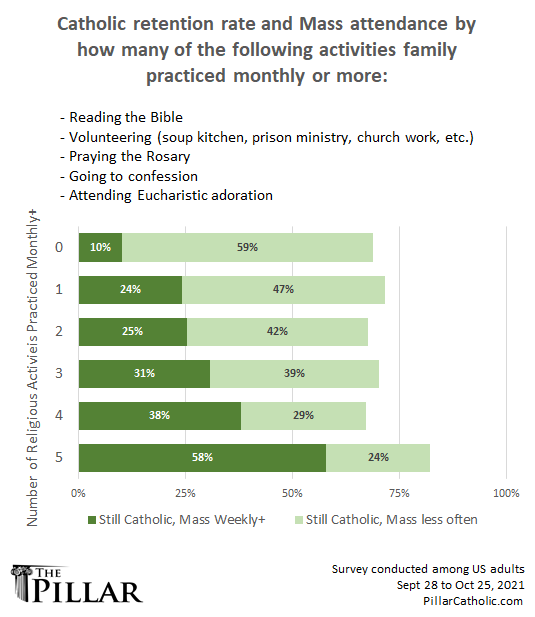
It’s easy to become dominant when the whole pie is shrinking. All you have to do is shrink more slowly. Devout Catholics seem to be doing that within their parishes, but that won’t be enough to bend the curve in the wider culture unless they can get their retention numbers up.
What Does the Future Hold?
All we can say with confidence right now is the course major American organized religions have been on for the past few decades. Projecting that course forward paints quite a bad picture for American religion as a whole, albeit with some good news for Evangelicals and Latter-Day Saints, and especially bad news for Catholics.13
We can also say with confidence that I know a whole lot more about exploring large data sets than I did three weeks ago, so, mission accomplished!
NEXT VOYAGE: I don’t know what exactly I will write next, but I know there are many De Civ readers who aren’t here for “the Catholic stuff,” and it has been a lonnnng six weeks for those readers. Some change of pace is in order. We will see what. I may run an repost article from the archives next week while I work on it.
I’ve shared the code behind this post on my GitHub.
Most people know Leah Libresco Sargeant from her conversion story, but I’m the weirdo who first encountered her as a FiveThirtyEight data journalist with a good eye for a story and a readiness to admit when the data led her to a place she didn’t expect or want. Don’t get me wrong, I like a lot of what she writes on Substack or at America, and The Great Soul Train Robbery was good fun, but I must confess that I miss Data Journalist Libresco.
They generally reach an equilibrium after 20 or 30 generations.
In this model, there is always an equilibrium. Eventually, a shrinking religion becomes small enough that it no longer needs very many conversions from larger religions to keep the enterprise afloat. Actually wiping out a religion requires not just a decrease in size, but a decrease in conversion rates, and this model assumes conversion rates remain fixed forever.
Likewise: eventually, a growing religion becomes so large that even relatively small rates of out-conversion overwhelms its growth rate from in-conversion—there are simply fewer converts available, the religion having already picked all the low-hanging fruit.
In reality, religious traditions sometimes vanish completely or become completely dominant, thanks to feedback loops or external events, but this model can’t represent that.
This model also omits immigration and differential death rates, which are a big deal in reality.
I was 22, unmarried, and fresh out of college when I wrote “Countering Countering Conventional Wisdom,” an extended rebuttal to Planned Parenthood’s claims during that election cycle that it was okay—actually good!—for the government to to force Catholic nuns to pay for contraceptives, because “98% of Catholic women” didn’t follow Catholic teaching on contraception anyway, so clearly the nuns who took vows of lifelong celibacy in service to the Church couldn’t take the lame contraceptive teachings all that seriously, either.
If you are young enough to have missed this, and think it sounds stupid, you cannot imagine how stupid that election cycle was. The reasons Donald Trump is president (de facto) today are overdetermined, but one sine qua non of Trump’s 2016 victory was the stupidity and unfairness of the 2012 campaign against Mitt Romney and every other human being who right-of-center. For many of us, it was a mask-off moment, revealing institutional rot in American institutions that could not be reformed, only destroyed. This was much less obvious before Trump, covid, the Hunter Biden laptop, and the Biden senility crisis. Heck, I was a regular NPR listener in 2012! Some people who saw this, and were (rightly) radicalized by it, concluded (wrongly albeit understandably) that Donald Trump was the solution to that problem. But I digress!
Preparing “Countering Conventional Wisdom” took weeks and weeks. Most of the time wasn’t spent on analyzing the data and drawing conclusions. Most of it was spent trying to learn the software I had to use (SPSS), one painful sequence of commands at a time.
Looking back, I strongly suspect that I did not assign weights correctly, potentially invalidating all my results. There was also a ton of time spent wading through codebooks, trying to find the information I was interested in, manually copying the appropriate values into SPSS, running a query, and refining the query after it inevitably didn’t quite show what I wanted.
I was (and am) very proud of the industriousness I showed that month, out of sheer bitter-minded contempt for the Alan Guttmacher Institute (which I still hold!), but it was more than I could chew. It was months before I had time to attempt another data project, and, by then, I had forgotten so many of the things I had learned from my first run at SPSS that trying again seemed like an insurmountable obstacle. I haven’t opened the General Social Survey since.
However, LLMs can read manuals really, really well. ChatGPT told me how to do this project in SPSS… but then suggested I do it in a program called “pandas” instead, and ChatGPT was right, that’s a much more powerful approach, and thank goodness ChatGPT has read the pandas manual, because I certainly haven’t!
MY WIFE: “I can tell!”
Whether this reflects actual change or simply different methodologies for determining fertility, I can’t say. However, our methods do appear to have been significantly different. Libresco had Evangelicals tied with Catholics at 2.3 children per child, with the third-highest fertility overall. I found them at 1.91 children per mother, significantly above Catholics, although still third overall.
Pew itself has a good article about this, entitled “Religious Switching,” that delves a lot deeper into conversion. My heatmap is cooler, though.
Except Hindus, Buddhists, and Nones. Just like before.
This is a sweeping generalization, as most labels on statistical categories are.
Here is that chart. Relaxing the definition of “indifferent” does indeed tend to boost the (now more relaxed) retention stat in each religion, but not by much.
The growth of the Haredim in Israel is doubly impressive, demographically speaking, because Israel’s population as a whole has always been remarkably fertile. Even secular women in Israel (hiloni) average 2.2 children, which makes secular Israeli women one of the wonders of the world, fertility-wise. Self-identified non-religious “cultural” Jews have 2.5 children, traditionally religious women (masorti) 3.2 children (ahead of American Mormons), “national-religious women” (who take their religion with a side of Zionism) a stunning 4.0 children per women… but they are still being outpaced by the ultra-fertile, ultra-retentive Ultra-Orthodox (haredi), who average 6.6 children per woman. (source for birth rates) (source for labels)
Thus, their slice of Israel’s pie continues to grow, even though Israel is one of the few countries on Earth where the pie isn’t shrinking, or about to start shrinking.
As a matter of fact, the Amish are in a great position to do this. They have about 75% retention, have significantly more than 4 births per woman, and they are already 1/1,000th of the U.S. population, not 1/10,000th like my hypothetical sect. So if the Amish can just hold steady, their exponential growth would make them the majority U.S. religion in just nine or ten generations (or so), a couple centuries faster than the chart. However, Amish fertility, high as it is, has been in free fall for forty years, and that would need to stop for this prophecy to come true.
Similarly, this will be all of us in a few years:

Catholics have been buoyed by immigration (which is totally ignored in this model). They may continue to benefit from that, but it’s probably not sustainable as Latin America secularizes, the Church there loses ground to Evangelicals, especially if U.S. immigration policy continues to curtail Latin migration. Also, the buoying effect is not as strong as you think.
The last part is what gets me about this discussion. In almost every country, there are a handful of ultra-small but also ultra-fertile religious groups with very high retention rates, sometimes 90% and more. I also think that most of them will implode sooner or later, but only a single group has to resist modern culture. It's a fundamentally rigged game.
And as you say, in Israel we can already see it play out in real time. I can't tell you which group will win in any particular country with any confidence, yet it feels like a foregone conclusion that one will. And the group will most likely be FUCKING WEIRD to anyone with average modern sensibilities - at best, if not frightening. Mind you, it doesn't even need to be religious in the traditional sense, it could be some specific subgroup of natalists for example.
Two months later I have another comment: here's an ex-LDS (she spent decades in the LDS Church and ultimately left it in part to escape an abusive marriage), ex-Christian atheist on why she thinks religious affiliation has been declining in the United States, but the LDS Church has remained successful.
https://www.youtube.com/watch?v=LYC_Sa3lb8Y
In brief, she argues that mainstream Christian churches have ceased to serve a social function in the community, but the LDS Church has retained a structure that permits them to do so. People are leaving organized Christianity not because they have ceased to believe in the basic tenets of the faith but because they are no longer receiving any of the social benefits of being part of a local congregation, because local congregations, at least in her part of the United States, no longer exist as they once did.
(I am assuming she is primarily talking about Protestant Christianity, but she draws no distinction between various denominations.)