

This time, when acclaimed actor-director Jonathan Frakes asked for an interview, I refused outright. The first time I sat down with Frakes (best known for The Doctors and Star Patrol!), we had a tape malfunction that left only Frakes’s side of the interview intact. The second time, same thing! So, this time, I said no. I had been happy to help Frakes boost his career on De Civitate’s much larger coattails, but the fates were against us. It wasn’t working out.
However, this year when we spoke, Frakes suggested an interesting theory. Perhaps, he suggested, the cameras were being shorted out by the charisma differential between us.
You see, cameras are perfectly fine filming me, and perfectly fine filming Frakes. However, when his electric charisma is contrasted with my “face for radio,” it sends the cameras on the fritz. (This struck me as logical.) The solution: rather than a traditional interview, which involve long soliloquies that risk building up a high “charge” in the charisma differential, this time we would sit down together and have more free-ranging conversation. That would keep the charisma differentials low and the cameras online.
Like a fool, I agreed.
As I soon learned, Two-Takes Frakes is a lunatic. He cannot hold a discussion thread together for more than a few seconds. His idea of “conversation” is to emit a koan and then stare at me uncomfortably for several seconds waiting for my reaction, before leaping to a new, wholly unrelated, koan, as if I’d never replied at all. During our entire interview, he blinked exactly twice, which was somehow much worse than never blinking at all.
Worse still, the rapid-fire camera movement between him and I seemed only to build up the fatal charisma differentials even faster. Not only am I, once again, invisible on this tape, but the quality of what’s left is visibly degraded!
Oh, well, fool me once, shame on you, fool me twice, shame on me, fool me thrice, you fool me, it can’t get fooled again.
I here attempt to reconstruct some of what I said to Frakes to keep our bizarre “conversation” afloat, and I must say I’ll be actively looking for a better way to spend my April 1 next year. My best to Jonathan on his budding career, but I’m afraid I can’t keep helping him out like this.
On to the interview:
Our hatred for this reptile goes all the way back to the dawn of civilization.
Wait WHAT?! That’s a huge snake! Where did that snake come from? Where were you keeping it when you came in and sat down and I offered you a soda?! Wait, is that a rattlesnake? No, you— no. Out. Get it out. Yes, I’ll hold your Mr. Pibb, it’s fine, just—
Chess is more than a microcosm of war.
The more I play games, the less I think of chess as a microcosm of anything. Chess is, in its own way, quite a beautiful game. From a single, fair, simple, consistent starting position, the application of just a handful of rules (which you can fit on a single page of paper) blossoms into a staggering array of possible, yet delightfully finite, outcomes. However, your opponent has the same access to those possibilities as you do, so the only sure way to outmaneuver him and carry the day is to outthink him. This is a lot of fun.
However, everything that makes chess beautiful also makes it alien to any actual human experience. Take war, for example. War is never fought from a fair position. The sides are never perfectly matched. Even in an even fight, each side will have advantages and disadvantages, which create an asymmetry in every conflict. The rules, such as they are, are often discovered in-flight, are constantly evolving, and (between combat, logistics, strategy, politics, finance, morale, technology, and a thousand other considerations) would fill all the books in the Library of Alexandria while barely scratching the surface. The possibility space of war is not actually infinite, but it’s close enough.
I find myself gravitating today more towards games that open up more possibilities. I don’t doubt that, someday, the LLMs will be just as good at the Star Trek card game as the world’s best players, but there is so much more rich variability in a game like that compared to chess that I suspect Trek’s AlphaGo moment is still a ways off. I am particularly attracted to games (like Trek) that involve building a custom deck beforehand, because so much of the outcome is then determined by choices made long before the first turn begins… much like in a real war!
Cakes are more than just a delicious way to end a meal.
No, cake sucks.
I love sweets. When playing Santa Claus / the Easter Bunny and filling stockings / baskets, I deal myself in for an even share of the loot. When my wife goes in to Regina’s Fine Candies to buy me my birthday present, the woman behind the counter invariably asks if it’s her “usual order.” (My wife does not eat candy.) I bake two Sweet Martha’s Gourmet Chocolate Chunk cookies to eat hot out of the oven almost every night right before bed, a tradition I’ve had now for nearly twenty years.
Cake, however, is a very dull dessert. It’s so fluffy that much of it is just air. It’s less a delectable sugar explosion and more like mildly sweet bread. I like bread a lot, but it’s no dessert. Frosting can help break up the monotony of a slice of cake, but usually it’s heavily concentrated at the top, with perhaps a thin layer in the middle, so you’re either getting a boring mouthful of sweetish bread or you’re getting an intense mouthful of frosting that crowds out everything but the sugar taste. You want a dessert to spread its tastes through every bite, like a well-mixed Cold Stone ice cream or a DQ Blizzard. In that sense, cake just isn’t fit for purpose, even if its tastes were really exciting, which they mostly aren’t.
I have a rather daring theory about this:
I think cake is beloved because of cultural heritage. People long ago had no great desserts (many of our ancestors had the misfortune to be British), so they hit on this pretty mid dessert, lost their minds for it, and passed on that excitement to their kids, who are inculturated into loving cake before they have the critical faculties to realize that cake is pretty boring. Of course, we all like cake and I don’t deny that some of us legitimately love it, but I tend to opt out.
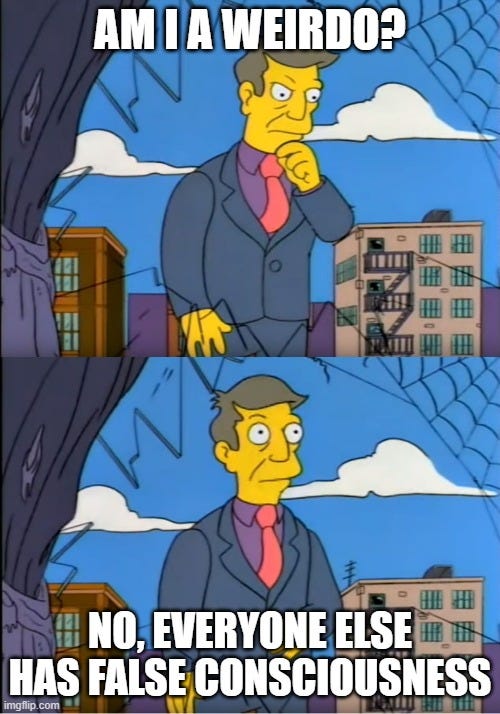
Flourless dessert tortes often solve many of these problems simply by increasing density, so I will go for a torte, but what I actually have as a “birthday cake” at my birthday party every year is a bowl of raw cookie dough dumped on a plate with candles stuck in.
I highly recommend it.
Books can be viewed as food for the mind.
True enough!
Fiction is the queen here. Non-fiction is good and much of it is formative in important ways. Where would I be without Doris Kearns Goodwin’s Team of Rivals or Elie Wiesel’s Night in the back of my head? How does anyone make sense of a classic Call of Duty WWII campaign without having read Stephen Ambrose’s Citizen Soldiers? Nonetheless, fiction can’t give you the full picture of humanity the way a good tale can. On the other hand, reading is in such free-fall at the moment that I’m not really in a position to have that argument. Reading’s not even losing to other storytelling mediums, like television, film, or single-player video games. It’s getting replaced by short-form video and Steal a Brainrot multiplayer slop. I really don’t know what our civilization will look like if those become our common texts instead of Pride & Prejudice and The Lord of the Rings. But whereof one cannot speak, thereof one must be silent, so let’s move on.
In the age of communication, we can always be reached.
In 2026, this is becoming less true every day.
As a culture, we are becoming paranoid to the point of hysteria about our “private” information. As individuals, we are becoming too fragmented to find one another.
I’ll give you a for-instance. A few weeks ago, I found a CD wedged underneath a drawer, where it must have fallen years prior. It clearly belonged to the last person who lived in my house. I knew her name because the CD was lodged next to some eight-year-old medical bills. The CD appeared to have sentimental value to the owner, so I resolved to give it back to her. In the 1990s, this would have been straightforward: knowing her first and last name, I would have looked her up in the White Pages. (She had a rather distinctive name.) The White Pages would have listed her phone number. I would then have called that phone number, told her about the CD, asked her if she wanted it back, and, if so, arranged a pickup.
In 2026, this was impossible. I spent two days trying to track down her contact information through the Internet, looking for mutual friends on various social media networks. Once upon a time, everyone was on Facebook, but Facebook is dying. Lots of people are elsewhere, and lots of people are nowhere. The death of landline telephones has made tracking phone numbers nigh-impossible, even if the White Pages still existed. I wasn’t willing to pay $20 for some online “public records lookup” to send me a list of suspected phone numbers that may or may not prove out. In the end, I got lucky and found a local address linked to one of those “public records lookup” companies, and her niece was a year ahead of my wife in high school, so I was able to do a little Facebook stalking through the niece to confirm the match. The address was an assisted living facility, so my only way to return the CD was to sneak into the building (the doorbell went unanswered), find her room, and hand it to her personally. She was first annoyed that someone was knocking at her door, then surprised, then quite pleased when she realized what I’d done. But boy I would have loved to just phone her and save myself all the trouble!
Even among friends and well-known contacts, I used to just have to track their phone numbers. Now, I have some friends who have landlines and can’t receive texts (although not many), some who have cell phones and only accept texts, some who mostly answer email, some who ignore email and only answer Facebook Messenger, some on Discord, and one exclusively on WhatsApp. If I ever lose his number from WhatsApp, I will probably never speak to him again. I’ve had to start taking notes on my friends, not to remind myself of their numbers and/or screennames, but only to remind myself which messaging service to use to contact them!
Another example: universities used to all have public directories. These directories listed basic information about contacting current students: their names, ages, class years, phone numbers, email addresses, and mailbox numbers. This was such a normal and indeed important part of life that FERPA, the giant federal privacy law governing higher education, has a giant exemption carved into the heart of it allowing “directory information” to be shared with the general public. However, in the last fifteen years or so, not only have universities all but eliminated these directories, but the very idea of allowing people to know that an individual student so much as attends the school has become an affront. (“What if they’re dealing with a stalker?” Well, we can always just take those specific students out of the directory!) Publishing actual student contact information? Beyond the pale. People who had all this info published about themselves a couple decades ago and never gave it a second thought now think you’re inviting murder and mayhem if you confirm a given student’s dorm number without a form signed in triplicate.
I don’t know exactly whom to blame for this. School shooters? Online scammers? Our suffocating culture of safetyism and/or liability avoidance? Perhaps it’s just the 15-minutes-of-fame phenomenon, pushing anonymity shields created for celebrities into the mainstream because any one of us could suddenly find ourselves facing down an Internet cancel mob of thousands.
Whatever the cause, though, in this age of communication, we are actually getting quite weird about anyone daring to actually communicate with us. I don’t think we talk about this enough.
A game of cards reflects life itself.
I… I know. I already said that, didn’t I? When we were talking about chess?
An organized workspace is a must.
This is true. My wife touts her ability to look around a messy counter and just find stuff on it, and she is quite good at it. It took me years to realize, though, that she had no magic powers in this department. If a cabinet got sufficiently crowded or messy, she would lose track of what was in it and put things on the grocery list that we already had, no matter how good her eyes were at picking things out. Eventually, “heap management” as a form of organization always fails!
Don’t listen to people who call it “OCD” or “autistic” if you need to organize a space before you start working in it! This is received wisdom hundreds of generations old, practiced in every professional shop I can think of, and just obviously true. It’s harder to get work done if you don’t organize first. One can go over the top with this (which can become pathological), but this is another area where our culture has gotten weird and prickly about normal human operating parameters.
A dream about driving might be a statement of independence.
But it probably isn’t. Dreams mostly have no meaning and reveal nothing. Freud is mostly bunk, and prophetic dreams are rare.
A true archaeological find is like winning the lottery.
What does this mean?
Does it mean that you can make a lot of money off finding an important primitive humanoid skull in your back yard? I suppose you can, but it requires a certain amount of savvy, a really good find, clear legal rights in your favor (rarer than you might think), and is frowned on by both professionals and Indiana Jones.
Does it mean that a good find significantly increases the sum total of human knowledge and prosperity? Perhaps it does, but lotteries don’t. Each lottery has one huge beneficiary, but that’s paid for out of the prosperity of hundreds or thousands of others. None of them are better off for it. Some of them are addicts, losing their lives to gambling. The state extracts some pittance of the lottery to inefficiently spend on birds or something, but, net-net, lotteries are bad for mankind.
Does it mean, then, that finding a big archeological discovery is going to lead to a ton of paperwork, and probably lawyers? That, I admit, does seem probable.
If someone takes their picture, they steal your soul.
Bad news for Hollywood actors, Frakes!
…but also explains a good deal about Hollywood in general, now that you mention it.
The better you look, the better you feel.
You know, there is something to this. That may be surprising, coming from me, given the intense apathy I expressed toward clothing last year. Yet there does come a point in the day when you’ve been in sweats and a bathrobe for too long. Even though clothes don’t matter to you, a self-image forms, and I don’t like it. The image usually includes stink lines, often unjustly. Then I put on real clothes and do, in fact, feel better. If I put on a suit, better still.
My suit is tailored,1 and that counts for something, too. It fits really nice, better than any other clothing I own. That just feels smart, physically. It may also project a message to everyone else in the area, but the clothing’s physical feel, I think, is doing a lot of the work here.
Hospital rooms can be drab, depressing places.
Can’t argue the point, but putting up one crucifix helps a lot.
The crucifix is a particularly good symbol to bring into a place of suffering. It reminds simultaneously that one is accompanied in that suffering, and that the suffering leads to something better. Losing sight of that leads to despair, I think.
Annnnnnd that’s all I got! I know that’s only half of my conversation with Frakes, but the rest of the tape recording I have appears unsalvageable.
Perhaps I’ll be able to repair it, but I estimate it would take a team of technicians working on it for (at a very rough estimate) somewhere between 364 and 366 days. I know that’s a huge range, but repairs are very tricky to predict.
For now, thanks again to Jonathan Frakes… I guess… for sitting down with me… again. I am being told that we do have a clip Jonathan wants to share tonight from one of his directorial projects, so I’ll leave you with that:
As for me, it’s time to bake a couple cookies!
DE CIV NEXT VOYAGE: I apologize for my three-week silence. I had a very productive February followed by a much quieter March, and I have been feeling guilty about it.
Aside from this annual April Fool’s treat, I have been working hard on the next installment of Letters to My Daughters, which has proved fiendishly difficult. If I do my job well, the final product will look easy-breezy—even shallow—but let me assure you I’ve been rewriting paragraphs over and over again! Speaking about metaphysics precisely, clearly, and concisely, all while staying age-accessible is no easy task!
One way or another, though, I won’t let this drought continue. You readers are too important. Happy April and see you soon.
Not, like, fancy luxury tailoring, just Milbern’s Value Tailoring, but it still cost an arm and a leg and is the best piece of clothing I’ve ever owned.
Hear, hear on cake. As a corollary, buttercream is the most overrated substance known to man. It’s overly dense and has no flavor other than “cloyingly sweet.”