

It’s too easy to call “Rollicking!: A Winter Carnival Musical” an incoherent mess.
It is, of course. Rollicking! is nonsense, the most bizarre thing I’ve ever seen on stage.
Not the worst thing, mind you. Not even close. Let’s list the wins: the cast is both passionate and talented. I attended on “understudies” night, with three on-stage subs and a music sub, so I don’t know who they usually have playing Vulcanus Rex, but Joshua Row1 was a standout. He brought just the right amount of camp to a role that’s been camp since the fin de siècle. The bleach gnomes2 were charming, particularly Elena Glass’s Gned. I chuckled often throughout the performance. The cast’s energy was unflagging and confident, particularly leads Roland Hawkins II and Erin Nicole Farsté, which is all the more impressive when you consider the material. They made a cast of nine feel like a cast of twenty. The lighting was superlative and the puppetry delightful. The costumes were all the funnier for being historically accurate. The pop-up trivia facts were interesting.
Crucially, this musical’s music was catchy, and sometimes more than catchy. Besides, Minnesotans have a well-known weakness for songs about their homeland, which is why we are all fans of The Hold Steady. Kudos to composer Keith Hovis and music director Isabella Dawis.3 I looked for the cast recording album online afterward, not entirely sure whether I wanted it for myself or as a top white elephant gift.4 Alas, the Rollicking! soundtrack is not available for streaming or purchase. (Yet?)
In fact, I spent much of the play clinging desperately to the songs like flotsam after a shipwreck, because everything that happens surrounding the songs is insane.5 Everyone’s talking around that, even though it is the central fact of the show. There have been at least five reviews of this play. Four cheerily insist that everything was basically fine. One, the St. Paul Pioneer Press, admits to serious problems, but isn’t honest about what they are.
I’m here to tell you what they won’t. Rollicking! shows that the dumbest forces in our culture are not dissolving (as is sometimes reported), but only retreating back to their incubators, ready to ride forth again when the cultural moment is right. It also offers a cautionary tale for any writer, because all of us have, in one form or another, faced the temptations to which Rollicking! succumbs.
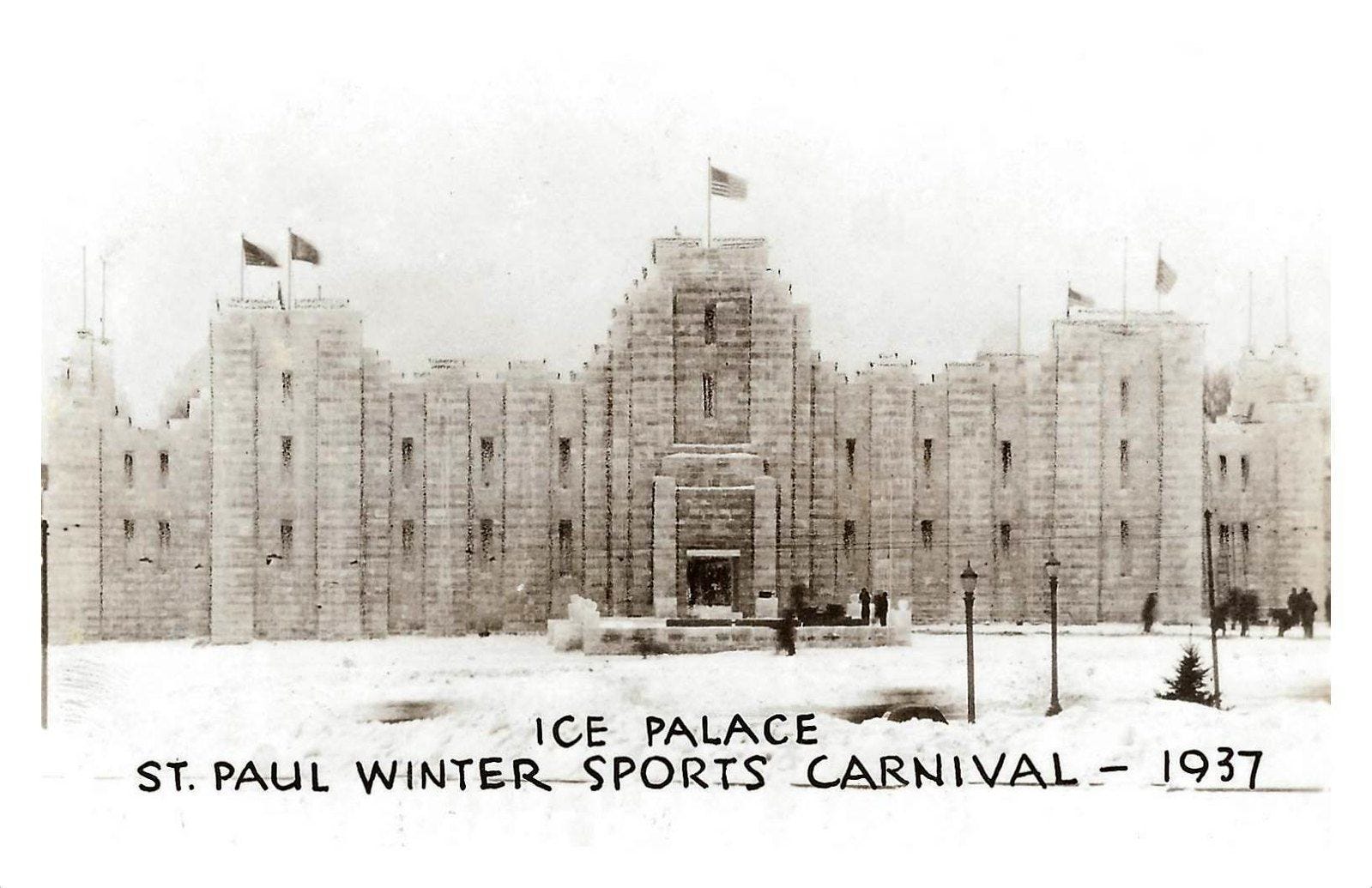
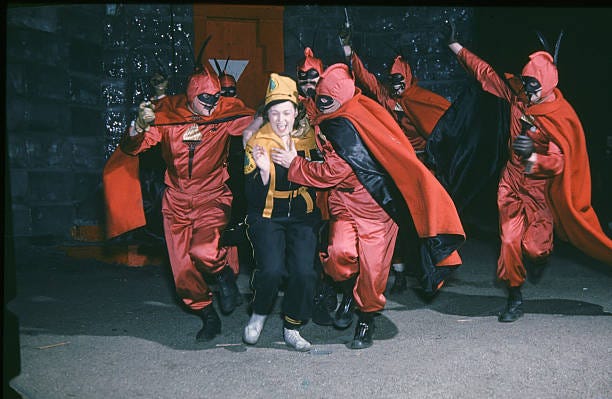
Some background: the Winter Carnival is a 140-year-old tradition of Saint Paul, Minnesota. If you’re not from the Twin Cities, you should understand that the Carnival runs deep here. Every schoolchild knows how King Boreas, lord of Winter, establishes his throne in the ice palace of St. Paul every winter and declares a festival of skating, sledding, ice sculpting, parades, and treasure hunting… only to be driven out ten days later by Vulcanus Rex (god of fire) and his Vulcan Krewe, who melt the palace in order to villainously usher in the spring. Even those of us who rarely attend the festivities have seen the Carnival royalty, or been “attacked” by sniggering Vulcans all in red, who brand their “V” symbol on the cheeks of their victims. (There’s an expanded mythos involving King Boreas’s four sons, the princes of the winds, as well as Boreas’s beautiful queen, Aurora, not to mention the flighty scoundrel Klondike Kate… but I have a word limit.6)
Of course, the reality is that the Winter Carnival has always been a civic venture, put together by local businesses and St. Paul’s government to draw in tourists, make some money, and, most importantly, show up Minneapolis. The practical reality of the thing has always been just tawdry enough to add to, rather than detract from, the Carnival’s charm.
Finding a play in this messy, evolving, ancient tradition was always going to be a challenge. I don’t know where I’d begin, personally, to find the human story that can carry an audience through the full sweep of the Carnival’s history. However, it’s easy enough to see where this playwright,7 in this play, went wrong.
Writing fiction is not like writing non-fiction. Non-fiction (usually) starts from a thesis, which naturally unfolds into an explanation of how you got to the thesis, which naturally expands with evidence, and maybe you tell some jokes along the way. By the time you finish expounding, you find that you’ve written a blog post, a magazine article, a really long blog post, or a book. It just happens. The whole outline is there in germ from the moment you grasp the thesis, and just has to be explained to your readers. Non-fiction is easy. (It’s why I write so much of it.) It’s like setting sail with a compass and a clear sky. Even if there are choppy waters, even if you have to change course, even if some of the sailwork is a bit touchy, you always know where you’re going.
Fiction is a different animal. If you start from a thesis in fiction, you’re either going to write bad, preachy fiction, or you’re going to write Larry Niven’s Ringworld, which is worse.8 Every fiction starts with a billion billion possible directions, a vast teeming universe of ideas (some good, the vast majority bad). Russell T. Davies called this zone “The Maybe.” The writer has to somehow whittle the finite but overwhelming possibilities of The Maybe down to one singular choice. This is very hard, may take hours or days, and may end with the writer forced to tear up whatever progress he has heretofore made and start fresh. In the end, though, what makes him a writer is that he forces his way through The Maybe.
The writer has now written… the first line. Unfortunately, this line has opened up a billion billion new (and very different) possibilities, which must now be whittled, again, down to one. If he repeats the feat a thousand times, he has a script.9 It gets a little bit easier as he progresses, as the story takes shape. Eventually, each line is only one out of a million million possibilities, rather than a billion billion—but most of them are still crap.10
Writing fiction, then, is not like setting sail. It is more like falling naked into a fast-moving river in a wide ravine, half-drowning, and trying to find your way to one of the few parcels of accessible shoreline, dimly seen in the distance. The writer has some control, but often finds himself at the mercy of the story’s current. You can try to plan a few moves ahead, predict what choices will lead to better options later, but you can’t force it, or the current will pull you under and dash you against the cliff face. It is therefore imperative that the writer enter the river with, yes, strong muscles, but, more importantly, an open mind. That doesn’t guarantee the river will carry you to a good story, but, in fiction, all you can ask for is a fighting chance.11
That’s why it isn’t fair to call Rollicking! a mere mess. That gives the impression that it was just bad luck, or, at worst, unhoned craftsmanship. Stories fall victim to that all the time.
Rollicking!, however, was deliberate. Rollicking! chose to fight the logic of its own story at every turn, because its author did not have an open mind. She had a checklist.
