

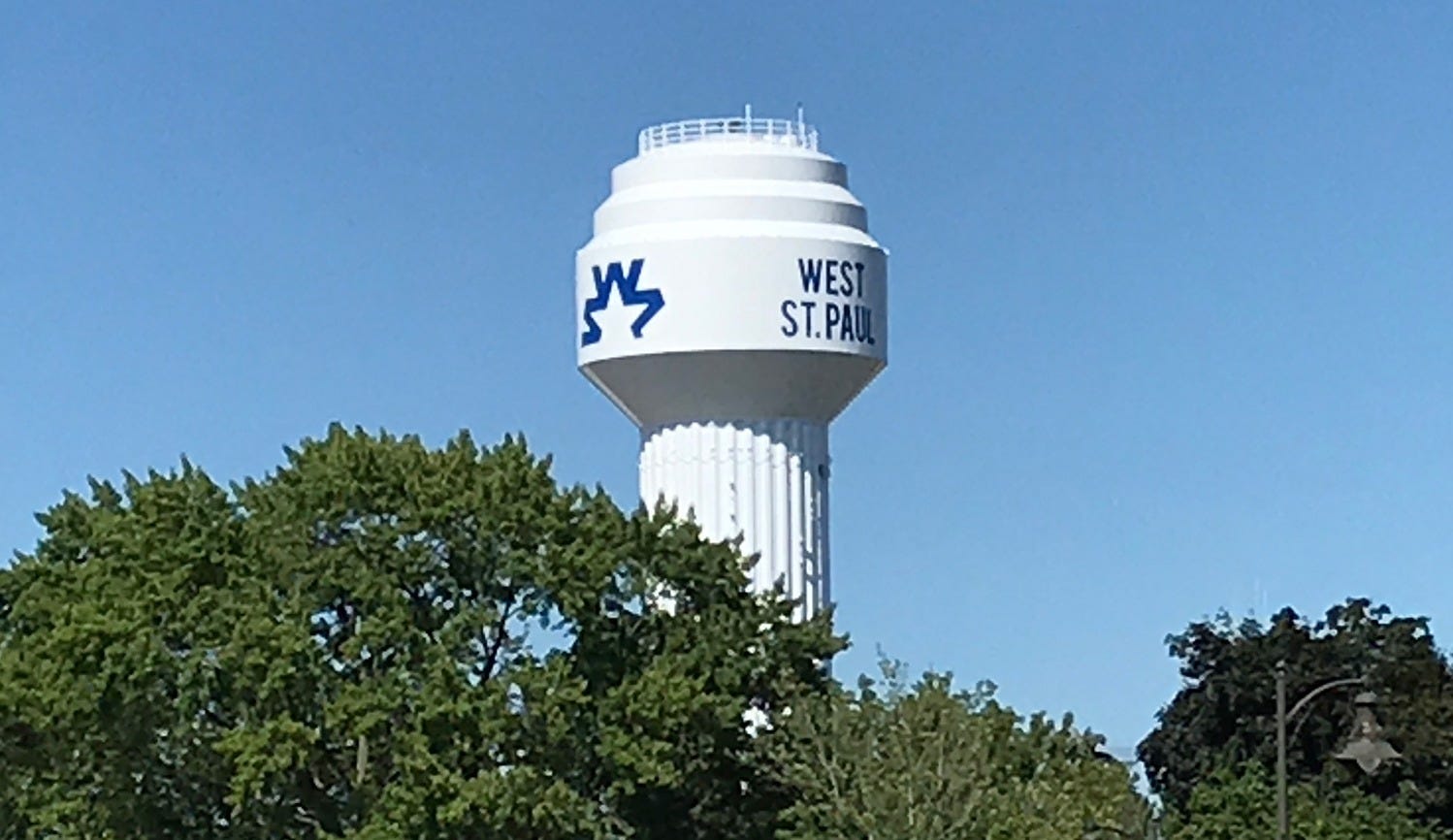
Most De Civ subscribers do not live in West Saint Paul, and many of you are not even privileged to live in its vicinity. Should you read this anyway? I think having a general understanding of how to compare property taxes is valuable. Anyone can apply the principles in this article to their own town. However, it’s up to you!
West Saint Paul offers its residents a good value proposition: we are an old-growth, first-ring suburb. We’re “close to it all,” an ideal commuter town, but without the poor city services and routine dysfunction of actually living in Regular Saint Paul. Our property values… well, it’s hard to call anyone’s property values “reasonable” these days, with the housing market the way it is, but our property values are more reasonable than some of our neighboring cities. That makes us an attractive destination for young families.
In fact, that’s why I moved here ten years ago. I wanted to continue living in my hometown, Regular Saint Paul, but I couldn’t afford a house for my growing family there. In West Saint Paul, I could, while keeping an easy commute. After ten years, though, West Saint Paul has become my adopted hometown. I never want to leave. We have amazing plowing, good neighborhoods, increasing walkability (as a parent whose kids often walk home from school, I love the new sidewalk on Bidwell), a couple of great parishes, terrific parks, good rec programs, exactly two excellent chicken joints,1 and a splash pad + municipal pool that are everything neighborhood water areas should be.2
We also have a responsive city government. You really can write to the mayor, your city council members, or the city manager, and they will reply to you, usually very quickly! This is possible in a city of 20,000. It is not possible in a city of 300,000. As the famous song goes, “Get your permit at city hall / and build a new retaining wall / in West Saint Paul / in West Saint Paul”:
Living here, under a government of regular humans who weren’t raised from birth to run for office, has reshaped my whole perspective on American government. I don’t have many complaints about West Saint Paul.
However, West Saint Paul city property taxes have gone up, and up… and up.
NOTE: Five years ago, I wrote an article explaining how property taxes work. If you could use a refresher, see here:

The usual suspects3 always say, “Oh, stop complaining, it’s only another $100 per year, you can afford it, that’s cheaper than one streaming service.” But my property tax bill for West Saint Paul has already gone up $930 since the pandemic. That’s just the line item for West Saint Paul, not the rest of the property tax bill!4
The usual suspects say, “James, that’s just inflation!” No, it’s not. After adjusting for inflation, my WSP property tax bill is up $408. Meanwhile, after adjusting for inflation, my salary has gone down since the pandemic. WSP is asking me to pay significantly more at a time when everything costs more and I’m trying to make do with less. It’s currently on course to do the same thing next year. I already cut nearly all my streaming services to make ends meet. I don’t eat out or buy coffee during the workweek, either, for the same reason. I already cancelled all my newspapers,5 for the same reason. The belt is tight. Tax hikes hurt.
Even so, I was indeed able to absorb the first few hikes. Now, though, they’re starting to pinch. The usual suspects always say, “You’re just paying more because your home value has gone up.” That’s not true, either. The way property taxes work, your personal tax should only go up from valuation increase if your valuation increase is greater than the city average.6 That’s not my situation. Our taxes—all our taxes—really have gone up. You can see it for yourself on page 8 of this report.
When I moved to West Saint Paul, the argument for our high taxation was that the city was settling its debts after a (somewhat extravagant, albeit largely successful) reconstruction of Robert Street, and that the annual levy increases would soon stop. Then the argument became that inflation was eating up the city budget. Now the argument is that cities and counties are being forced to shoulder more costs because of unfunded mandates from the GOP trifecta in Washington and the DFL trifecta in St. Paul. To be fair, all these arguments have merit! It is not easy to keep costs down when inflation and the federal government are determined to drive costs up. I do not envy our city council nor our redoubtable city staff.
However, inflation and the unfunded mandates have affected every city in our area, not just West Saint Paul. Are our peers handling it better?
Bluntly: yes. By almost any measure, West Saint Paul in 2026 has the highest taxes in Dakota County, and our city taxes are higher than Regular Saint Paul’s.7 It’s not even a particularly close call.
Let’s compare our city to other nearby cities, to see how well they are handling the increased costs compared to WSP. I decided to compare WSP to each city it borders, plus each city in Dakota County with state-certified property tax levies for 2026. Here are those cities, their basic demographics, and their 2026 property tax levies:
As our city manager (the dashing Nate Burkett) often reminds the city council, property taxes in Minnesota are complicated. Nevertheless, there are several good ways to compare property tax levels between Minnesota communities.
One obvious way is to ask how many dollars the city takes in property tax per resident. By this measure, West Saint Paul is only the second-highest-taxed city in the area:
However, Mendota Heights, Sunfish Lake, and Inver Grove Heights are all substantially wealthier than West Saint Paul. It makes sense that the city taxes them more. Once you adjust for West Saint Paul’s income level, we stick out like a sore thumb:
Mendota Heights, Sunfish Lake, and the gang also have much higher home values, so adjusting for home valuations yields the same conclusion:
A canny city manager might look at this and go, “Ah, but this comparison is too blunt of an instrument! You’re not taking into account the fact that the property tax levy is apportioned across a variety of different property types!” This is true. In West Saint Paul, homeowners pay different property tax rates than apartment landlords, who pay a different rate than home-rental landlords.8 Cub Foods’ landlord pays a different (much higher) property tax rate than all of them. In Eagan, that may all be arranged quite differently. In theory, it is possible that, even though West Saint Paul’s levy is quite high, the city apportions most of the levy away from residential homeowners, and, as a result, our homeowners don’t pay particularly high taxes compared to other nearby cities. In theory.
In practice, there is only one way I know of to prove or disprove this theory: one could go through every town in Dakota County, look up property tax records for two or three arbitrary residential addresses9 in each of those towns, and reverse-engineer the actual tax rate paid by homeowners in all those towns.
Guess what I spent three hours doing tonight?10
You’re not imagining it. It’s not a quirk of the complexity of Minnesota’s property taxes. West Saint Paul’s taxes are genuinely very high. This hits residents hard in their pocketbooks, and makes it more difficult to absorb other local taxes. Our local school district, ISD 197, reportedly has taxes below the local average. They hope to pass a levy this year to close a budget gap—but the voters must approve it. If the ISD 197 levy goes down to defeat, West Saint Paul’s very high residential tax rate will share in the blame.
In my opinion, West Saint Paul should aim to grow its budget slower than the rate of inflation over the next several years, at least until our neighbors catch up to us.
I expect that would be very difficult. I listed a lot of wonderful things about WSP at the start of this article. They all cost money, and lots of it. Our city councilors are not sitting on thrones of cash waiting for lobbyists to stuff their pockets. They’re currently underpaid, relative to both the number of hours the job takes and to other local cities. Recently, our city council voted down a pay raise recommended by the city Charter Commission out of solidarity with the homeowning ratepayers. There are no villains here.
Nevertheless, as Jimmy McMillan famously put it, “The [tax rate] is too damn high.” Burnsville, which is demographically similar to us, is getting by on about 80% as much property tax per resident as WSP. Unlike us, Burnsville does not supplement its property tax levy with a sales tax. Yet Burnsville is not exactly a hellhole. I’m curious to know what they’re doing differently.
I have always said that nobody should demand a policy change without suggesting how it might be possible to actually achieve that policy. In that spirit, I offer these few suggestions for planned spending we should consider foregoing for the next several years, until our property tax rates are back in line with the rest of the area’s. These things would all be great to have, and I would be sad if we didn’t get them… but we don’t need them, and I’ll be even sadder if my property tax bill goes up faster than inflation again.
The Albert Park expansion + memorial to Officer Patrick
As I understood the 2025 budget discussion, cancelling this would save the city $500,000, or about $80 for the median household—or at least would have at the time. Whatever money we may have spent on this during 2026 is gone now, but I think we already delayed most of it. The expansion looks beautiful, and I’d love to have it if the city came into a lot of free money.
Raise fees at the ice arena
The WSP ice arena offers no skate rental and has open skate only at bizarre times which mostly overlap with school and parents’ working hours. It is therefore not really much of an amenity for many WSP residents. The ice arena is mostly used by hockey teams, many of them from out of town, specifically Mendota Heights. I am under the impression that they pay well below the “market price” for these rentals.
Raising those fees 50% could net $400,000 or so per year, as I understand it from last year’s budget presentation, permanently lowering the levy by about $64 for the median household.
People always talk about closing the pool to save money (which I oppose), but nobody ever looks at the ice arena. But the pool costs less to operate than the ice arena, and a fee hike on the ice would allow the city to save money without closing either amenity.
There may be other opportunities to raise fees, particularly fees paid by out-of-towners.
We budgeted $75,000 last year for park signage replacement, and another $75,000 for the “placemaking art fund,” a fund to create murals, fun benches, and the like on city property. I am all for these things in principle. I assume Carolyn Swiszcz would do a bunch of the placemaking art, and I am 100% in favor of putting money in Swiszcz’s pocket to do more cool things for West Saint Paul. But cutting both these things would have lowered the levy by $24 for the median household.
Love the city magazine. I read every issue. My seven-year-old’s picture showed up in it this month (in the Explore WSP Days collage), and she was so thrilled! She cut out the page from the magazine and taped it to her bedroom wall. However, I get the sense that most residents recycle it unread, and that those of us who read it would be equally well-served by an email newsletter. I don’t know how much it costs to physically produce What’s Happening in West St. Paul a few times a year, but I suspect it’s more than chump change.
I do not wish to hurt anyone’s feelings by saying this, but, whatever we have spent on the new city mascots, the WiSPs… I will say only that I do not think we should spend any more money on them.
I understand that this year’s proposed 7% levy increase is being driven largely (not exclusively) by wage increases. Our city workers do a great job and it would be very good to pay them more money. Again, though: the last time my own co-workers saw an annual wage increase above 2% was pre-pandemic. In this environment, increasing the total compensation pool more than 4% or so would be unreasonable.11
Sunfish Lake borrows our police department, right? Have you seen their dirt-cheap property taxes? (Bet you hadn’t before today!) Can we make them pay more for our police? I don’t know how this works, so the answer might be “no,” but I know Sunfish Lake is weird. It reminds me of the suburb in the opening scene of Get Out. The last time I was in there, to visit a (rich) friend who lived there, I came upon what was clearly a speed bump, but the road sign labeled it a “road hump,” like something out of The Backrooms.
Again, I offer these few (and admittedly inadequate12) suggestions not as demands, but simply so that I’m not out here demanding cuts without doing at least a little bit of the work to find some plausible places to cut.
West Saint Paul is a great city. It’s just getting harder to live here. We’re spending a lot, and Minnesota’s property tax system is so opaque that I suspect many of our city leaders don’t even realize that it’s gotten so expensive. I hope this post starts a conversation about how to adjust that.
NOTICE: I’m going to make the same commitment I usually make when I write about local affairs: in the unlikely event that any member of city government, elected or otherwise, writes a response to this article and asks me to print it, I will do so. I will share it even—or, rather, especially!—if they call me an innumerate dunce and proceed to show that I made a series of horrible mistakes here. If a given response is brief, I will post it in this space. If long, I will post it as a separate article and link to it from this space.
I would not be doing a very good job starting a conversation if I didn’t give people the space to respond! Besides, as I hope I’ve made clear, I really like our city government.
Cane’s and Pollo Campero, obviously. (I will not be taking questions.)
Years ago, a city survey asked me about my satisfaction with the Harmon Park Splash Pad. I replied:
The Splash Pad is the crown jewel of Harmon, the most valuable nineteen acres south of the Mississippi. If West Saint Paul ever faces a Red Dawn-style invasion by the Soviet Union, I will be the first in the trenches around the Splash Pad to defend it with my life, my fortune, and my sacred honor.
Although my kids have now grown enough that the pool has become more important to my daily sanity than the splash pad, I nevertheless hope I adequately conveyed to the surveyors both the excellence and the importance of the city’s summer water amenities.
You know the ones. On the West St. Paul Neighbors group on Facebook. Home of the suburban moral panic. The only place in the city where people relish outrage and the humiliation of others. Less a group of neighbors, more a blood sport. (It is not our best foot forward.) But still a useful place to swap reviews of your garbageman (Highland Sanitation has done right by me) or share a local news article.
The line item for “West St. Paul” is line #7 on the standard form. When I talk about how much they’ve risen “since the pandemic,” I mean since I paid my “2020 Payable”. Again, my previous article on property tax goes into the weeds on what this means and how it works.
I’m sorry, Kevin Hendricks! Every resident who can afford to should subscribe to the Reader!
The small cavil to this is that rising home value can reduce your Minnesota homestead exclusion, exposing more of your property’s value to the city’s taxes. However, if your whole neighborhood of similarly-valued homes goes up the same amount, everyone’s exposure goes up roughly the same, too, so your personal share of the levy pie doesn’t increase relative to other homeowners.
The small cavil to that is that it can raise your exposure, not relative to other homesteaders like you, but rather to other types of property owners entirely, like commercial landlords. If the overall value of homes in West Saint Paul goes up enough to meaningfully reduce the “protection” provided by the Minnesota homestead exclusion, while commercial property values (which were never protected by the homestead exclusion) go up the same amount, homesteaders as a whole will have to take on a greater share of the city’s overall property tax burden (unless the city raises rates on commercial property / lowers it on residential).
This very mechanism led to a peculiar situation in the 2026 budget: our amiable City Manager, Nate Burkett, discovered that, even if the West Saint Paul levy had remained exactly the same, the median homeowner would still have seen a $94 increase in property tax. If the state legislature indexed the homestead exclusion to the Case-Shiller index (which tracks inflation in real estate), my understanding is that this sort of weirdness would stop happening.
Again, at the risk of repeating myself, my previous article on property tax goes into many of these details.
(Devoted readers wondering whether this intersects with the article I wrote about with Daniel Pareja a couple years back about the problems with means-tested benefits may rest assured: the homestead exclusion is not really a form of means-testing, although it serves some of the same purposes and behaves similarly in certain ways.)
Regular Saint Paul residents pay more in total property taxes, but that’s because county taxes are higher up there. Dakota County is much more frugal than Ramsey County, which somewhat cancels out the fact that West Saint Paul is considerably more spendy than Regular Saint Paul. The fact that our total property taxes are lower, then, is thanks to Joe Atkins, our Dakota County Commissioner, and his colleagues. It is in spite of high spending by the West Saint Paul city council.
Economists generally agree that some of the property tax paid by landlords is actually passed on to the renters through rent increases, although it is widely disputed how much. (Plausible estimates range from 15% to nearly 100%, and results depend on conditions in the local housing market.) This double-sucks for renters, since they don’t get the cushy kickbacks homeowners get through the homestead exclusion and M1PR homesteader refund, and they don’t even have the ability to challenge their valuation, since it’s officially an issue between the landlord and the county.
Specifically, residential homesteads with no expiring exclusions or exclusions from new improvements. Dakota County’s excellent online property records tool makes this relatively easy.
A few hours later, I found out that the three hours of work I did was completely unnecessary. Turns out, you can also just look up the municipal tax rates directly on the county website, rather than deducing them from first principles.
They’re on the Dakota County website under Residents » Home and Property » Understanding Taxes » Reports » 2026 tax reports » Tax Rates, in the column Tax Capacity Rate, sub-column Municipality. You take that rate and multiply it by $253,200 to get the payable municipal taxes on a $275,000 house.
My original data-collection method produced results that were almost exactly identical to this, often to within thousandths of a percent. Nevertheless, now that I have the exactly correct data, I’ve used that instead, and the graph reflects that data. (I’ve put all the data—both the official rates and my deduced rates—in a side-by-side chart on Google Sheets.)
The one mistake I made in my personal research was mixing up the cities of Hampton, Hastings, and Vermillion with their corresponding townships (Vermillion Township, and so on). These had different tax rates, and I didn’t realize it until I saw Dakota County’s official figures.
(FUN FACT: Hastings’ internal township is the ghost town of Nininger, which still exists, as far as I can tell, exclusively for tax purposes.)
I don’t know the exact size of the proposed compensation pool increase, because the exact number is not yet in the packet. It’s possible the city is not planning an increase beyond 4%, in which case my suggestion to trim back is much less useful.
Worth noting, though: inflation for 2026 is expected to clock in at between 3% and 3.5%. Nationally, annual average nominal wage growth is not, so far, any higher than that. We’re all just trying to keep our heads above water out here. If your personal wages are increasing more than 3.2% this year, you’re doing better than more than half the population, and much better than some!
My very back-of-the-envelope math, based on a spreadsheet I made during the 2025 budget discussions (so I worry that my numbers may be outdated), is that cancelling Albert Park, raising ice arena fees, and closing the park signage and art funds would lower a future levy by about $175 for the median household, depending. That’s more than the $94 levy increase the city currently has in mind for the median household in the coming year… but it’s very back-of-the-envelope, and I suspect the realized savings would be lower than I’d hope.
Note on medians: according to our City Manager (the radiant Nate Burkett) during the budget proceedings last year, the median household of West Saint Paul in 2026 had a home valuation of $311,000. In 2025, the median home valuation was $294,000. I do not (yet) have a figure for 2027.
Asset-based means tests, particularly ones based on real property, can in some ways be worse than income-based tests.
In all cases, of course, policymakers should be careful to ensure that there's never a METR above 100%, though having a plethora of means-tested credits can make the rate get uncomfortably close to that.
The problem with asset-based means tests, though, is that it is much harder for the asset owner to control the value of the asset. At least with income it is generally possible to have some amount of control over how much you make: you can do overtime, seek a better-paying job, or pick up part-time employment after your regular employment. (All of this comes with quality-of-life tradeoffs, though, of course, and there was that case study done by one of the US Federal Reserve branches showing that a single mother of one child in DC ends up, after cash and cash-equivalent benefits, not seeing any substantial difference between making around $10,000 and $60,000 yearly, as I recall.)
But controlling the value of a home, and especially that part of it which comes from the land on which it rests, is often beyond the capability of the homeowner to control. A homeowner can, through no action of their own and with essentially no way to get out of it, see the value of an asset-based benefit (such as the homestead exemption) decrease. This makes it harder for families to manage their budgeting, not knowing what their property tax bill will look like because of the possible loss of that exemption, as you note in the article, which in a time of rising prices and stagnant remuneration is something that should be of significant concern to policymakers.
I will freely admit that I don't know what a good answer to this problem would be. California's notorious Proposition 13 was an attempt, but it has resulted in numerous negative effects and is likely not worth attempting elsewhere. A Singaporean model where the government manages housing stock with an eye both to ensuring adequate housing for a growing population and controlling the rate of appreciation in value of existing housing might be worth considering.
This was quite good.